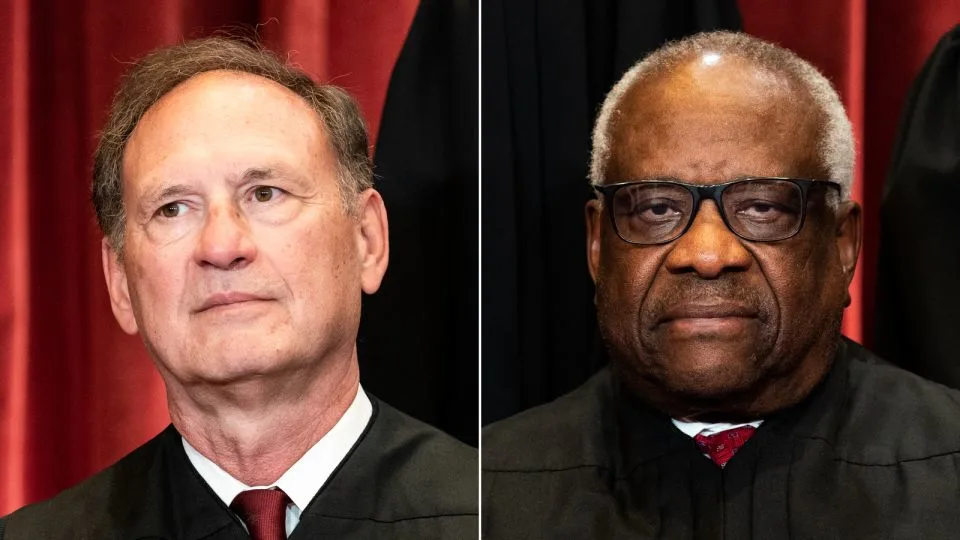

Donald Trump is openly entertaining the prospect of reshaping the U.S. Supreme Court again, suggesting in a recent Fox Business interview that conservative justices Samuel Alito and Clarence Thomas could consider retiring while Republicans retain political control.
Trump framed his remarks as praise for both justices’ jurisprudence but underscored the strategic value of timing. “It’d be nice to say, now I have somebody for 40 years,” he said of a potential successor to Alito, signaling a preference for younger nominees who could extend conservative influence for decades.
The comments highlight a longstanding, if unofficial, pattern at the high court: justices often retire when a like-minded president and Senate majority can secure a successor. In recent decades, most retirements—unlike deaths in office—have aligned with favorable political conditions.
Trump pointed to Ruth Bader Ginsburg as a cautionary example. Ginsburg declined to retire during a Democratic presidency and died in 2020, allowing Trump to appoint a conservative replacement and shift the court further right. The episode has since reshaped how both parties view judicial timing.

At ages 76 and 77, Alito and Thomas are nearing the typical retirement window—recent justices have stepped down at an average age of about 80. Their decisions carry heightened weight ahead of the 2026 midterms, where Republicans face the risk of losing ground, particularly in the House.
A narrower Senate majority—or a shift in control—could complicate confirmations, forcing reliance on moderate Republicans such as Lisa Murkowski and Susan Collins. That dynamic may incentivize earlier retirements while confirmation margins remain more secure.
Trump also appears motivated by legacy. Replacing one or both justices with younger conservatives would not alter the court’s current 6–3 ideological balance but could entrench it for a generation. Such appointments would expand Trump’s footprint on the bench to as many as five of nine justices across two terms.
The political calculus extends beyond the court itself. A high-profile confirmation fight could energize Republican voters in a midterm environment where Democratic enthusiasm is currently stronger. GOP strategists have long argued that contentious nominations—such as the 2018 battle over Brett Kavanaugh—can galvanize turnout in otherwise difficult cycles.
Trump hinted the potential changes might not stop at two seats. “In theory, it’s two or three,” he said, adding, “I’m prepared to do it.”
Whether Alito or Thomas act on that timing—and how the Senate landscape evolves—could shape not only the court’s future but the broader balance of power in Washington.