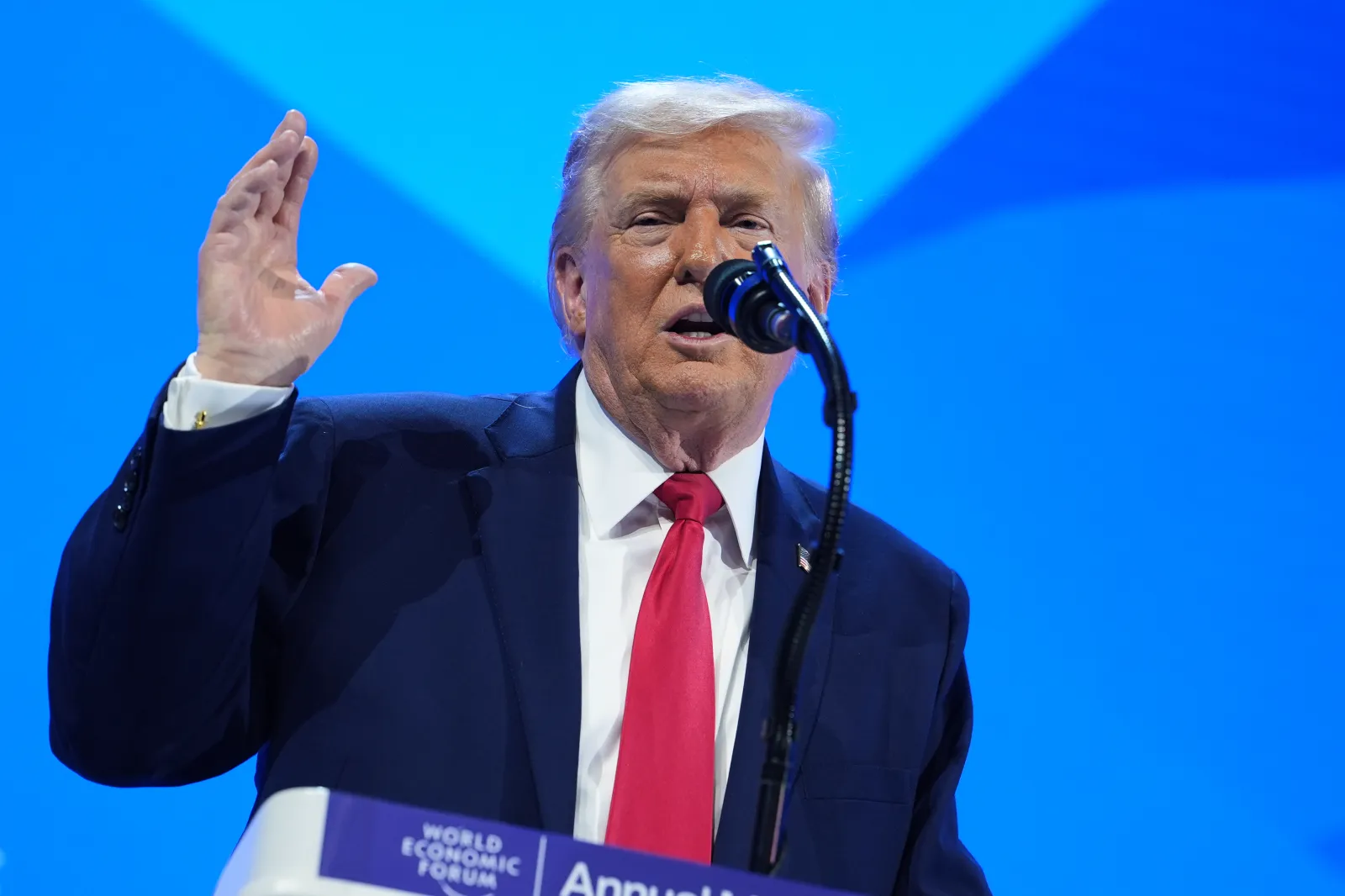

President Donald Trump asked supporters on Thursday whether he should “try for a fourth term” as new polling showed his approval rating at its lowest point of his presidency.
“Record numbers all over the place! Should I try for a fourth term?” Trump wrote on Truth Social. His wording appeared to treat the 2020 election—an election he lost—as a “third term,” which would frame a 2028 victory as a “fourth.”
The post came just hours after Trump attacked what he called “fake polls” and suggested legal action, following multiple surveys showing his approval rating had dipped as low as 35 percent.
Why It Matters
Trump has repeatedly flirted with the idea of staying in office beyond the constitutional limit. Last year, he told NBC News he was “not joking” about running again, and his official stores have sold “Trump 2028” merchandise. Earlier this month, at a House Republican policy retreat, he said he would have “the most unbelievable four years” if he could run for a third term, before adding, “I guess I’m not allowed.”
Despite the constitutional barrier, Trump has continued to discuss the issue publicly and privately. According to The Wall Street Journal, he has spoken about a possible third term with longtime legal adviser Alan Dershowitz, who has written a book exploring the subject.
What To Know
Trump’s “fourth term” remark followed a burst of posts accusing major media outlets and polling firms of distorting results. A The New York Times/Siena College Research Institute survey placed his approval in the low 40s, while separate polling from American Research Group, released Wednesday, put it lower—35 percent approval, with 63 percent disapproval.
“The REAL Polls have been GREAT, but they refuse to print them,” Trump wrote, claiming the Times/Siena poll was “heavily skewed toward Democrats.” He also said he would add the research institute to a lawsuit he has already filed against the newspaper.
Can Trump Run for Another Term?
Under current U.S. law, no person may be elected president more than twice. Trump was elected in 2016 and again in 2024, meaning he is barred from winning a third election unless the Constitution is amended.
What Is the 22nd Amendment?
The 22nd Amendment—ratified in 1951—set the two-term limit in direct response to Franklin D. Roosevelt’s four elections and his death during his fourth term. Before that amendment, there was no legal cap on presidential terms, though George Washington’s decision to step down after two terms established a long-standing tradition until Roosevelt broke it in 1940.
The amendment includes the line: “No person shall be elected to the office of the president more than twice,” intended to prevent any future president from holding power for extended periods.
Which President Had the Lowest Approval Rating?
The lowest approval rating ever recorded for a U.S. president is widely cited as Harry S. Truman’s 22 percent in February 1952, as his second term was battered by the Korean War and allegations of corruption. Other historically low points include Richard Nixon near 24 percent during Watergate and George W. Bush around 25 percent during the 2008 financial crisis, according to Gallup and other trackers.
Trump’s movement into the mid-30s would not surpass Truman’s low, but it would still be a notably weak position by modern standards—especially as attention turns toward the political impact of a divided electorate and Trump’s escalating rhetoric about future elections.
What People Are Saying
Trump wrote on Truth Social: “Something has to be done about Fake Polls! They are truly OUT OF CONTROL. We have the Greatest Economy in the History of our Country, we have the Strongest Border in History, nobody has ever done a job like I have done, and they have me in the low 40s…. The REAL Polls have been GREAT, but they refuse to print them. This is no different than a writer who is corrupt, of which there are many. The New York Times, and so many others, print Polls that are knowingly false. They have become deranged, and sick. They suffer from a major case of TRUMP DERANGEMENT SYNDROME (TDS).”
White House spokesperson Davis R. Ingle said in a statement to Newsweek: “President Trump was overwhelmingly elected by nearly 80 million Americans to deliver on his popular and commonsense agenda.”
Baltimore University law professor Kimberly Wehle previously told Newsweek that ballot access could become a flashpoint if Trump tried to pursue another run: “States each decide who gets on their presidential ballots, not the federal government. Ultimately, it’s the party that makes the nomination. If enough states put him on the ballot, the GOP will obviously nominate him—it has put no checks on his illegal behavior whatsoever this far, so it cannot be expected to choose the 22nd Amendment over him.”
What Happens Next
With the 2026 midterms approaching, Trump’s approval numbers—and his attacks on polling—are likely to remain a pressure point for the White House and for Republicans watching the political landscape.