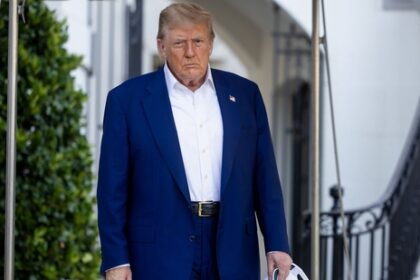
President Donald Trump said Tuesday that beginning Feb. 1, his administration will deny federal funding not only to so-called sanctuary cities, but also to any state that contains local governments resisting his immigration policies — a broader threat than the one he has floated in the past.
If carried out, the move could ripple across the country, including in places that don’t typically frame themselves as particularly welcoming to noncitizens.
Trump has tried similar approaches before. Two earlier efforts to restrict certain federal funds for sanctuary jurisdictions were blocked by courts.
He raised the idea again late in a speech Tuesday to the Detroit Economic Club, without offering details on how it would work or which funding streams would be targeted.
“Starting Feb. 1, we’re not making any payments to sanctuary cities or states having sanctuary cities, because they do everything possible to protect criminals at the expense of American citizens and it breeds fraud and crime and all of the other problems that come,” he said. “So we’re not making any payment to anybody that supports sanctuary cities.”
Back in Washington, reporters asked what kind of funding would be affected on Feb. 1. “You’ll see,” Trump said. “It’ll be significant.”
There’s no single legal definition of “sanctuary city” or “sanctuary policy.” The label generally refers to jurisdictions that limit cooperation with Immigration and Customs Enforcement.
Courts have rejected the idea before
In an executive order last year, Trump directed federal officials to withhold money from sanctuary jurisdictions that, in the administration’s view, try to shield people in the country illegally from deportation.
A federal judge in California struck down the order, even though government lawyers argued it was premature to intervene because no specific conditions had been announced and no funding had yet been cut.
During Trump’s first term, courts also blocked a 2017 effort to deny funding to cities over sanctuary policies.
The details — and the definition — can get complicated
Last year, the Justice Department published a list of three dozen states, cities, and counties it considers sanctuary jurisdictions.
The list was dominated by places run by Democrats, including the states of California, Connecticut, and New York; cities such as Boston and New York; and counties including Baltimore County, Maryland, and Cook County, Illinois.
That list replaced an earlier, longer version that drew pushback from officials who said it was unclear why their jurisdictions were included.
The administration has already been using funding threats in specific disputes
In recent weeks, the federal government has moved to halt or freeze funding tied to several programs, and those actions have already triggered legal challenges.
- The U.S. Department of Agriculture warned states that refused to provide data on recipients of Supplemental Nutrition Assistance Program benefits that administrative funds could be reduced. A court fight over the information request was already ongoing. Money has not been halted yet.
- The U.S. Department of Health and Social Services said last week it was stopping money to five Democratic-led states for daycare subsidies and other aid to low-income families with children, citing unspecified fraud concerns. A court has temporarily blocked that move.
- The administration has also sought additional financial pressure on Minnesota, where it has sent federal officers as part of an immigration crackdown. The Agriculture Department said it is freezing funding in the state, without providing much detail.
- The Centers for Medicare and Medicaid Services told Minnesota last week it intends to withhold $515 million every three months from 14 Medicaid programs deemed “high risk” after rejecting a corrective action plan the agency demanded because of fraud allegations. The amount equals about one-quarter of the federal funding for those programs. State officials said Tuesday they plan to appeal.