
Now that the Senate has passed its budget bill, the House is preparing to vote on a measure that threatens my ability — and that of countless others — to foster and adopt medically complex children. Of course, that’s not how the bill is being sold. But with $930 billion in proposed cuts to Medicaid, the real impact will fall hardest on vulnerable children waiting for families — especially those in the foster system.
In the United States, four in 10 children rely on Medicaid for healthcare. That includes approximately 368,000 foster children, all of whom are entitled to Medicaid benefits through the system. These cuts won’t just cause harm — for many foster kids, they could mean the difference between finding a forever family and being left in institutional care.
My husband Nic and I have fostered around 30 children over the past 14 years. We know from experience how critical Medicaid is to their health and well-being. Nearly half of all foster children have special healthcare needs, and Medicaid not only covers their medical treatments but often continues to support them even after adoption or aging out of the system.
Every single foster child who has come through our home has had their life saved or stabilized because of Medicaid. It’s what made it possible for us to foster in the first place — and to adopt. These cuts would be catastrophic for children like mine across the country.
The Children Behind the Numbers
Our daughter Ansley came to us as a foster infant with complex medical conditions. We adopted her, and she became a beloved part of our family until her death at age 5 in 2019. Ansley loved yellow, balloons, and music. She also inspired me to become an advocate — not just for her, but for all medically complex foster children.
Because of Ansley, I see every child as valuable. And because of Medicaid, I was able to care for her. Without that support, her medical needs — which were never a burden, but undeniably complex — would have been beyond our reach, as they are for most families.
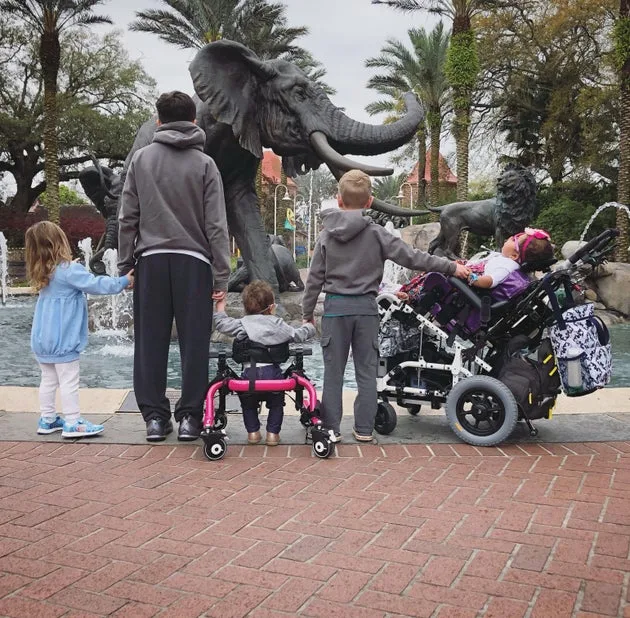
Medicaid didn’t just keep Ansley alive. It helped us provide her with therapies and tools that allowed her to thrive. The same is true for our daughter Luci, a micropreemie born at 27 weeks, who continues to receive mental health support through Medicaid after her adoption. Her needs are ongoing, and Medicaid ensures she doesn’t fall through the cracks.

Our youngest, Lilah, was born at 22 weeks and survived thanks to Medicaid. It allowed us to bring her home with oxygen and the surgeries she needed. Families in our micropreemie support groups often tell us they’d have been bankrupt without Medicaid. No one expects a premature birth, and NICU stays can cost millions. The medical needs don’t end when babies leave the hospital.
Five-year-old Z, who we adopted after four years in foster care, has complex disabilities including spastic quadriplegia, hearing and vision loss, and a traumatic brain injury. Medicaid pays for the life-changing equipment he needs, including a Tobii Dynavox eye gaze device that allows him to communicate — to tell us when he’s hurting, what toy he wants, and which song he wants to hear. It’s opened his world and ours.
Without Medicaid, we could never afford these tools. Without it, Z would likely be in a hospital or state facility instead of learning, growing, and laughing at home.
What’s at Stake
Every child deserves access to love, stability, and community. Medicaid makes that possible. Without it, children like mine — those with disabilities, chronic illness, or terminal conditions — risk being institutionalized simply because no family can afford their care.
Even worse, these cuts could force families like mine to stop fostering altogether. We wouldn’t be able to meet the healthcare needs of the children we welcome into our home. Children we’ve already adopted would also lose the medical support that keeps them safe and thriving at home.
Medicaid is also essential for family reunification, the primary goal of the foster system. We’ve seen relatives take in children with medical needs because Medicaid gave them the means to do so. Take that away, and you don’t just disrupt systems — you break up families.
The heartbreaking truth is that some children are already waiting in institutions simply because no one can afford to bring them home. Slashing Medicaid will leave even more of them behind.
A Moral Obligation
As a foster mother, this is my calling — to care for children who need someone to say yes, even when their needs are great. I do not believe these devastating cuts reflect what it means to love our neighbor or protect the most vulnerable among us. When Jesus said, “Let the little children come to me,” I don’t believe He meant for us to turn them away because they were too expensive to love.
I pray that one day I’ll be reunited with Ansley. Until then, I will continue her legacy by providing care, comfort, and home to children like her.
But if Medicaid is gutted, I may be forced to close our doors — not because we stopped loving, but because we can no longer afford to give these children what they need to live.
Disabled and medically complex children already face unimaginable challenges. Denying them access to home- and community-based care is one more cruelty they shouldn’t have to endure.
Even one child left without support is one child too many.