
The United States on Monday announced a $2 billion commitment to U.N. humanitarian relief, even as President Donald Trump’s administration continues cutting U.S. foreign assistance and urges U.N. agencies to “adapt, shrink or die” in response to tighter budgets.
The new pledge is far smaller than what the U.S. has contributed in past years, but officials argue it still reflects a sizable commitment—one they say will preserve America’s standing as the world’s largest humanitarian donor.
Instead of routing funds directly to a range of U.N. programs, the administration plans to place the money into an umbrella fund. From there, it would be distributed to specific agencies and priorities. That approach is central to U.S. demands for major structural changes at the United Nations—changes that have alarmed many humanitarian workers and contributed to deep cuts in services.
According to U.N. data, U.S. humanitarian funding for U.N.-backed efforts has reached as high as $17 billion annually in recent years. U.S. officials say only about $8 billion to $10 billion of that total was voluntary. The United States also pays billions more in annual dues tied to its membership.
Critics of the reductions say Western governments have moved too aggressively, pushing more people toward hunger, displacement, and disease, while weakening U.S. influence abroad.
A year of crisis in humanitarian funding
The announcement arrives after a bruising year for major U.N. organizations, including agencies focused on refugees, migration, and food assistance. The Trump administration has already reduced foreign aid by billions, prompting organizations to cut budgets, scale back projects, and eliminate thousands of jobs. Other long-time donor nations have also lowered their spending.
The $2 billion pledge is being shaped through a preliminary agreement with the U.N. Office for the Coordination of Humanitarian Affairs (OCHA), led by Tom Fletcher, a former British diplomat and government official.
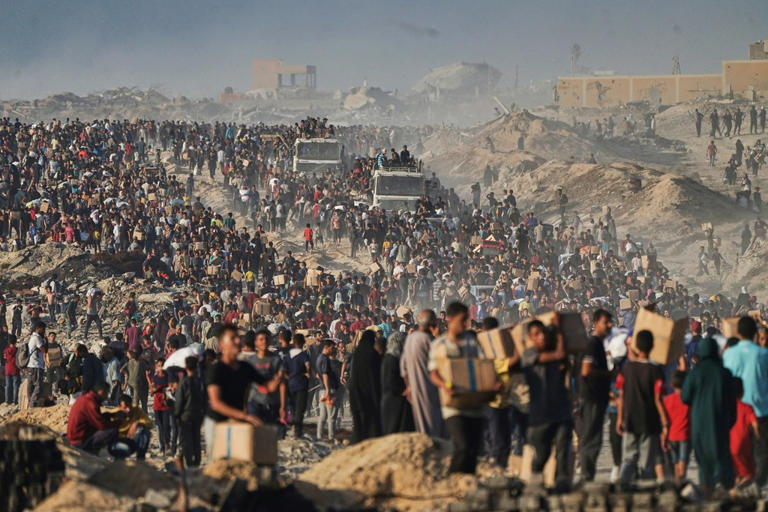
Meanwhile, global humanitarian needs have grown. Famine has been recorded this year in parts of Sudan and Gaza, and floods, droughts, and other disasters—many scientists link these trends to climate change—have displaced communities and caused widespread loss of life.
Cuts are expected to ripple through U.N.-affiliated bodies such as the International Organization for Migration, the World Food Program, and UNHCR. Those organizations have already received far less from the U.S. this year than they did under allocations during the previous Biden administration—or even during Trump’s first term.
Under the new model, OCHA would play a stronger coordinating role. Fletcher’s office previously launched a “humanitarian reset” aimed at improving efficiency, accountability, and the impact of aid spending. U.S. officials now want OCHA to serve as a central channel for aid funding—so money can be redirected strategically, rather than dispersed across multiple separate appeals.
U.S. seeks to consolidate how aid is managed
A senior State Department official, speaking on condition of anonymity to discuss details ahead of the announcement at the U.S. diplomatic mission in Geneva, said the U.S. wants “more consolidated leadership authority” in U.N. humanitarian systems.
Under the plan, the official said, Fletcher and OCHA “are going to control the spigot” on how funding is distributed.
“This humanitarian reset at the United Nations should deliver more aid with fewer tax dollars — providing more focused, results-driven assistance aligned with U.S foreign policy,” said U.S. Ambassador to the United Nations Michael Waltz.
U.S. officials described the $2 billion as an initial release intended to support OCHA’s annual funding appeal, announced earlier this month. Fletcher has already reduced this year’s request in response to the new funding environment. Other major donors—including Britain, France, Germany, and Japan—have also cut aid and pushed for reforms.
In a statement, the State Department said the agreement requires the U.N. to consolidate humanitarian functions to reduce “bureaucratic overhead, unnecessary duplication, and ideological creep,” adding: “Individual U.N. agencies will need to adapt, shrink, or die.”
The department said reform is especially urgent for humanitarian agencies, which it described as responsible for some of the U.N.’s most vital work. It framed the new agreement as an attempt to balance Trump’s stated commitment to remain a leading humanitarian supporter with a push to overhaul how U.S. funding is structured, monitored, and integrated into U.N. relief operations.
Targeted funding pools and countries left out
A key goal of the reform effort is to create pooled funding that can be directed toward specific crises or countries based on need and strategy. Seventeen countries will be prioritized initially, including Bangladesh, Congo, Haiti, Syria, and Ukraine.
Afghanistan—often cited as one of the world’s most dire humanitarian situations—is not included. The Palestinian territories are also not part of the initial list, with officials saying those areas would be covered through funding connected to Trump’s still-unfinished Gaza peace plan.
U.S. officials say the initiative has been in development for months and reflects Trump’s long-held view that the United Nations has significant potential but has fallen short. In this view, the organization has drifted from its core mission of saving lives and instead undermined American interests, promoted ideological agendas, and tolerated wasteful spending without enough accountability.
Fletcher welcomed the deal, saying in a statement, “At a moment of immense global strain, the United States is demonstrating that it is a humanitarian superpower, offering hope to people who have lost everything.”