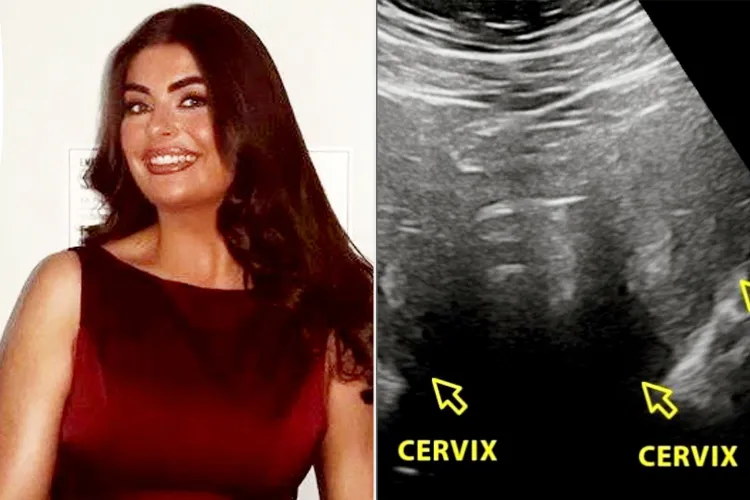

A woman who has long dealt with intense, painful periods once feared the pain might be related to her appendix. But doctors later told her that much of what she was experiencing was linked to a rare condition: she has two wombs.
Ellie Curran of Ireland was 12 when she got her first period. “I noticed roughly just after that, they were very sore and heavy,” she says. “I’d mainly have to stay in bed a lot, and I was so drained it affected my social life also.”
Years later, Curran — now 21 — recalls one night when she developed “really bad pain” in her lower stomach and believed it could be appendicitis. According to SWNS, she underwent surgery to remove her appendix, and doctors made an unexpected discovery: she has two uteruses.
“[The doctors] said there seems to be two uteruses, but didn’t say too much when I had my appendix removed,” Curran recalled.
After the surgery, she went through further testing and was formally diagnosed with a complete bicorporeal uterus — meaning she has two separate uterine cavities divided by a wall of tissue. (Only about 0.4% of women are born with the condition, according to the Cleveland Clinic.)
:max_bytes(150000):strip_icc():focal(499x0:501x2):format(webp)/Ellie-Curran-two-wombs256-012626-83701adee98f4c5bbd58fa191da8da87.jpg)
Curran also told SWNS that later scans revealed she has two cervixes and that she “might have an extra kidney.” She was additionally diagnosed with endometritis, which doctors have said could be contributing to the severity of her period pain.
According to Curran, “[There are] not really many treatment options I’ve been told of yet, so it’s a waiting game now.” She says she’s currently on a wait list for more tests and is scheduled to undergo surgery in May.
If she decides to have children, Curran says pregnancy could come with added complications. “I’d have to mainly get pregnant in the left womb, because it’s bigger than the right, and it’s safer in the left,” she explains.
:max_bytes(150000):strip_icc():focal(749x0:751x2):format(webp)/Ellie-Curran-two-wombs255-012626-860e5ef112af48a4abceca348a91e347.jpg)
Curran, who works at a call center, says she’s sharing her experience to help others feel less alone — and to encourage people to keep pushing for answers when something feels off.
“Women, you know your own body better than anyone,” she says. “If you think there’s something not right, don’t stop fighting for answers.”