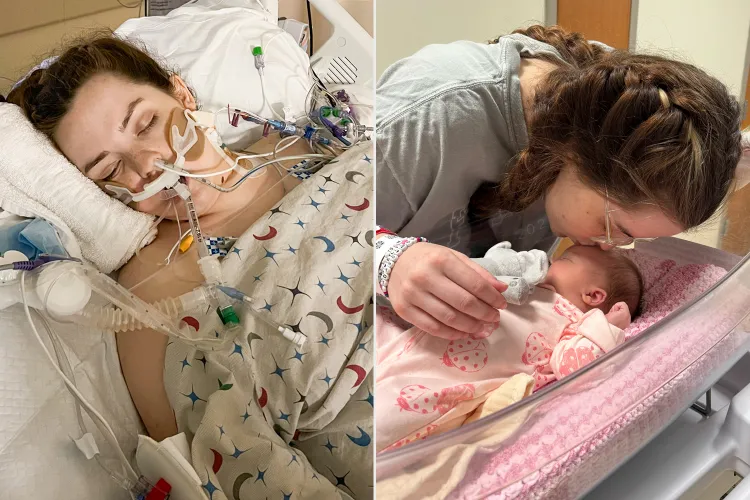

Jennifer Choate’s pregnancy had been routine — until Feb. 18, 2025, about two weeks before her due date.
That day, she was taken to the hospital with high blood pressure and headaches that had lasted nearly three weeks. With doctors concerned about preeclampsia, she was admitted right away and started on magnesium infusions to help protect both her and her baby.
“Everything pretty much felt normal. I had a smooth pregnancy overall,” Choate says. “I would’ve never suspected something like this to happen.”
The next day, doctors induced labor with Pitocin. Choate received an epidural, but she says she still felt each intense contraction.
In the early hours of Feb. 20, her condition changed suddenly. Choate began reporting chest pain, head pressure, and dizziness — then became unresponsive. Doctors determined she had suffered an amniotic fluid embolism, a rare, life-threatening complication that occurs when amniotic fluid enters the bloodstream. The event triggered cardiac arrest, sending medical teams into immediate crisis response.
After about two minutes of CPR, doctors performed a perimortem cesarean section (PMCS). Her baby was delivered 33 seconds after the incision, at 12:51 a.m.
:max_bytes(150000):strip_icc():focal(749x0:751x2):format(webp)/Jennifer-Choate-Woman-Survives-Cardiac-Arrest-During-Traumatic-Labor-011426-4-9e769e0423e341439bffcd703a1a1dd1.jpg)
Choate was intubated, and emergency IV access was placed in both shin bones. After surgery, she experienced postpartum hemorrhage and required a massive blood transfusion.
“My body went into Disseminated Intravascular Coagulation, a severe and life-threatening condition where the body’s blood clotting proteins become abnormally activated throughout the bloodstream, causing clots and bleeding,” she explains.
Although her heart continued to beat, it was failing — and her lungs were declining as well. Doctors transferred her to another hospital, where she was placed on VA-ECMO, a form of life support that temporarily takes over the work of the heart and lungs.
During the transfer, Choate’s fiancé and her mother were asked to sign documents acknowledging serious risks, including the possibility of her condition worsening or death.
:max_bytes(150000):strip_icc():focal(696x0:698x2):format(webp)/Jennifer-Choate-Woman-Survives-Cardiac-Arrest-During-Traumatic-Labor-011426-2-8a0c4d17d3e947b99bc6973fc60bea3d.jpg)
“I cannot imagine how hard that may have been for them,” she says. “They didn’t have a handbook for my experience; they did the best they could with what they thought was best, and they did an amazing job.”
Her fiancé, she says, was overwhelmed and searching for answers about what had gone wrong. Caught between fear for her life and the responsibility of caring for their newborn, he spent every night at Choate’s bedside while family members helped care for the baby at home.
“As soon as he knew II was going to make it, he gave me confidence to push as hard as I had to,” she says. “He knew how bad I wanted to be a mom, and this wasn’t stopping me.”
After 11 days in the hospital, Choate was discharged — but the hardest part of recovery still lay ahead. At home, her C-section incision reopened twice, sending her back to the hospital and into weeks of painful wound care.
:max_bytes(150000):strip_icc():focal(761x0:763x2):format(webp)/Jennifer-Choate-Woman-Survives-Cardiac-Arrest-During-Traumatic-Labor-011426-5-aeec725da4e549d5871d6789a0bb60d5.jpg)
Swelling and daily treatment kept her from sleeping in her own bed. Instead, she lived out of her living room, propping her legs up nightly to manage discomfort.
“It was hard — very hard,” Choate says. “But I would do it a million times over if I knew my amazing outcome.”
She credits both hospitals for what she calls “immaculate” care, saying the patience, empathy, and respect she experienced made her feel heard throughout a terrifying ordeal.
Now, nearly a year later, Choate says she still struggles physically, including pain in her back and near her C-section scar. Mentally, though, she has focused on gratitude and perspective.
:max_bytes(150000):strip_icc():focal(1045x0:1047x2):format(webp)/Jennifer-Choate-Woman-Survives-Cardiac-Arrest-During-Traumatic-Labor-011426-7-a09bb14b16914877b969eb76f4a627cb.jpg)
“I don’t complain about laundry, I’m grateful to have enough clothes to create a basket of laundry,” she says. “I don’t complain about baby toys in the living room, I’m grateful I have a baby to have toys for.”
She adds that 2025 brought more loss — including the deaths of her grandmother and grandfather, and the loss of the family dog — and she has learned to give herself grace as she continues healing.
“It’s truly hard to stay in a dark place for very long when I have my beautiful daughter smiling at me,” she says. “As the months go on, I find myself laughing and smiling every day because I’ve been given a second chance at life.”
:max_bytes(150000):strip_icc():focal(728x0:730x2):format(webp)/Jennifer-Choate-Woman-Survives-Cardiac-Arrest-During-Traumatic-Labor-011426-3-f1a79752309d40fe95a6280a6acbe52a.jpg)
Asked whether she would ever consider another pregnancy, Choate says she’s undecided. Stories from other survivors give her hope, but the fear of risking her life — and leaving her daughter and family behind — still weighs heavily. For now, she says she’s grateful to be alive and that her family of three is doing “amazing.”
“I know I have a reason to be here and it is to be her mom,” she says. “If there is something else out there, I will find it. But otherwise…being her mom feels like a dream.”