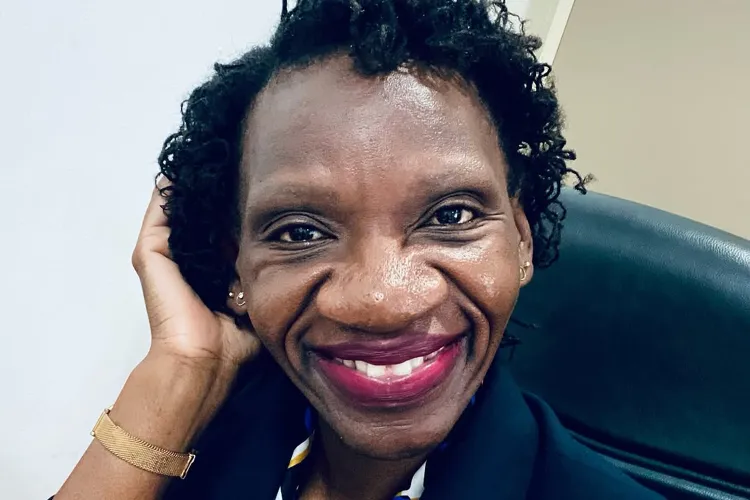

Naomie Pilula lives a life many can relate to.
She works Monday through Friday, goes to church on Sundays, and enjoys getting her nails done. She loves fashion, family, and friends. Like many people, she shares these everyday moments on Instagram, posting a few times each week.
But she was shocked when a simple video about one of her favorite face masks sparked comments like “is this AI?” and “is she using a filter?” Soon, she realized people were questioning her actual appearance. When she posted a selfie in June, the comments became overwhelming.
:max_bytes(150000):strip_icc():focal(534x0:536x2):format(webp)/naomie-pilula-3-082825-c451930873294b90a113c075efd13dbf.jpg)
Pilula grew up in Zambia, a country in southern Africa. She’s the youngest of seven siblings, and she tells PEOPLE that her view of beauty has changed a lot over the years.
“In Zambia, my home country, beauty is more the curvaceous woman, the well-endowed woman,” she says. “And so, [as] somebody who is smaller, I was always told ‘eat more, fill out more.’ ”
Pilula studied at the University of Queensland in Australia and the University of Auckland in New Zealand. In Australia, she was often the only Black student in her classes — a big contrast from her life in Zambia, which brought new lessons about beauty and identity.
:max_bytes(150000):strip_icc():focal(621x0:623x2):format(webp)/naomie-pilula-4-082825-014b9041fb234651815c01acbff6e898.jpg)
She remembers being teased about her nose as a child. By her late teens, she had learned to appreciate her features.
“I know one of the most controversial features I have, which blew up the internet, was my nose. It’s my father’s nose. Why would I want to remove something that connects me to him? It doesn’t make sense,” she says.
She adds, “At some point, I just decided I liked the way I looked. Once you get to that point, no one can take it away from you.”
Today, Pilula works as a lawyer in Zambia’s financial sector. Life was moving forward until June, when one Instagram comment hit harder than the rest.
“I got a comment that said something about trying out rhinoplasty,” she recalls. “I had already been told worse things — like ‘you’re ugly’ or ‘you don’t deserve to be on the internet’ — but that one really pissed me off.”
She first posted a “passive-aggressive” response video, then deleted it and called her sister for advice.
Her sister reminded her to think about why the comment bothered her so much. Pilula realized, “Maybe I’m not as healed as I thought I was.”
She turned back to her faith. Pilula often reflects on Psalm 139:15-16, which reminds her that God created her exactly as she is.
“If it’s flowing from my relationship with God and understanding who he is, then what can people say? Nothing can take that away,” she explains.
That strength was tested when her June selfie went viral, gathering more than 530,000 comments and shares, many of them negative. She thought about deleting the post but instead leaned on another Bible story — Joseph in Genesis.
Joseph was betrayed by his brothers, sold into slavery, and later rose to power. When his brothers apologized, he told them that what was meant for harm, God turned for good.
“That story reminds me: if I didn’t already love myself, this backlash would crush me. But instead, I’ve gained the most followers from the hardest posts,” she says.
Now, Pilula plans to keep doing what she’s always done: living authentically.
“I want people to see God. I want people to see confidence. I’m not the most traditionally beautiful person, and that’s okay. But I love myself, and that’s its own kind of beauty. Everyone has a light, and it deserves to shine.”
Her social media following proves the point. “I began April with 1,000 followers. By August, I have 20,000. This has been insane — but I’m not doing anything different. This is just me being me.”