
Paige Seifert first realized something might be wrong in August 2024, when she noticed blood in her stool during a trip with friends. She assumed it would pass, but promised herself that if it didn’t improve within a week, she’d see a doctor. When it didn’t, she booked an appointment.
At that visit, her doctor asked whether she had a family history of gastrointestinal problems. When she said no, she was reassured it was most likely hemorrhoids and would resolve within a week with stool softeners.
But the bleeding continued. Seifert says she had a routine physical about a month later and brought it up again—only to hear the same conclusion. Doctors told her she wasn’t anemic, her bloodwork looked normal, and at 24, there was “really no concern.” She was referred to a GI specialist to have hemorrhoids treated.
By the time she was finally seen by the specialist in December 2024, her symptoms hadn’t changed. The doctor scheduled a colonoscopy for the following month, intending to get a clearer picture before proceeding with hemorrhoid surgery.
Seifert describes the process as slow and frustrating, saying referrals took months—especially because she was young and otherwise healthy. In her words, there didn’t seem to be urgency to get her evaluated quickly.
Everything shifted after her colonoscopy in January 2025.
:max_bytes(150000):strip_icc():focal(517x755:519x757):format(webp)/24-Year-Old-Woman-Gets-Diagnosed-with-Stage-Three-Colon-Cancer-012726-5-06ff1cebd67f4214ae2ed6d7a664913c.jpg)
She says she woke up from the procedure to her doctor telling her they had found cancer—and that it appeared so clear they didn’t need to wait for a biopsy to suspect what it was. Soon after, she was referred to an oncologist. A week later, she was officially diagnosed with stage 3 colorectal cancer.
Doctors told her the treatment plan would include 12 rounds of chemotherapy and a colon resection (colectomy), a surgery to remove part of the colon. They said the order didn’t matter, so Seifert decided to start chemotherapy first. On Feb. 12, 2025, she had a port placed in her chest and began chemo five days later.
She chose to prioritize treatment in a way that still allowed her to keep skiing—something that mattered deeply to her. She completed eight rounds of chemo, then took a month off to prepare for surgery. In July 2025, she underwent her colon resection and received a temporary ileostomy, which reroutes digestive waste through a stoma in the abdomen.
A month later, the ileostomy was reversed. Seifert then returned to complete the remaining four rounds of chemotherapy.
Throughout the process, she says she leaned heavily on her support system. Her mother flew in from Texas to drive her to the colonoscopy—what was meant to be a simple ride quickly became something much bigger when the diagnosis came. Seifert says her father also traveled to be there for her earliest oncology visits and treatments, and her friends showed up in a major way once they learned what was happening.
Around the same time, Seifert’s mother was also diagnosed with breast cancer, which meant she needed to step back and focus on her own health. Still, Seifert says experiencing chemotherapy in parallel—despite how painful it was—created a deeper bond between them, because her mother understood exactly what treatment felt like.
:max_bytes(150000):strip_icc():focal(1225x368:1227x370):format(webp)/24-Year-Old-Woman-Gets-Diagnosed-with-Stage-Three-Colon-Cancer-012726-4-4a1f4541d6b74616b42a47d29bd034d8.jpg)
Seifert also says staying active helped her mental health. She went in for treatment every other Monday, rested for several days afterward, and then tried to get back outside on the weekend—often skiing long distances when she felt up to it.
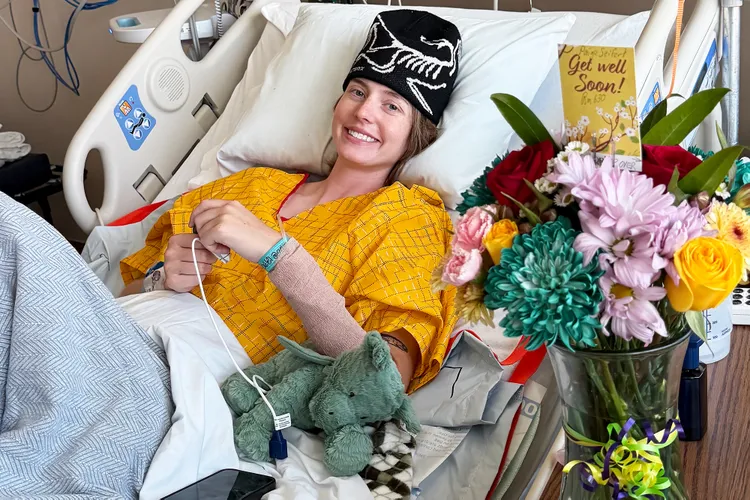
After about 10 months, she finished treatment on Nov. 17, 2025. But a week later, a follow-up CT scan revealed something unexpected: a 5 cm blood clot near her heart and a pulmonary embolism—something she says was discovered “as a fluke.”
She recalls her doctor calling shortly after the scan and asking if she had chest pain. She didn’t—she had just returned from an eight-mile mountain bike ride and felt fine. Still, the doctor told her to go to the hospital immediately, warning that she could have a heart attack or die. Seifert spent a week hospitalized over Thanksgiving and had surgery to remove the clot.
Now, she says she feels “great,” even though she recognizes how surreal that sounds after stage 3 cancer and a life-threatening clot. She says the experience forced her to confront mortality far earlier than anyone should have to—and yet, she feels she lives with a sharper appreciation for each day.
:max_bytes(150000):strip_icc():focal(1348x286:1350x288):format(webp)/24-Year-Old-Woman-Gets-Diagnosed-with-Stage-Three-Colon-Cancer-012726-2-47c2a6b7654c487da08e3907db53350f.jpg)
She also says she’s still dealing with lingering side effects of treatment, including neuropathy—nerve damage that causes numbness and tingling in the hands and feet. Since September, following her surgery, she says she hasn’t been able to properly feel her feet or fingertips. It’s affected simple tasks like writing, picking things up, and running. She believes it may be something she lives with permanently.
After sharing her story online, Seifert says she started hearing from others—especially in the Denver area—who had similar experiences. Those messages helped her find community among people going through treatment or living as survivors.
She also worked with friends to make a short film about her journey, which she says pushed her to process the experience more seriously. During treatment, she stayed focused on getting through each stage—what she describes as survival mode. But afterward, she began reflecting on what it meant, including how it shaped her relationships and her day-to-day life.
Seifert says she thought about death often over the past year and has come to accept it as a reality—but she also finds it frightening to face those thoughts at 25. Even so, she tries to hold onto something constructive: the urgency to live more fully.
She says she wants to travel more, chase opportunities, and stop postponing experiences she cares about. Where she once prioritized work, savings, and being practical above everything else, she now feels driven to “seize every opportunity”—to explore, to move, and to live the life she wants while she can.