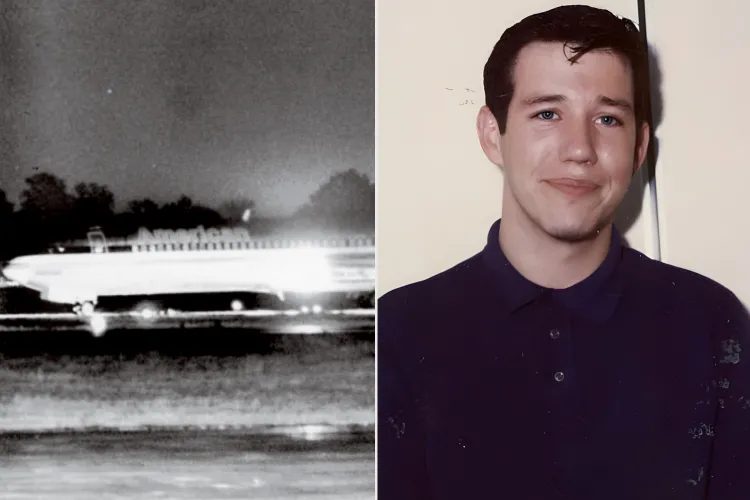

Sunrise was still hours away on a June morning in 1972 when Martin McNally finally worked up the courage to jump from the back of the Boeing 727 he had hijacked. The aircraft was roaring over central Indiana at nearly 300 miles per hour.
McNally, then 28 and a Navy veteran, had never worn a parachute in his life. Seconds after stepping into the void, he was tumbling uncontrollably through the sky.
Strapped to his waist was a bag containing $502,000 in ransom money. When his reserve chute — provided by an FBI agent at his insistence — suddenly deployed, it smashed into his head, leaving him bloodied and bruised.
Then came the worst blow: the money tore loose and vanished into the darkness below.
“I couldn’t believe it,” McNally recalls now. “I was screaming and yelling, ‘The money’s gone!’ It’s the first and only time I ever thought about suicide.”
Things only spiraled further from there. McNally’s daring escape attempt unfolded during what later became known as the “Golden Age” of skyjacking, a period when airline security was dangerously lax.
Between 1968 and 1972, more than 300 planes were hijacked in the United States, forcing authorities to radically overhaul airport safety procedures. McNally’s stunt earned him two life sentences for air piracy, and he spent nearly four decades behind bars before being paroled in 2010.
During those years in prison, McNally — now 81 — grew increasingly reflective and remorseful, if still candid about his past. “It was insane. I was stupid,” he says. “I should have never done it.” His life story is explored in the documentary American Skyjacker, now streaming on major platforms.
:max_bytes(150000):strip_icc():focal(999x0:1001x2):format(webp)/mag-rollout-martin-mcnally6-1626-fc5690a886e842208975217cff1bc0f3.jpg)
Raised in Wyandotte, Michigan, the son of a popular shoe salesman, McNally says the idea of hijacking a plane took hold after he heard a radio report about the mysterious D.B. Cooper. In November 1971, Cooper jumped from a jet near Portland, Oregon, and vanished with $200,000 — a crime that remains unsolved to this day.
To McNally, the scheme sounded almost foolproof. A high school dropout who had worked as a military aircraft electrician and drifted through odd jobs and scams after his discharge, he remembers thinking: “What could be easier?”
Seven months later, on June 23, 1972, he put his plan into action. Armed with a sawed-off .45 rifle, smoke bombs hidden in a briefcase, a fake name, and a disguise, McNally hijacked an American Airlines flight carrying about 100 passengers from St. Louis to Oklahoma.
But the situation quickly unraveled.
The plane was forced to return to Missouri so authorities could assemble the ransom. As news coverage exploded, a local vigilante even attempted to ram the jet with his Cadillac while it sat on the tarmac. The bizarre stunt failed. Eventually, McNally agreed to release all but one hostage in exchange for a fresh aircraft and crew to carry him toward the Canadian border.
After parachuting into Indiana, he remained on the run for just five days. When police caught him, he had only $13 left — not the half-million he had demanded.
Six years later, while incarcerated in Marion, Illinois, McNally became entangled in another tragic episode: a botched escape attempt involving a hijacked helicopter. The incident ended with the death of Barbara Oswald and the brief imprisonment of her teenage daughter, Robin, after Oswald tried to land the aircraft at the prison out of love for another inmate. McNally says the event still weighs heavily on him.
“That’s why I’m telling my story,” he explains. “To rehabilitate Barbara and Robin. Neither of them were criminals. We were scamming them.”
:max_bytes(150000):strip_icc():focal(749x0:751x2):format(webp)/mag-rollout-martin-mcnally5-1626-9654dbadc9ba49debda97066fceb82a2.jpg)
Life after parole has been remarkably quiet. McNally says he has stayed out of trouble for years and even struck up a friendship with one of the flight attendants from the plane he hijacked decades ago.
“I take care of my sister’s 93-year-old mother-in-law, live with my two cats, and have no worries,” he says.
:max_bytes(150000):strip_icc():focal(999x0:1001x2):format(webp)/mag-rollout-martin-mcnally2-1626-d466fa5cf07e417cb9705df0d1ac59f3.jpg)
Looking back, McNally sums up his choices with blunt regret. He says he threw his life away “for a bunch of paper.”
And his message to anyone tempted by a similar path is equally direct: “Forget that nonsense. You’re not going to get away with it — especially today. Get an education, stay clean, and get a decent job.”