
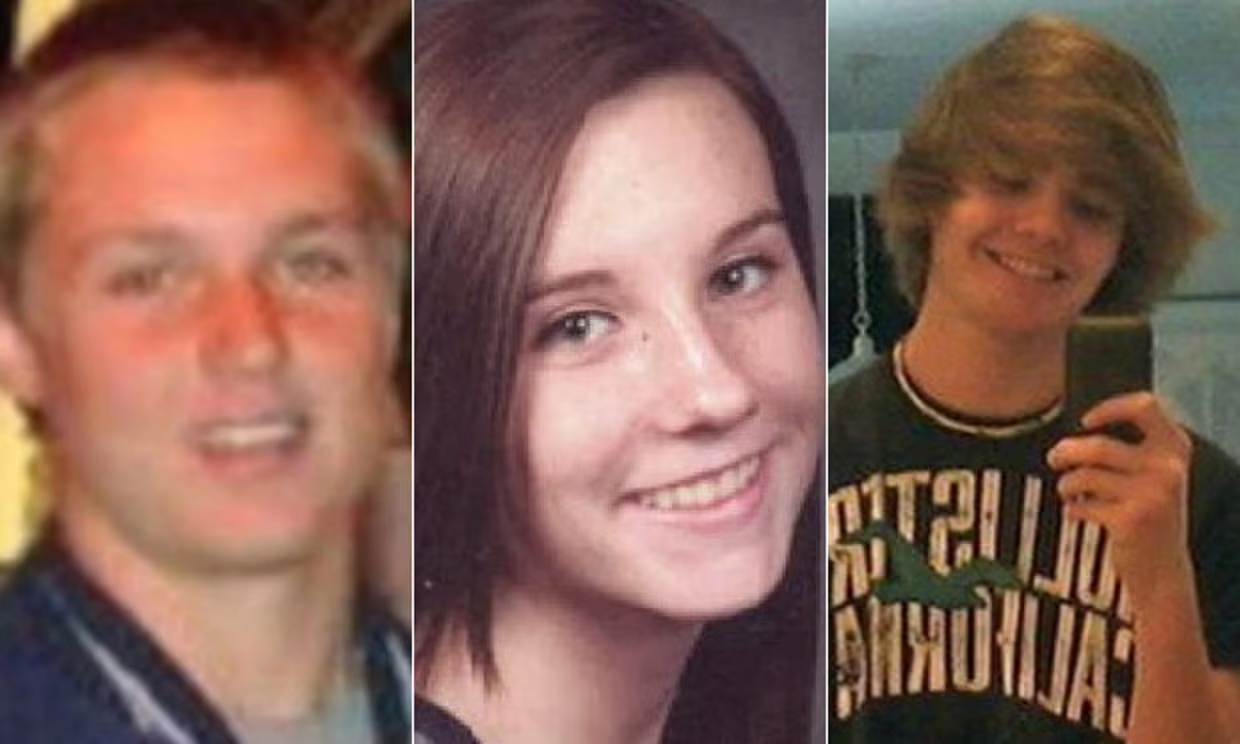

In spring 2011, three students from the same small town in Florida died — and all three had previously been hypnotized by their principal, Dr. George Kenney.
The former North Port High School principal hypnotized more than 70 people, including many students, during his tenure, despite never being a licensed hypnotherapist. Some students praised his methods and credited him with improved athletic and academic performance, as detailed in the 2023 docuseries True Crime Story: Look Into My Eyes.
But within weeks, students Marcus Freeman, Wesley McKinley and Brittany Palumbo — each of whom had private hypnosis sessions with Kenney — were dead.
Kenney has long denied that his hypnosis harmed students. However, the teens’ parents alleged that he taught students how to enter trances in which they couldn’t fully grasp the consequences of their actions, including self-harm.
The case is revisited in an episode of the ID series The Curious Case Of…, which premiered Feb. 16.
:max_bytes(150000):strip_icc():focal(691x244:693x246):format(webp)/look-into-my-eyes4-21226-afce348788ba499a9050eab357a1f7a5.jpg)
How Kenney got involved with hypnosis at the school
Kenney said he became interested in hypnosis as a teenager after reading about it and experimenting with a friend. After joining North Port High School in North Port, Florida, he attended a large school conference where a hypnotist performed for thousands of students — an experience he said motivated him to pursue training.
In late 2009, Kenney took a five-day course through the National Guild of Hypnosis at the Omni Hypnosis Center. He did not become a licensed hypnotherapist, but said the course left him feeling confident in what he was doing.
He later began participating in hypnosis-related activities tied to school events, demonstrated hypnosis in classes, and worked with groups such as the school’s JROTC.
:max_bytes(150000):strip_icc():focal(999x0:1001x2):format(webp)/look-into-my-eyes2-21226-51fbd04e1a7f49c7aced7853b4d75a1d.jpg)
Private sessions with students
Kenney eventually began offering private hypnosis sessions to students seeking help with issues like test anxiety, difficulty focusing, and athletic performance. He documented and videotaped the sessions and required signed parental permission slips.
Some students said the sessions helped. One student, Eric Williams, claimed his test scores improved significantly after hypnosis. A 2011 report said Kenney hypnotized at least 75 people, including students, athletic teams, staff and parents, with one student reportedly undergoing about 40 sessions.
In legal documents, Kenney later acknowledged he did not screen students for medical or mental health history and said he did not understand hypnosis could be harmful in some cases — such as when someone is depressed.
Other students described experiences they believed were disturbing or humiliating. One JROTC student alleged that after being hypnotized on a field trip, he woke up with lipstick on his face and no memory of what happened. Another claimed he became disoriented after a session and later woke up wearing pantyhose and lipstick, saying he continued to struggle with memory and focus issues years afterward.
Marcus Freeman’s death
In the docuseries, Freeman’s best friend Deric Thomas said Freeman, 16, began seeing Kenney every Friday before football games to reduce pain so he could keep playing. Thomas described Freeman entering a trance-like state in which he appeared mentally present but disconnected from physical sensation, sometimes leaving the field with a “blank stare.”
Kenney said he hypnotized Freeman to help his brain process the game more slowly but denied using hypnosis to block pain.
On March 15, 2011, Freeman and his girlfriend were driving home after a dentist appointment when, according to the girlfriend’s later police statement, he suddenly developed a “strange look” and veered off the road, crashing into a tree. Freeman died. His girlfriend was seriously injured but survived.
:max_bytes(150000):strip_icc():focal(749x0:751x2):format(webp)/look-into-my-eyes9-21226-b90a75a7eeab4907adb79b8c97a9b876.jpg)
Wesley McKinley’s death
McKinley, 16, died by suicide on April 8, 2011, weeks after Freeman’s crash.
Kenney hypnotized McKinley — a talented young musician preparing for a Juilliard audition — the day before his death, according to reporting cited in the case coverage. He had three known sessions with Kenney.
McKinley’s mother, Peggie, said her son sometimes behaved oddly after sessions, including not responding to his name, believing he had 11 fingers, and skipping the number seven when counting. She described his demeanor as “zombie-like” and out of character. On the day he died, she said he came home, walked past her without responding to questions, and went out the back door. Not long afterward, she heard sirens.
Kenney said McKinley dealt with cyberbullying and other private stressors, and he insisted he did not know McKinley was depressed during their sessions. He said the death continued to haunt him.
Brittany Palumbo’s death
Palumbo, 17, met with Kenney at least once in late 2010, hoping to improve her SAT score and reduce test anxiety.
Her mother, Patricia, said Palumbo had recently ended a long relationship and felt stressed about college plans, but wasn’t depressed. Patricia attended the hypnosis session, which was recorded. She said that during the session Kenney instructed Palumbo to relax and remain bent forward for several minutes — and afterward, Palumbo did not remember being in that position.
Palumbo later retook the SAT and still did not score as she had hoped. Her mother said Palumbo became distraught, believing hypnosis had been her “last resort” for reaching her college goal.
On May 4, 2011, Palumbo went to her room saying she planned to take a nap. When she didn’t respond later, her parents checked and found her dead in her walk-in closet.
Patricia said she did not believe Kenney explicitly told her daughter to die, but she questioned whether hypnosis gave her a way to disconnect from fear or self-preservation, pointing to Palumbo’s limited memory of the session.
Shortly after Palumbo’s death, Kenney denied to a local newspaper that he had hypnotized her. In later deposition testimony, he said he did not contribute to her death and claimed he had lied under stress.
:max_bytes(150000):strip_icc():focal(599x0:601x2):format(webp)/marcus-freeman-21226-761450f0f8ca4c17bf0af99bd3eac2af.jpg)
Investigations, discipline, and the legal aftermath
After Palumbo’s death, Kenney was placed on paid administrative leave. Despite community controversy, he was permitted to participate in the 2011 graduation ceremony.
Some students defended Kenney, arguing he became a scapegoat for families’ grief. One student, Stephen Ware, said Kenney’s sessions helped him finally pass a required standardized test after multiple failures, allowing him to graduate on time.
The school board hired a private investigative agency to examine Kenney’s hypnosis activities. In the resulting report, the school nurse accused Kenney of interfering with her care of an injured student, alleging he attempted hypnosis to manage pain and kept her away before paramedics arrived. Kenney said he was trying to calm the student and later acknowledged he may have gotten in the way, though he claimed it wasn’t intentional.
:max_bytes(150000):strip_icc():focal(749x0:751x2):format(webp)/look-into-my-eyes6-21226-00ca60adbc014aa9b37d0bcae72b346d.jpg)
The Florida Department of Health investigated and alleged Kenney violated state law because he was not a licensed healthcare professional. Kenney ultimately pleaded no contest to practicing therapeutic hypnosis without a license, a misdemeanor, and resigned in June 2012. He received two consecutive six-month probation terms and 50 hours of community service. After completing those requirements, he left Florida and later moved to North Carolina, according to local reporting.
In December 2012, the parents of Freeman, McKinley, and Palumbo sued the Sarasota County school board for wrongful death, alleging Kenney’s hypnosis contributed to the teens’ deaths and that the district should have stopped him. In October 2015, the families and the school board settled, with each family receiving $200,000.


