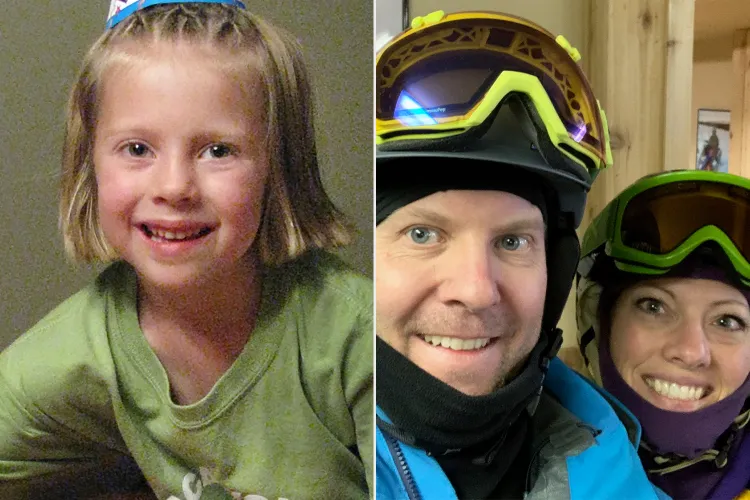

A nightmare doesn’t even begin to capture what Chauncy and Kelli Johnson faced on Christmas Eve 2010, when they headed out for a couple of runs at their local mountain in Casper, Wyo., with their daughters Elise, 5, and Camilla, 3.
While Kelli’s parents watched the couple’s 4-month-old baby, Logan, back at the lodge, Chauncy—an expert snowboarder—took “Milli” to the bunny hill. Kelli, an adept skier, went with Elise on a short blue run.
Then, in an instant, everything changed.
As Kelli paused on the side of the trail to fix Elise’s ski, a snowboarder traveling an estimated 50–60 mph slammed into them from behind.
Elise was thrown roughly 50 feet. She broke her neck and died. The snowboarder, Craig Shirley, was hurled about 40 feet and died from blunt force trauma. Kelli suffered a brain injury so severe doctors weren’t sure she’d ever wake up—and if she did, whether she’d walk again.
“She still doesn’t remember the moment of impact, which is actually a blessing,” Chauncy, 46, says, tearing up as he recalls that day. “I also feel fortunate not to have witnessed it, because the aftermath was so traumatic.”
In the days that followed, Chauncy moved through an impossible checklist: arranging Elise’s funeral, deciding where to bury her, and even making the decision to wean their infant off breastmilk—while Kelli was being transferred to a hospital specializing in brain injuries, her outcome unknown.
“She had amnesia and couldn’t remember Ellie was dead,” Chauncy says of visiting his wife in those early days.
Kelli, now 46, was placed in an induced coma for three weeks. When she was moved to a hospital that specialized in TBIs, she began the slow, grueling work of recovery—relearning how to walk and swallow.
She returned home after three months. But survival didn’t mean the suffering was over. Grief settled over the family with a crushing weight, and Chauncy says it nearly broke them.
“I started drinking. I didn’t know how to process all of this,” he says. “I was ready to give up on a belief in God. There were moments where all I could do was breathe.”
Eventually, he stopped drinking and leaned into faith again. “I realized with some good friends, Kelli and some great support, that that wasn’t gonna be a productive way to move my way through this,” he says.
Even as they struggled, a new question kept surfacing for him: what could have prevented this—and how could anyone feel safe returning to the mountain after a loss like theirs?
“In the aftermath of losing my daughter,” Chauncy says, “I’d think about how I could make the mountain safer, even just for me to feel good about going back to skiing again.”
By 2016, he felt strong enough to pursue that idea. He reached out to the National Ski Areas Association about collaborating on a safety program.
“They could easily have said, ‘Look, that’s not good PR,’ ” he recalls, “but they welcomed us with open arms.”
In 2023, the Johnsons launched their nonprofit, the Snow Angel Foundation. They partner with resorts to speak to youth groups, race clubs, ski patrollers and others about Elise’s story—and about safety on slopes across the country, where an average of 40 people still die annually.
Their PSAs—now on more than three dozen mountains—are widely recognized for a blunt, haunting message: “She was 5. You were doing 50.” Another: “Ski and Ride RAD,” meaning ready to stop, be alert, and distance yourself. Next, they hope to expand through more videos at lift lines and additional resort programming.
“We do our best to leave people inspired and not feeling sad,” Chauncy says of sharing their story.
He adds, “We’re really the first people that have lost a family member on the slopes, come back in and said, ‘We need to be more open about our conversations about safety on the mountain, and we need to provide people with better tools to understand how to mitigate risk better.’ ”
He also emphasizes they don’t carry hatred toward the man who hit them. “We also want people to know we don’t harbor ill will toward the snowboarder,” he says.
About a year after Elise was killed, Chauncy decided to get back on his board.
“It was one of the scariest experiences of my life,” he says. But as he carved through 8 inches of fresh powder, he remembered the feeling that had drawn them to the mountain in the first place—how alive it could make you feel.
Kelli soon followed. And today, the family’s four children—including daughters Reese, 11, and Leilani, 9, who were born after Elise’s death—now ski with them regularly.
“We want our kids to know that when tough things happen, you can face those fears,” Chauncy says.
He looks forward to a day when tragedies like theirs are rare—and safety is treated as a shared responsibility, not an afterthought.
“We’ve got a long way to go. But I’m willing to do anything to make skiing better,” he says. “There’s that piece of my heart that’s never going to heal. And that’s okay too. We know we’re on the right path.”