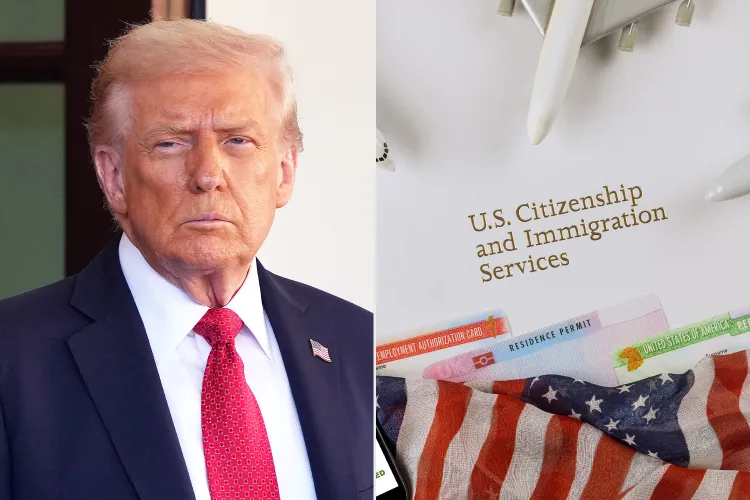

A key part of the U.S. citizenship process has just become more difficult under President Donald Trump’s administration.
The U.S. Citizenship and Immigration Services (USCIS) announced in an Oct. 20 news release that it is revising the 2020 Naturalization Civics Test to “ensure proper assimilation of lawful immigrants into the United States and promote a unified American identity and attachment to the Constitution, laws, and founding principles of the United States.”
The agency stated that the update aims to clarify what applicants must know and understand “of civics as required under section 312 of the Immigration and Nationality Act (INA),” including demonstrating “a knowledge and understanding of U.S. history and of the principles and form of government in the United States.”
Under the changes, the number of questions has doubled — from 10 to 20 — and applicants must now answer at least 12 questions correctly to pass, instead of the previous six.
In addition, test administrators are required to stop the exam “when the applicant correctly answers the minimum number of 12 questions required to pass the test, or answers nine questions incorrectly,” according to USCIS.
:max_bytes(150000):strip_icc():focal(818x360:820x362):format(webp)/American-Flag-071824-6c715ead0f164e5b92f6fb93ad808173.jpg)
The updated exam applies to anyone who filed for U.S. citizenship on or after Oct. 20. Those who applied before that date will continue to take the 2008 version. Applicants who “qualify for special consideration because they are age 65 or older and have resided in the U.S. as a lawful permanent resident for at least 20 years” will be given a 10-question test drawn from a “specially selected bank of 20 test questions” from either the 2008 or 2025 exams, as noted in the Federal Register.
The new civics section includes 128 potential questions, up from 100 in the previous version. Sample questions include who makes federal laws, what the Constitution does, and who lived in America before Europeans arrived. Others ask applicants to name three of the original 13 states, identify two national holidays, and list two of the three rights in the Declaration of Independence.
Beyond civics, those seeking citizenship must also show that they can read, write, speak, and understand English.
:max_bytes(150000):strip_icc():focal(749x0:751x2):format(webp)/us-citizenship-paperwork-102425-c01b6d9d932b4b90a26919f1475b10f7.jpg)
Joseph Edlow, director of USCIS, said in September that he considered the earlier test “just too easy” to pass.
“We need to make it a little bit more challenging,” Edlow said. “We’ve got to make sure that people are actually understanding what it means to be a U.S. citizen, what it means to get that benefit.”
The revision has faced pushback from several organizations, including the Clinic Legal Immigration Network Inc. (CLINIC), the Citizenship Test Working Group (CTWG), and more than 120 national, state, and local groups and educators.
In a joint letter, they warned that the changes could disproportionately harm applicants with “low literacy, limited financial resources, lack of access to preparation materials, and older applicants who may find the increased complexity difficult to navigate.”