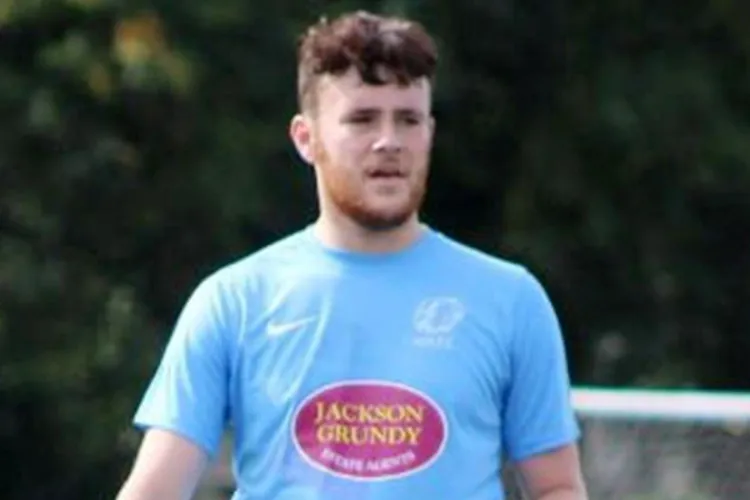

An amateur soccer player was diagnosed with tonsillitis and given antibiotics just days before he died from sepsis and necrotising fasciitis, a rare but aggressive “flesh-eating” bacterial infection.
A court investigation into the death of Luke Abrahams, 20, was opened at Northampton Coroner’s Court on Tuesday, Jan. 20, following his death on Jan. 23, 2023, according to a post on the North Northamptonshire Council website.
The BBC reported that Abrahams, from Northampton — about 70 miles north of London — died from sepsis and necrotising fasciitis.
According to the Cleveland Clinic, “Necrotizing fasciitis, also known as flesh-eating disease, is a bacterial infection that affects the tissue under your skin called fascia.” The clinic notes the condition can be treated with antibiotics and surgery to remove damaged tissue.
:max_bytes(150000):strip_icc():focal(582x542:584x544):format(webp)/luke-abrahams-012126-3-6ce9ff2daec04e52b647421b3ac0674a.jpg)
Multiple medical contacts before his condition rapidly worsened
In the week leading up to his death, Abrahams had contact with multiple doctors, as well as the emergency room, paramedics and an out-of-hours service, ITV reported. He also called 111 — the U.K.’s non-emergency medical line.
After he was diagnosed with tonsillitis and prescribed antibiotics, his condition deteriorated, and severe leg pain left him unable to move, according to the BBC.
Three days before his death, Abrahams had a video consultation with an out-of-hours doctor on Jan. 20, 2023, where he was diagnosed with sciatica, the BBC reported. The Mayo Clinic describes sciatica as pain that travels along the path of the sciatic nerve, running from the buttocks and down the leg.
Despite a high temperature and high blood sugar levels, an ambulance crew later decided he did not need to go to the hospital when his family called them roughly 12 hours after the sciatica diagnosis, the BBC reported. He was admitted to the hospital two days later — and died the next day.
Before his death, doctors attempted to save Abrahams by amputating his leg, ITV reported.
:max_bytes(150000):strip_icc():focal(781x306:783x308):format(webp)/luke-abrahams-012126-5-49deccfc13bf4c5ca4339d317cac5078.jpg)
Family calls for answers
Speaking ahead of the court investigation, Abrahams’ father, Richard, said it was “so frustrating,” adding that “they know they could have treated him better than they did,” according to ITV.
“We want justice and accountability. Someone has to be held responsible,” he said.
Abrahams’ mother, Julie, said the family wanted clarity about what went wrong and why, asking for honesty and accountability so they can grieve properly, ITV reported.
Ambulance service leader: He should have been transferred
During the court investigation, Susan Jevons — head of patient safety and coroner services for East Midlands Ambulance Service — acknowledged Abrahams should have been taken to the hospital, according to the BBC.
“If you look at Luke’s presentation, it was not normal,” Jevons said. His blood sugar and pain score, she added, “warranted a transfer” to the hospital. “He was an unwell man,” she said.
Jevons also said Abrahams had already been treated and “it wasn’t working,” adding that leaving him at home meant he did not get the care he needed.
It was also confirmed in court that a paramedic involved later left the ambulance service after a period of supervision following the incident, the BBC reported.
:max_bytes(150000):strip_icc():focal(601x181:603x183):format(webp)/luke-abrahams-012126-2-5aa3210d8d74456f9e99550e58290701.jpg)
Earlier findings cited by the BBC
In a November 2024 report, the BBC said a court hearing had previously been adjourned until May 2025, after a coroner stated Abrahams had died of “natural causes.”
That earlier report also said a serious incident investigation at East Midlands Ambulance Service Trust found the crew failed to follow guidelines and policies, and that Abrahams’ symptoms should have indicated a life-threatening condition requiring transfer to hospital. The report described a “missed opportunity” for medical help that could have prevented deterioration, the BBC said.
“That was Luke,” his parents said
Abrahams’ parents told the BBC their son was known for always making time for others. “He just got on with everyone, he had a second for everyone,” they said, describing him as someone who would check on friends late at night if they needed to talk.
NHS Northamptonshire Integrated Care Board didn’t immediately respond when contacted for comment and additional information.
An East Midlands Ambulance Service spokesperson said in an email that, with the investigation underway, the service would wait until the coroner concludes proceedings before issuing a statement.
A spokesperson for the Northampton Coroner’s Office said the investigation may conclude on Thursday, Jan. 22, or Friday, Jan. 23.