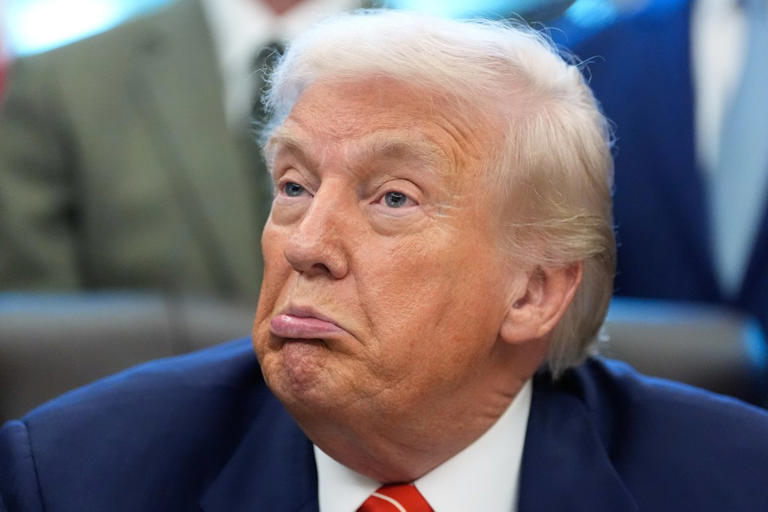

As President Donald Trump continues efforts that critics say could expand federal influence over how elections are run ahead of the 2026 midterms, two conservatives warned in a Wednesday podcast that he may try to “break” the election process through procedural maneuvers and pressure campaigns.
Stephen Richer, the former Republican recorder for Maricopa County, Arizona, said he is increasingly concerned that the 2026 midterms could be handled differently from past elections. Richer served in his role during the 2020 election, when Trump and his allies pushed claims of widespread fraud and sought to overturn results in key states. Richer described facing intimidation and political backlash after refusing to validate allegations he said had no factual basis.
At one point, Richer said he realized that those demanding action were not seeking an investigation or new information. Instead, he felt they wanted confirmation of a predetermined narrative.
David Frum, a centrist journalist, raised a scenario in which a narrowly contested House outcome could be leveraged to undermine the results. If only a handful of House seats determine control—rather than a large wave—Frum suggested that concentrated doubt around a few targeted races could create an opening for aggressive challenges.
Richer expanded on the idea, describing a theory in which Republicans could claim a small number of races are “disputed” and use that uncertainty to justify extraordinary steps. In that scenario, Richer said, House leadership could be pressured to delay or refuse seating newly elected members from contested districts.
Legal limits, however, constrain what the House can do. In Powell v. McCormack (1969), the Supreme Court ruled that the House may not exclude a duly elected member who meets the Constitution’s explicit requirements for office.
Richer also argued that proof may not be necessary to persuade many committed supporters that an election was illegitimate. He said that in the aftermath of 2020, he spoke with Republicans who privately acknowledged that the fraud claims lacked substance, but he contended that many either stayed silent or publicly embraced them because it carried political benefits.
Frum criticized Trump’s broader political style as well, saying that behavior he characterized as inflammatory can tarnish other actions taken by an administration, even when those actions resemble routine governance.
Other observers have voiced similar concerns. Wendy Weiser of the Brennan Center for Justice said recent activity should dispel doubts, in her view, that groundwork is being laid for interference or disruption around elections.
Derek Clinger of the State Democracy Research Initiative at the University of Wisconsin Law School described what he called a “nightmare scenario” that, in his view, has shifted over time. Rather than an overt military intervention under emergency powers, Clinger suggested a more plausible risk could involve ballot seizures or related actions carried out under the appearance of lawful procedure—an approach he said could be harder to challenge quickly as events unfold.