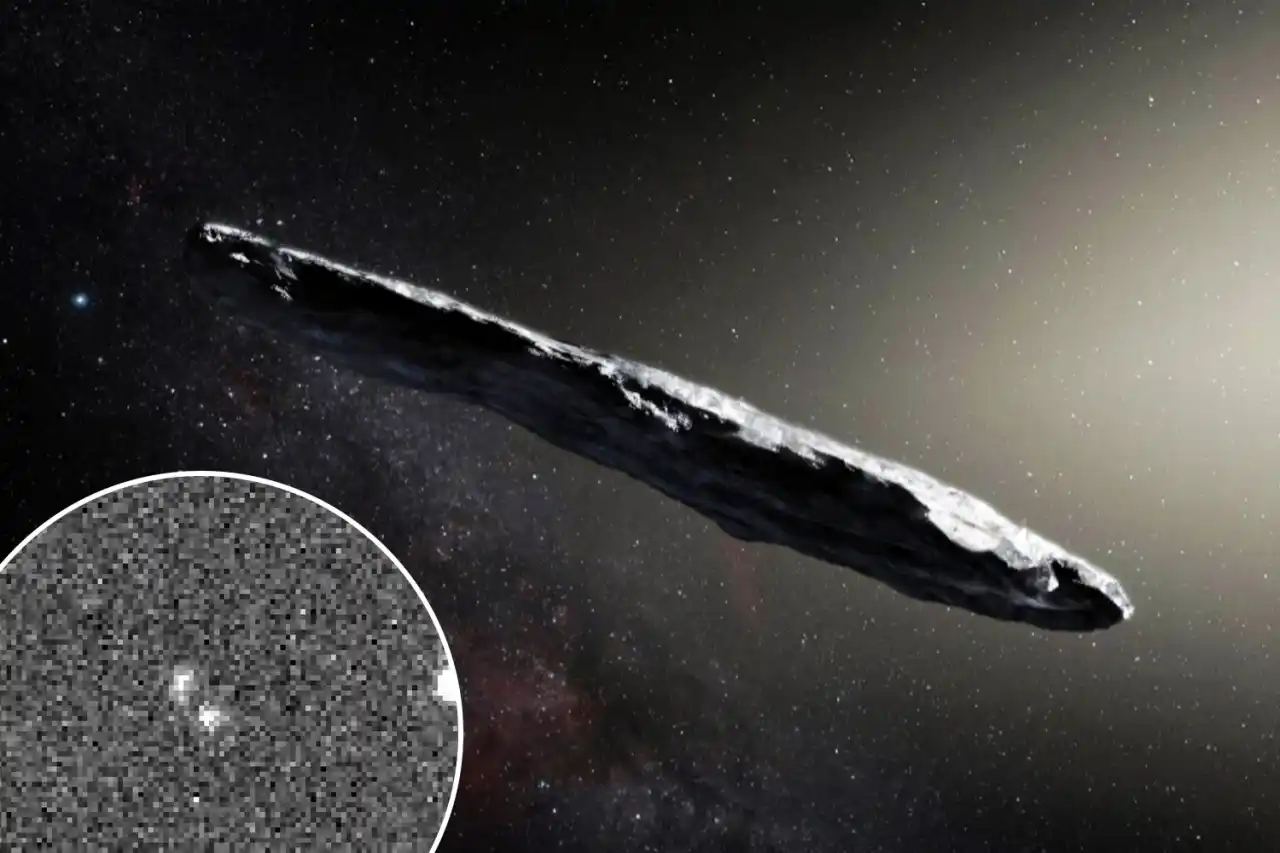

A mysterious object from deep space has entered our solar system—and scientists say it’s only the third confirmed interstellar visitor ever recorded.
The icy traveler, believed to be a comet, was first detected on July 1 by the ATLAS telescope in Río Hurtado, Chile. It’s been officially named 3I/ATLAS—the “3I” marking it as just the third known object from beyond our solar system, following the historic arrivals of ʻOumuamua in 2017 and 2I/Borisov in 2019.

Unlike a rocky asteroid, this cosmic visitor has a “fuzzy” appearance and a short tail, indicating it’s mostly made of ice and gas.
“The fact that we see some fuzziness suggests it is mostly ice rather than rock,” said Jonathan McDowell of the Harvard-Smithsonian Center for Astrophysics.
“It looks kind of fuzzy… there is some gas around it,” added Peter Veres from the International Astronomical Union’s Minor Planet Center.
An Interstellar Journey
3I/ATLAS is estimated to be about 12 miles wide and is currently zooming through the solar system at a staggering 37 miles (60 km) per second.
According to ESA planetary defense head Richard Moissl, the comet poses no threat to Earth. Its closest approach will occur in late October, when it will pass just inside Mars’ orbit, remaining at least 240 million kilometers (149 million miles) from Earth.
Unfortunately for skywatchers, 3I/ATLAS will be hidden behind the Sun during this flyby, making it impossible to see from Earth. It’s expected to become visible again in early December, providing astronomers another brief chance to study it.
A Visitor from Another Star
Scientists quickly noticed the object’s unusual trajectory, which doesn’t follow a typical orbit around the Sun.
“Its path shows it’s not bound to our star,” said Moissl. “It’s flying in from interstellar space and will soon head back out again.”
Its original designation was A11pl3Z, but once confirmed as interstellar, it was renamed 3I/ATLAS. It’s likely a fragment from a distant planetary system and may carry insights into worlds beyond our own.
Why These Objects Matter
According to the European Space Agency, objects like 3I/ATLAS offer a rare glimpse into the building blocks of alien solar systems.
“They are remnants of other planetary systems, carrying with them clues about the formation of worlds far beyond our own,” ESA said in a blog post.
“Interstellar comets give us the chance to study something truly alien—without leaving our own solar system.”
To prepare for encounters like this, ESA is developing its Comet Interceptor mission, set to launch in 2029. The spacecraft will wait in orbit for the right moment to intercept a pristine comet—or possibly another interstellar object—allowing for in-depth analysis.
Fast Facts: Asteroids, Meteors & Comets
- Asteroid: A small rocky body orbiting the Sun, mostly found in the asteroid belt.
- Meteoroid: A small fragment from an asteroid or comet.
- Meteor: A meteoroid burning up in Earth’s atmosphere (“shooting star”).
- Meteorite: A meteoroid that survives its journey and lands on Earth.
- Comet: An icy body that forms a tail of gas and dust when near the Sun.
While 3I/ATLAS may be just passing through, its journey is a cosmic reminder of the vast, mysterious universe beyond our star—and the clues it occasionally sends our way.