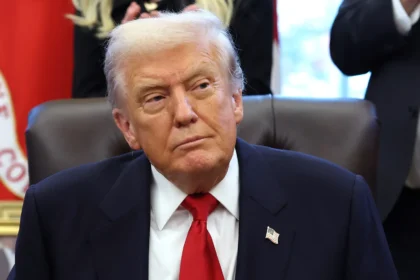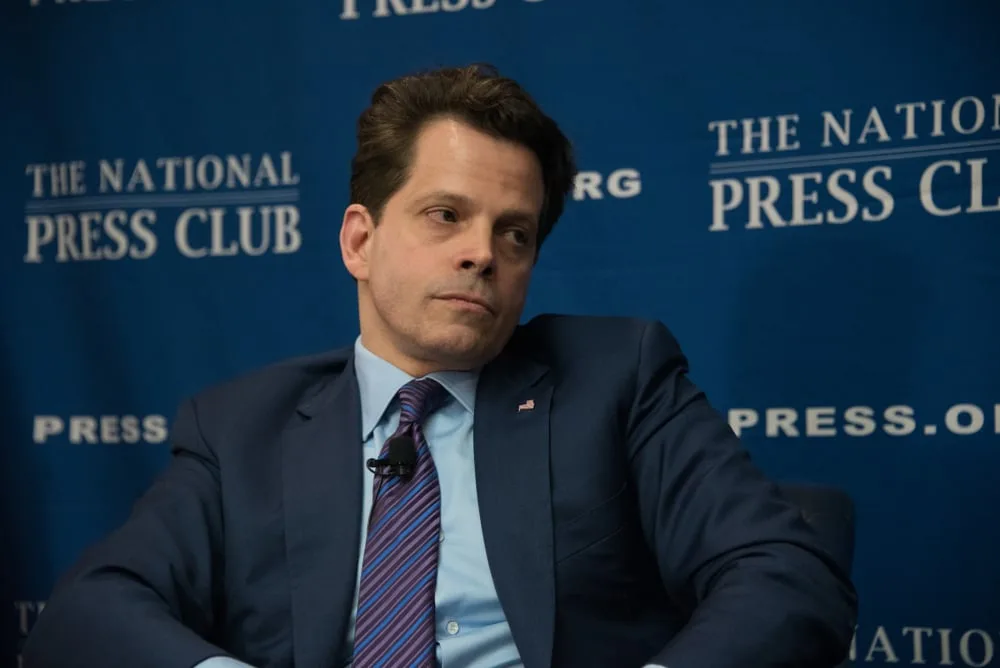

NEW YORK — Anthony Scaramucci, the former White House Communications Director and a prominent critic of Donald Trump, declared Friday that he would eschew legal prosecution of the former president if he held executive power.
In a statement released via X (formerly Twitter), the SkyBridge Capital founder argued that the pursuit of political rivals threatens the foundational stability of American democracy. Scaramucci emphasized that the United States must prioritize national “healing” over the “pendulum” of retaliatory litigation.
The Case for Restraint
While Scaramucci explicitly characterized Trump’s past actions as “illegal and reprehensible,” he maintained that institutional preservation outweighs the impulse for legal accountability. He warned that a cycle of “tit-for-tat” prosecutions would degrade the U.S. into a “banana republic,” where the transition of power is marked by the imprisonment of predecessors.
“You start locking up political opponents, you’re not fixing the country,” Scaramucci stated. “Leadership isn’t about revenge. It’s about restraint.”
Historical and Global Parallels
To bolster his argument, Scaramucci invoked the 1974 pardon of Richard Nixon by Gerald Ford. Though the decision was historically divisive and contributed to Ford’s eventual electoral defeat, Scaramucci noted its long-term recognition as a necessary step for national unity—a sentiment eventually acknowledged by longtime Ford critic Senator Ted Kennedy.
Scaramucci further cited the volatile political landscape in Brazil as a contemporary warning. He referenced the ongoing legal see-saw between Luiz Inácio Lula da Silva and Jair Bolsonaro to illustrate the dangers of a justice system entangled in partisan shifts.
A Strategic Pivot
The shift in rhetoric is significant coming from a figure whose relationship with Trump soured following a record-short 11-day tenure in the White House in 2017. Since his dismissal, Scaramucci has leveraged his background as a Goldman Sachs alumnus and hedge fund executive to become a vocal “Never-Trump” Republican.
His latest call for restraint suggests a strategic pivot toward centrist stability. By advocating for a “move on” approach, Scaramucci aligns himself with a growing cohort of political moderates who fear that prolonged legal battles involving former executives further fracture an already polarized electorate.
“As much as I find him despicable… let’s move on,” Scaramucci concluded, urging leaders to focus on the future of the republic rather than the grievances of the past.