
Treasury Secretary Scott Bessent confirmed this week that a high-stakes executive order requiring banks to verify the citizenship of all customers is officially “in process.” The move, which shifts the burden of immigration enforcement onto the private financial sector, marks the end of a decades-long standard where identity—not legal status—governed access to the American economy.
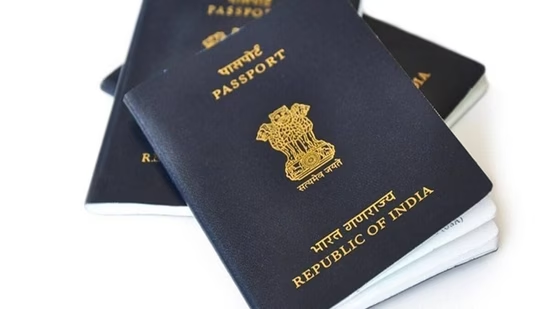
Bessent’s remarks on April 15 move the proposal from internal rumor to active policy development. While the administration frames the measure as a tool for “visibility and control,” industry experts warn it functions as a sweeping paperwork test for millions of Americans. Unlike existing “Know Your Customer” (KYC) rules that rely on driver’s licenses, the new mandate is expected to explicitly exclude REAL IDs—which prove lawful presence but not citizenship—requiring instead a U.S. passport, naturalization certificate, or birth certificate.
The Documentation Gap
The logistical hurdle for the American public is staggering. According to 2026 research from the Brennan Center for Justice, approximately 21.3 million voting-age citizens (9.1% of the population) do not have proof of citizenship readily available.
The burden is not distributed equally, revealing significant racial and gender disparities:
- Racial Inequity: Nearly 11% of Americans of color lack ready access to these documents, compared to 8% of white citizens.
- The Gender Barrier: As many as 69 million women have legal names that do not match their birth certificates due to marriage or divorce. Without a passport, these women may be forced to produce a “paper trail” of marriage licenses and affidavits simply to keep their bank accounts open.
Economic and Industry Toll
The American Action Forum estimates the mandate will trigger a bureaucratic avalanche, adding between 33.1 million and 73.3 million hours of paperwork. For the banking industry, compliance costs are projected to reach between $2.6 billion and $5.6 billion.
These costs are unlikely to be absorbed by institutions alone. Economists warn that banks will likely pass expenses to consumers through higher fees or by closing accounts that are “high-effort” to verify. Chasse Rehwinkel, president of Devon Bank, warned that the policy risks pushing millions into the “unbanked” population, forcing them to rely on predatory lenders.
A Fundamental Shift
Currently, U.S. banks take roughly three minutes to verify a new account under federal law. Under the proposed order, that process could balloon to over 40 minutes per customer. For the 3.8 million citizens who have lost their documents entirely to theft or disaster, the order could represent a permanent lockout from the U.S. financial system.