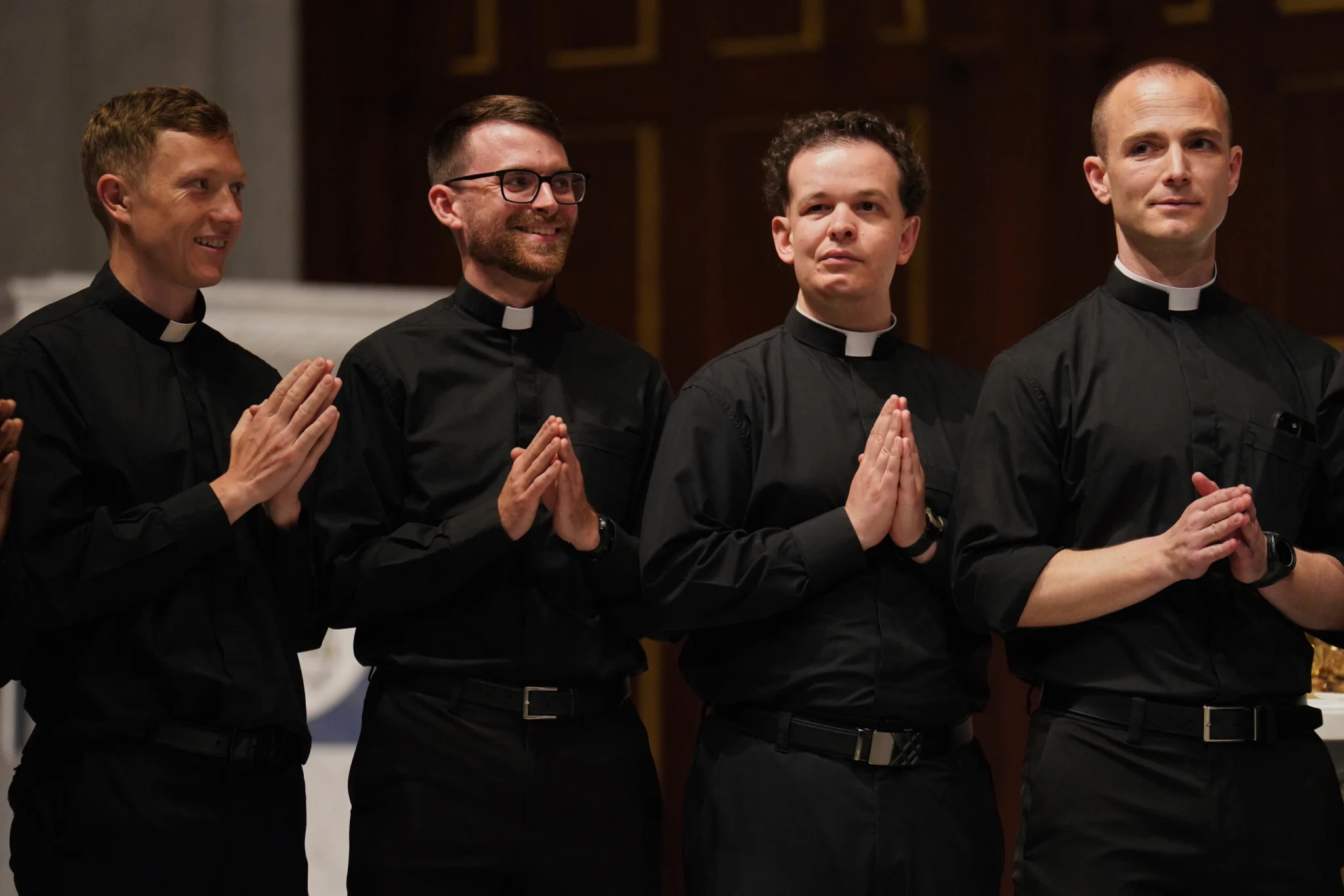

On the eve of their ordination, twelve men gathered beneath the gothic arches of the Cathedral of Saint Thomas More, rehearsing their steps for the most important moment of their lives — becoming Catholic priests.
It’s the largest group the Diocese of Arlington has ordained in nearly three decades, a powerful symbol of hope for a U.S. Catholic Church facing sharp declines in vocations and trust.
Nicknamed “the 12” by their bishop, the group’s size alone has become a kind of prayer — an embodiment of resilience in a Church still grappling with division, scandal, and dwindling numbers.
A Diverse Class Answering a Common Call
The ordinands range in age from 28 to 56. Among them are a former government attorney, a tech entrepreneur, engineers, and two future military chaplains. Most are American-born, while others trace their roots to Cameroon, Mexico, Peru, and Haiti.
Each left behind promising careers and personal ambitions in search of something more.
“I had the job I trained years to get,” said Rev. Alfredo Tuesta, a PhD engineer who worked at the U.S. Naval Research Lab. “But it wasn’t enough.”
Rev. Mike Sampson, 42, once a Protestant and government lawyer, converted to Catholicism in 2013 and entered seminary six years later.
“We’re laying our lives down,” he said, reflecting on the prostration ceremony, a symbolic gesture of surrender performed during ordination.
A Growing Diocese in a Shrinking Church
Nationally, the Catholic Church has lost more than 40% of its priests since 1970, but Arlington stands out. While other dioceses close parishes, Arlington is building new ones, fueled by young professionals working in the Washington, D.C. metro area and a growing Latino community.
This year’s ordination class is the second-largest in the diocese’s 50-year history.
“Some of the success is mysterious,” admitted Rev. Michael Isenberg, outgoing vocations director. But he credits dynamic parishes and strong leadership.
Sacrifice and Service
These men have already served as transitional deacons, performing baptisms and delivering homilies. Now, they’ll be assigned to parishes across Northern Virginia, where they’ll offer Mass, hear confessions, and minister to the sick.
For many, the hardest sacrifice was giving up the idea of having a family.
“I thought I’d be a great dad,” said Rev. Ricky Malebranche, a former high school counselor. “There’s a grieving process.”
Still, he finds joy in spiritual fatherhood — like baptizing a baby for a couple who had waited 20 years to become parents.
“I want to make Catholicism warm,” he said.
Called, Vetted, and Ready
The path to ordination is demanding. Prospective priests undergo rigorous screening, including psychological evaluations, interviews with laypeople, and meetings with abuse survivors. They ultimately answer to Bishop Michael Burbidge, who stays in regular contact with seminarians — a break from past norms.
“When I was in seminary, you didn’t even know your bishop,” Burbidge said. “Now, we know our men.”
Today’s young priests also tend to lean more conservative on theological and social issues than earlier generations, though many say their mission transcends political labels.
“People want truth and beauty,” said Burbidge. “These men are products of that desire.”
A Joyful Sendoff
On ordination day, the cathedral was packed. More than 1,200 people watched as the 12 men lay face down in prayer before the altar, then rose to be welcomed into the priesthood by nearly 200 fellow clergy.
“They gave up a lot,” said Malebranche’s father, Jacques. “But when they say they were called, they mean it.”
After the Mass, the new priests celebrated with family before heading off on short breaks: Sampson to Italy, Tuesta to Peru, and Banach to hike the Appalachian Trail with a travel-sized Eucharist kit.
A Sign of Hope
As they walked out of the cathedral in ivory and blue vestments, the cheers were deafening. They had committed their lives to the Church — and for many watching, their presence felt like the start of something new.
“They were sent out,” said one attendee, “just like the twelve apostles before them.”