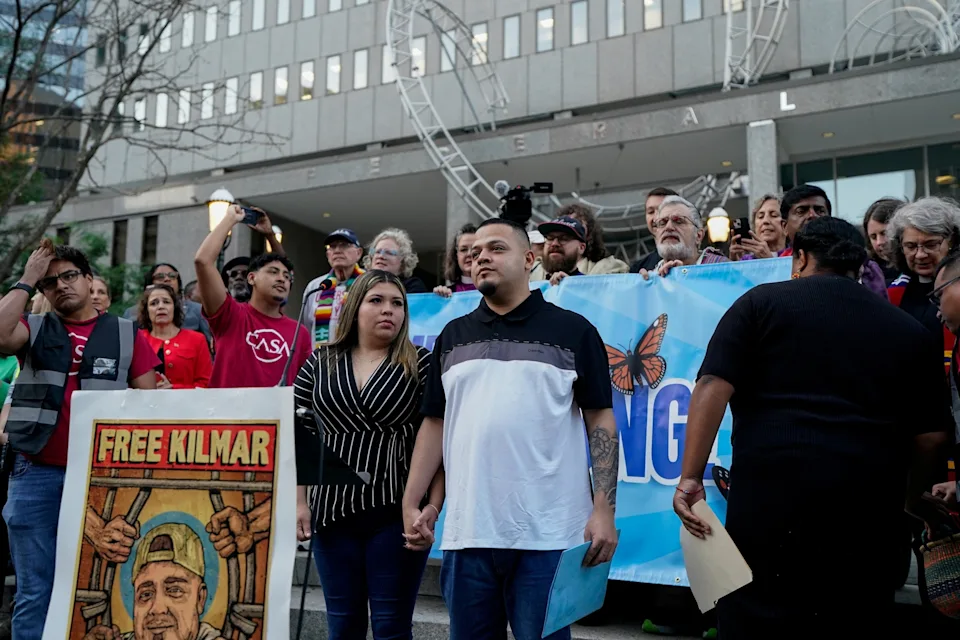

Kilmar Abrego Garcia, who was wrongly deported in March before being returned to the U.S. to face new criminal charges, was taken into immigration custody after checking in with Immigration and Customs Enforcement at its Baltimore office on Monday morning. He is now being held at a detention center in Virginia, where he faces potential deportation once again.
U.S. District Judge Paula Xinis, overseeing his deportation case, said during a habeas hearing Monday afternoon that the federal government is “absolutely forbidden” from deporting him for the time being.
“Your clients are absolutely forbidden at this juncture to remove Mr. Abrego Garcia from the continental United States,” Judge Xinis told government attorneys.
The federal government is blocked from deporting him through Wednesday, and Judge Xinis indicated she may extend a temporary restraining order preventing Abrego Garcia from being deported to Uganda, despite indications that the government might send him there instead of his designated country of choice, Costa Rica.
The judge also directed the government not to transfer Abrego Garcia from the Virginia detention center and to ensure he has access to legal counsel.
Abrego Garcia, who was released into his brother’s custody in Maryland on Friday from criminal detention in Tennessee while awaiting trial on human smuggling charges, was detained by ICE Monday morning upon arriving at the Baltimore office for a scheduled check-in, according to his attorney, Simon Sandoval-Moshenberg.
“We asked the ICE officer what the reason for his detention was, the ICE officer didn’t answer,” said Sandoval-Moshenberg, noting that officers also refused to disclose which detention center Abrego Garcia would be sent to.
His attorneys also stated that ICE would not commit to providing any paperwork served to their client during the detention.
A court filing from his lawyers noted that ICE informed them Abrego Garcia could be deported to Uganda after he rejected a plea deal that would have allowed him to plead guilty to human smuggling in exchange for deportation to Costa Rica. The filing accused the federal government of pressuring Abrego Garcia to accept a guilty plea or face deportation to East Africa.
Abrego Garcia, a Salvadoran native, was deported in March to El Salvador’s CECOT mega-prison, despite a 2019 court order barring his deportation there due to fears of persecution. The Trump administration had claimed he was affiliated with the MS-13 gang, which his family and attorneys deny.
He was brought back to the U.S. in June to face charges in Tennessee for allegedly transporting undocumented migrants while residing in Maryland. He has pleaded not guilty.
In July, Judge Xinis ordered that if released while awaiting trial, Abrego Garcia should remain under ICE supervision in Maryland, where he lived with his wife and children prior to his mistaken deportation. The order aimed to “provide the kind of effective relief to which a wrongfully removed alien is entitled upon return.”
Xinis also stated that if the government intends to deport him to a third country, it must provide 72 hours’ notice.
The Trump administration was allowed to initiate “lawful immigration proceedings” upon Abrego Garcia’s return to Maryland, which may include arrest, detention, and eventual removal, Judge Xinis said.
In their habeas petition filed Monday, Abrego Garcia’s lawyers claimed the government detained him without allowing him to be heard regarding his fears of persecution and torture if deported to Uganda.
“Respondents are seeking to remove Petitioner to Uganda — a process which they know will trigger lengthy legal proceedings — rather than Costa Rica — the country for removal designated by Petitioner that offered him resettlement — in order to punish him for his constitutionally protected activity,” the filing stated.
The attorneys allege the government is targeting Uganda instead of Costa Rica to pressure Abrego Garcia for “refusing to plead guilty in his criminal proceedings” in Tennessee.
The lawsuit, filed in the U.S. District Court for the District of Maryland shortly after his detention, seeks to prevent the government from holding Abrego Garcia more than 200 miles from the Baltimore courthouse. It also requests that the government attempt deportation to Costa Rica before considering Uganda and to allow Abrego Garcia a “reasonable fear” interview prior to any deportation to Uganda.