
Terry McCarty has a distinct memory from age 6 — one he still can’t confirm was real or a hallucination — that continues to shape his life.
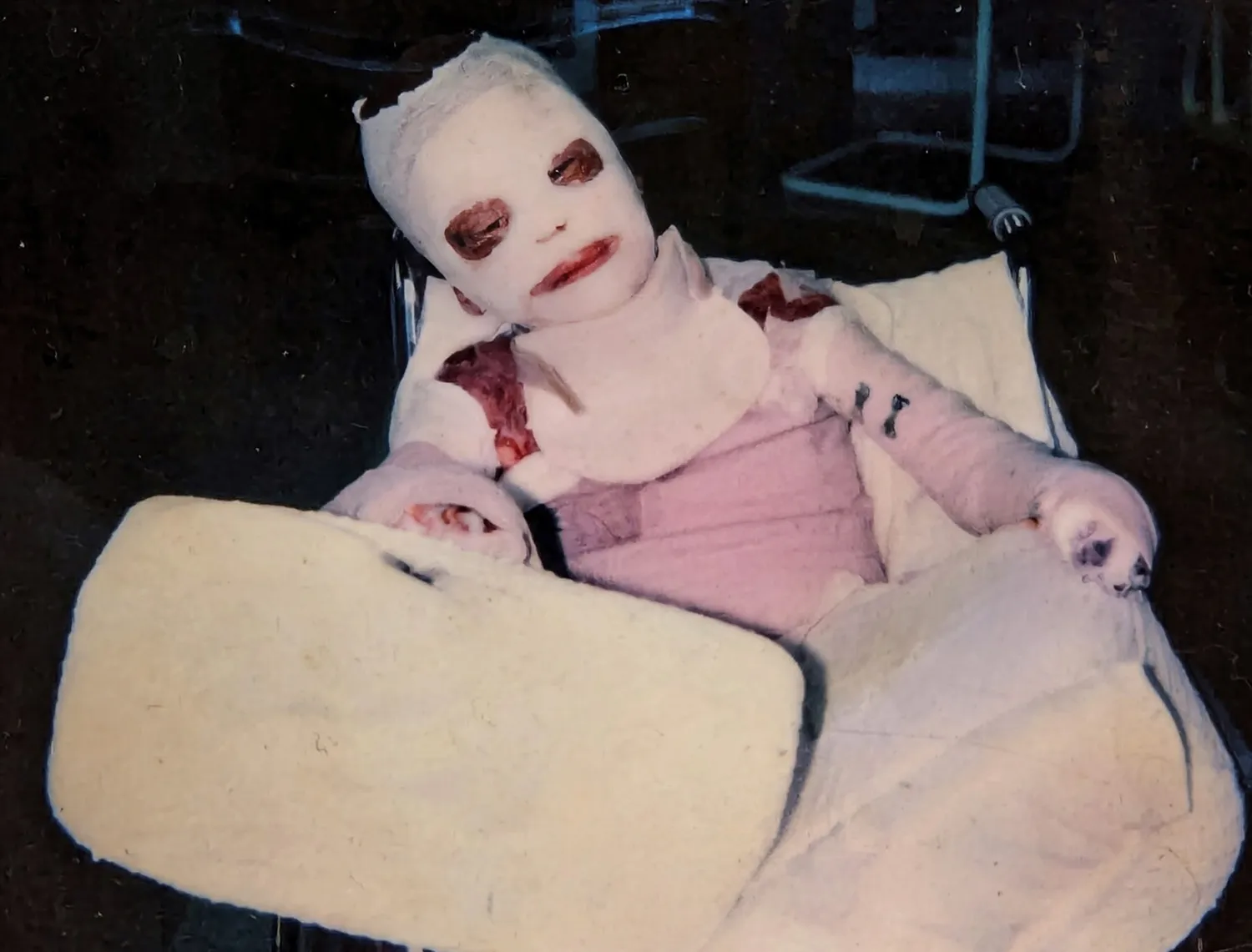
In 1992, a neighbor smothered a sleeping bag over McCarty’s head to extinguish flames that had engulfed him. The fire scorched 73% of his body and left lifelong scars. The bag didn’t save his skin, but it saved his life.
When the fabric dropped over him, he thought everything was over — the fire, his place in the Nevada neighborhood where he was growing up, his whole life.
He believed he was dead — “lights out and I guess good show folks,” the now-39-year-old recalls. On the other side of that darkness, he didn’t expect to find his father or his two older brothers. Ryan and Jason, then 10 and 12, had just watched their little brother catch fire — the unfathomable result of their experiment with kerosene.
They’d poured kerosene into a dog bowl and were trying to light it when McCarty came around the corner to bring them home. Fascinated, he watched quietly, unnoticed. Startled when the bowl ignited, one brother kicked it — and it struck Terry square in the chest.
:max_bytes(150000):strip_icc():focal(749x0:751x2):format(webp)/terry-mccarty-102425-6-b0200990afd6443a8b7dc9e70a8d3fe8.jpg)
“It wrapped around me like a wet blanket with all the flaming kerosene,” he says. It took a moment to realize what was happening — and that it was happening to him. “I thought everything around me was on fire. I didn’t realize I was the one on fire.”
Kerosene, he notes, behaves more like a gelatinous fuel. “It took a few seconds for the fire to burn through the kerosene layer and then get to my skin… That’s when the realization kicked in that something was very wrong.”
The pain and chaos were unforgettable, but a more recent recollection stands out: the sound. The fire was “deafening.” “Imagine you’re next to a bonfire, with the loud roaring you hear. Now, place yourself in the center of that.”
:max_bytes(150000):strip_icc():focal(749x0:751x2):format(webp)/terry-mccarty-102425-5-8263e33c12594c408d3ece8e0ab82413.jpg)
He panicked, then remembered school: stop, drop and roll. With kerosene, though, rolling isn’t very effective. He tried anyway — it was all he could do.
A neighbor sprinted over with a sleeping bag left in his car after a camping trip and tackled Terry, snuffing the flames. For a few seconds in the darkness, everything went quiet. “I thought, ‘Well, I must be dead now because everything is dark.’” Then his head peeked out. He saw the neighbor racing across the dirt lot toward the local fire station, pounding on doors and windows. A fire engine and ambulance peeled onto the street.
“Mentally, I’d given up. I thought I died,” he says. “When I saw the fire department coming out, part of my brain went, ‘Help is on the way. We’re OK.’”
That sentiment stuck. He held onto it during his hospital stay, through a medically induced coma, recovery, and waves of pain: a steady conviction that help was coming.
:max_bytes(150000):strip_icc():focal(749x0:751x2):format(webp)/terry-mccarty-102425-10-ade35f99d81548dcae3cb2f3eaba7a4f.jpg)
Shortly after the trucks rolled out, the pain slammed back — along with another sound: his father sprinting down the block, yelling like any parent would. His dad knelt beside him, big-lensed glasses reflecting a sight Terry will never forget. “He couldn’t touch me, but he was trying to piece together what was going on. I watched my face almost slide off in front of him — I could see it in his glasses.” That image was no hallucination.
The local hospital didn’t have the resources for his injuries. Doctors cut away his clothing and doused him in saline — so much that he remembers the sloshing on the floor — while a care flight prepped nearby. Two lucky breaks saved him: the neighbor with a sleeping bag and a ready medevac at the airport. He was flown to Las Vegas for intensive burn care.
“The fire isn’t the worst part of being a burn survivor. It’s what comes after,” he says. Debridement — scrubbing away dead, burned skin — began almost immediately. “I was laid on a strainer-style table, dipped in a solution, then pulled up and scrubbed,” he recalls. He endured that “a handful of times” to prevent infection. “My skin was so raw I could feel someone walk into my room. Just the disturbance in the air set me on fire all over again.” During that stretch, he flatlined about six times.
:max_bytes(150000):strip_icc():focal(749x0:751x2):format(webp)/terry-mccarty-102425-9-77ce60b4959e47dc83896528c4707eb6.jpg)
Two to three months later, Shriners Children’s stepped in, funding extensive care at its Galveston, Texas, burn center. There, he underwent major surgeries, including finger amputations. “Vegas was touch-and-go,” he says. “Galveston is where I started picking up the pieces.”
About a year after the accident — which happened a week before first grade — he returned to school, by then relocated with his family from Nevada to Washington State. Starting school in a different body was daunting. Administrators held an assembly to prepare students, which helped, but junior high proved tougher. “Why would someone call me Freddy Krueger if they knew what I’d been through?” he says. His teen years were consumed by figuring that out and learning to live in the moment.
Adulthood brought new hurdles. At 17, he lost his father to brain cancer. Employers saw him as a “victim,” and meaningful work was hard to find. He loved working on cars and, at 24, applied to an oil-change shop. The manager took one look and rejected him as a “liability.” Something flipped. “I was done with people shooting me down,” he says. He chose a new label: not victim, but survivor.
:max_bytes(150000):strip_icc():focal(749x0:751x2):format(webp)/terry-mccarty-102425-15-97f4a386aed044d286ec5a7f4a2c1df6.jpg)
He applied to be a volunteer firefighter. He passed the written test, then hit a wall at the medical clearance — an examiner dismissed him without testing. Terry challenged the doctor’s lack of burn expertise and walked out, heading straight to Central Kitsap Fire & Rescue to plead his case with the battalion chief.
Could he write his name? He demonstrated on the spot. Were his primary heat-loss areas (top of head, back of neck, underarms, groin, feet) severely damaged? They weren’t. The chief gave him a path: pass the Candidate Physical Agility Test (CPAT).
He trained, failed his first attempt, then failed again — the second time by four seconds after his sweatpants drawstring snapped mid-test. He returned with better gear and a sharper mindset, passed with one of the season’s fastest times, and started the 12-week fire academy.
He learned to suit up in under 60 seconds and adapted routines to his disability without losing speed. As class commander, he served as liaison between trainees and instructors. Live-fire exercises triggered a split-second freeze when he saw flames roll from the ceiling — a visual echo of the kerosene wave — but the moment the fire passed over his bunker gear, the fear broke. “I realized I had the tools. I didn’t have to be afraid,” he says. “It felt like that fire cleansed what was left.”
After serving as a volunteer firefighter, he eventually pivoted to nonprofit work supporting child burn survivors. He sometimes misses the job, but the academy and field experience became a catalyst for a broader mission. He now organizes motivational programs for firefighter groups and builds bridges between firefighters and burn survivors. “You see the worst of your community in that work,” he says. “I found a niche just outside the circle where I can still contribute.”
:max_bytes(150000):strip_icc():focal(749x0:751x2):format(webp)/terry-mccarty-102425-12-03141d474da6432d92c75faf58ce1f8b.jpg)
Despite his brothers’ role in the accident, their bond never broke. People often ask whether he “forgave” them. “There was no forgiveness needed. We were kids,” he says. “Curiosity outpaced understanding. Had they known, they wouldn’t have done it.” Today, the three live minutes apart and raise their kids alongside one another. “I took on the physical portion. They split the emotional and mental portion.”
Trauma, he’s learned, is fluid. Memories surface and shift. Years later, he returned to Hawthorne to find the spot where it all happened and the neighbor who saved him. At the firehouse, staff recognized him from an old photo on the wall, but his description of the scene — watching bay doors roll up and rescue vehicles roar out — didn’t match any obvious location. “So there’s this little thing inside my head: In that moment, was trauma showing me something that didn’t happen?”
:max_bytes(150000):strip_icc():focal(749x0:751x2):format(webp)/terry-mccarty-102425-11-713e4feb0f6f414f9849dd5873f0e00f.jpg)
And does it matter? If that image — real or imagined — carried him through the darkest weeks, perhaps it did its job. “There were so many times after when I couldn’t move or talk and everything hurt, but I held on to, ‘Everything’s going to be okay. You’re still here.’”
Maybe that memory is a superpower. The past 33 years of resilience are proof enough. He wonders: without that spark of hope, would his mind have held on the same way?