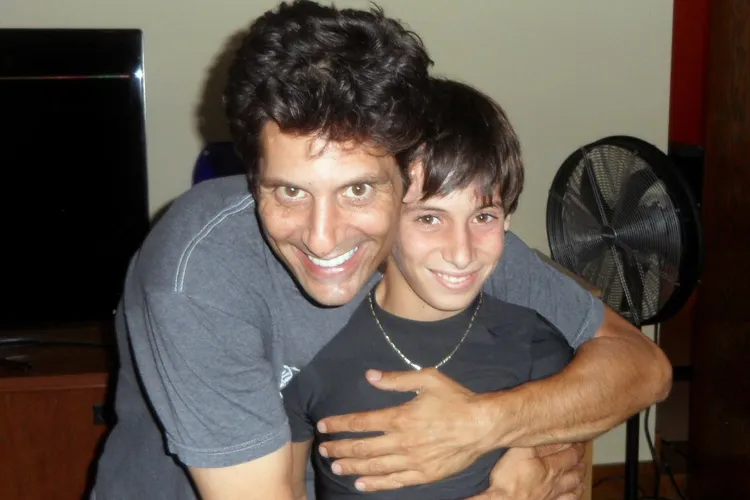

Phil Cohen has spent the last decade keeping the memory of his 14-year-old son, Perry, alive after his disappearance at sea—a loss that shattered him but ultimately led to a healing journey he now shares with millions online.
For Cohen, grief wasn’t just mourning—it became a means of transformation. Opening up about his experience on social media has not only helped him cope, but has also resonated deeply with others struggling through loss.
“It’s funny how your body remembers,” Cohen tells PEOPLE exclusively as the 10-year anniversary of Perry’s disappearance approaches. “You start to feel certain things… Even though I recognize them, you still feel them.”
:max_bytes(150000):strip_icc():focal(661x803:663x805):format(webp)/Perry-Cohen-PhilCohen-072225-e66941e94fc34928b01e394e37c06615.jpg)
“But at first, it absolutely destroyed me,” he says. “Just completely. I had no idea what to do. The only people I’d lost before were my grandparents. I didn’t know them well, so I didn’t really know grief. And then I lost the most precious person in the world.”
Perry and his friend, 14-year-old Austin Stephanos, left the Florida coast for a fishing trip on July 24, 2015. They were last seen departing from the Jib Yacht Club and Marina in Jupiter Inlet Colony. Later that day, they were reported missing.
:max_bytes(150000):strip_icc():focal(566x612:568x614):format(webp)/Perry-Cohen-2-072225-6715f6851eed4d828840601c5646b364.jpg)
A massive search effort followed—nearly 50,000 square nautical miles from Jupiter to North Carolina—making it one of the most extensive operations in U.S. Coast Guard history.
Eventually, their boat was found capsized off Bermuda. But the boys were never recovered.
Even today, Cohen says he doesn’t know “exactly what happened” out there. The lack of closure made grieving even more difficult.
“When things like this happen, your brain has to make some kind of story,” he reflects. “I didn’t know. Did he get hit in the head when the boat flipped over and just drown right there?… Did he float until he couldn’t anymore? Did he suffer? Did he get eaten by a shark?”
“For a parent to even think about their child in any of these scenarios is ridiculous.”
Two weeks after Perry’s disappearance, Cohen received what he believes was a spiritual sign—and a push from his older brother Rich.
Rich had suggested something unimaginable: “Let’s go in the ocean.”
Cohen remembers lying on the couch, consumed with grief. “There’s no way,” he said at the time. But then, something shifted.
“Immediately in my spirit, I just heard Perry be like, ‘Come on. Don’t be like that. Just stop,'” he recalls. “And then, so we did.”
That moment became a turning point, one he later shared on his platform “The Grief Guy”, where he speaks candidly about grief, healing, and emotional resilience. That video remains his most-viewed clip to date.
Submerging himself in the same ocean that took Perry offered unexpected relief.
“I actually felt better going through that… This whole grief thing, you can’t outrun it,” he says. “The monster gets smaller when you face it.”
He also discovered something else: silence. “People are so afraid to talk about it. You feel isolated. Literally, I lost friends and family.”
“I’ve had people say to me, ‘Phil, it’s too sad for me to be around you’,” he adds.
But Cohen turned that isolation into a lifeline for others. He built a digital community—offering guidance to those navigating loss, just as he learned to do.
“It’s been a long journey,” he says. “I believe that we’re always most powerfully positioned to serve the person that we once were. Everybody was somewhere… People just want hope.”
:max_bytes(150000):strip_icc():focal(699x461:701x463):format(webp)/Perry-Cohen-6-072225-14eef8f2a99e4009b51b65ff2e3cddbb.jpg)
Cohen credits mindfulness, resilience, and faith as the pillars of his recovery. But he says the most powerful comfort often comes in the form of subtle reminders that keep Perry’s spirit close.
One of the simplest but most meaningful gestures? Saying his name.
In a TikTok video that struck a chord with viewers, Cohen explains: “If someone you love is grieving, say their person’s name. Because I can tell you with 100% confidence and conviction—saying their name won’t break them. It’s you not saying it that’s breaking them.”
So Cohen does just that.
“If something comes up and I’ll mention Perry’s name, I do it for me. I don’t do it for anybody else,” he says. “Sometimes people get awkward, but now the people who know me and love me are cool with it. They’ll ask me about it.”
He keeps Perry’s memory alive through stories, memories, and moments that bring his son to mind.
“I talk to him all the time when I see things that remind me of him,” Cohen shares.
Baseball, especially, brings back some of the happiest memories—a sport Perry loved since he was a kid.
“A couple of years I was coaching the team,” Cohen recalls. “There was a park not too far from where I lived in Florida.”
“Bottom of the ninth inning,” he says, setting the scene. “We were down by two runs, playing against the rival team. It was one of those games where all the parents were standing on their feet.”
“Perry gets up to the plate… and smacks the home run. The whole place erupts. His whole team’s standing around home plate.”
But what Perry did next left an everlasting imprint on his father’s heart.
“Like ESPN, I expected Perry to jump into this pile of high-fives and cheers — but he didn’t. He ran past all of them and jumped into my arms,” Cohen says, his voice breaking. “And I remember thinking… ‘Oh, man.’”
Even now, 10 years later, Cohen says, “I can still feel that hug.”