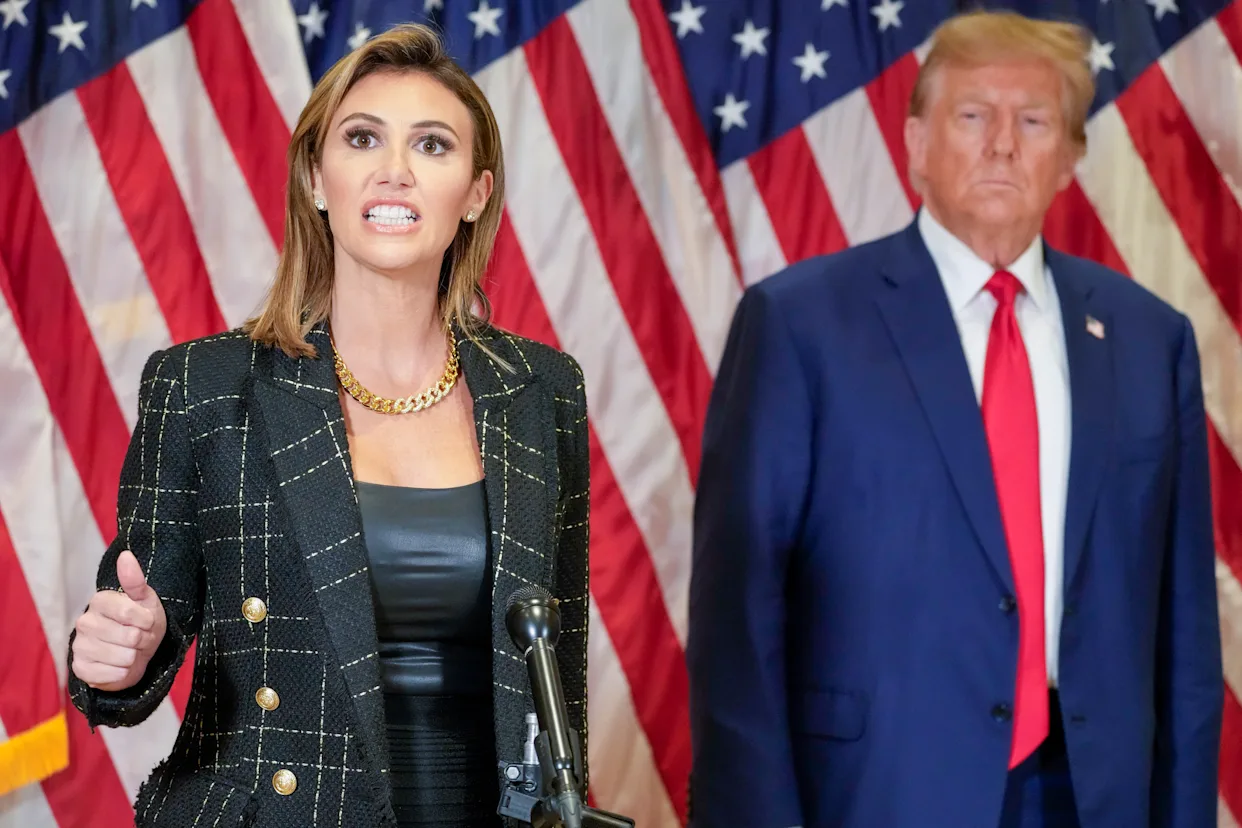

A federal judge has rejected President Donald Trump’s attempt to use a loophole to keep Alina Habba in her role as New Jersey’s top federal prosecutor.
In a 77-page ruling, U.S. District Judge Matthew Brann declared Thursday that Habba “is not lawfully holding the office of United States Attorney” and has lacked legal authority in the position since July 1.
As a result, Habba—who previously served as Trump’s personal attorney—cannot oversee the office that the president sought to maintain her control over after her 120-day interim appointment expired. The Trump administration attempted multiple maneuvers to keep Habba in charge after district judges removed her in July.
“Faced with the question of whether Ms. Habba is lawfully performing the functions and duties of the office of the United States Attorney for the District of New Jersey, I conclude that she is not,” Brann wrote.
Brann temporarily stayed his ruling, pending a potential appeal by the Trump administration. However, the decision could create significant complications across the executive branch. The judge noted that Habba’s actions in New Jersey over the past seven weeks “may be declared void” and that she must be disqualified from participating in any of the office’s cases as its leader. The office oversees thousands of criminal and civil cases at any given time.
The ruling, issued by Brann—a Republican appointed by Obama in Pennsylvania’s Middle District—could have broader implications for other U.S. attorney offices in Los Angeles, Nevada, New Mexico, and upstate New York, where the administration has bypassed both Senate confirmation and judicial appointments for selecting U.S. attorneys.
Attorney General Pam Bondi said the Justice Department would “immediately appeal.”
She added on social media that Habba “is doing incredible work in New Jersey — and we will protect her position from activist judicial attacks.”
A spokesperson for Habba did not immediately respond to requests for comment.
The ruling followed legal challenges from defense attorneys who argued that charges against their clients should be dismissed because Habba was illegally kept in office without Senate confirmation.
Although Brann declined to dismiss charges against defendants Julien Giraud and Cesar Pina, he noted that anyone prosecuting them “under the supervision or authority of Ms. Habba” could face disqualification.
Brann’s order formally applies only to the defendants in the case, but his opinion is written broadly to cover all of Habba’s actions in the office.
“I think it would be deeply irresponsible for the department to move forward with Alina Habba as the highest Justice Department official signing indictments or other pleadings,” said James Pearce, an attorney representing the Criminal Defense Lawyers of New Jersey.
Deputy Attorney General Todd Blanche, the No. 2 official at the Justice Department, has begun putting his name on some New Jersey office filings in recent days—an unusual step likely aimed at preventing challenges to the authority of prosecutions signed by Habba alone.
The ruling may also affect other federal agencies, said Anne Joseph O’Connell, a Stanford Law School professor specializing in appointment processes. She noted that modern agencies rely heavily on delegated authority when the Senate confirmation process is stalled, meaning aspects of Brann’s ruling could affect officials like the current FEMA director.
“If upheld on appeal, this ruling would upend common practice of acting officials under Democratic and Republican Administrations,” Joseph O’Connell said.
The ruling did not clarify who should lead the New Jersey U.S. Attorney’s Office.
In late July, assuming Habba’s interim term had expired around July 22, district court judges in New Jersey exercised a 160-year-old authority to appoint a temporary prosecutor. They selected Desiree Leigh Grace, a respected Republican career prosecutor, who was quickly fired by the Trump administration. Grace has since filed a grievance, calling her termination “completely unjustified and…direct retaliation for the District Court appointing me as U.S. Attorney.”
Trump officials, including Blanche and Bondi, had accused federal judges of overstepping, a claim Brann rejected.
The judge determined that Trump officials misinterpreted the length of Habba’s interim term and kept her in office three weeks longer than legally allowed. Initially, Bondi appointed John Giordano as interim U.S. attorney on March 3. Giordano left a few weeks later to become U.S. Ambassador to Namibia, and Habba succeeded him on March 28. Brann ruled that the 120-day interim limit did not reset when one interim appointee replaced another.
“Thus, Ms. Habba was not lawfully acting as the United States Attorney in any capacity from July 1, 2025 until at least July 24, 2025,” Brann wrote.
Following that date, leadership became unclear. Grace was appointed by the judges on July 22 and served until her termination on July 26. Normally, the first assistant attorney leads the office during a vacancy. Grace had previously held that position, which Habba had appointed her to.
Brann warned that stacking interim appointments could bypass Senate confirmation entirely. “Taken to the extreme, the President could use this method to staff the United States Attorney’s office with individuals of his personal choice for an entire term without seeking the Senate’s advice and consent,” he wrote.
The ruling also offers guidance for those aiming to check Trump’s executive actions.
“Congress is expected to speak clearly when it rebalances the separation of powers, and courts should be chary of Executive branch interpretations of structural enactments that result in greater arrogation of power to the President,” Brann wrote.
Habba had already drawn controversy in New Jersey prior to her appointment. She quietly settled a lawsuit with a 21-year-old former server at Trump National Golf Club in Bedminster who alleged sexual harassment by a supervisor. According to reports, Habba persuaded her to sign an illegal non-disclosure agreement in exchange for $15,000.
After Trump named her U.S. attorney, Habba told a right-wing podcast she could help “turn New Jersey red,” sparking concerns over partisanship. Critics say her early actions as U.S. attorney did little to quell those worries.
In May, Habba charged Newark Mayor Ras Baraka with trespassing at a private immigrant detention facility, even though he had been allowed inside and left voluntarily. Days later, she charged Democratic Rep. LaMonica McIver, a Baraka ally, with assaulting law enforcement during his arrest. At the same time, she dropped charges against Baraka, drawing criticism from a magistrate judge who suggested the arrests advanced political aims.
Prior to Brann’s ruling, Habba celebrated a New York appeals court decision tossing a half-billion-dollar civil fraud judgment against Trump, calling it a “resounding victory.”
Attorneys Gerry Krovatin and Abbe Lowell, representing Pina, emphasized the need for proper appointments.
“We challenged the authority of Alina Habba because her appointment ignored the rules that give legitimacy to the U.S. Attorney’s office,” they said. “We appreciate the thoroughness of the court’s opinion, and its decision underscores that this Administration cannot circumvent the congressionally mandated process for confirming U.S. Attorney appointments.”