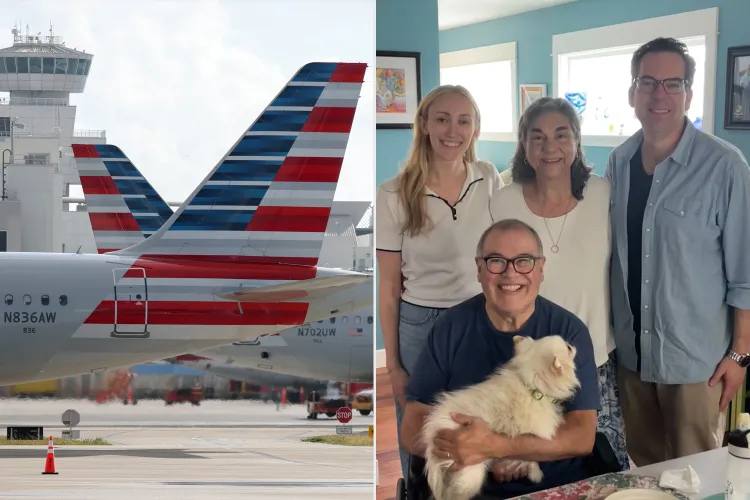

American Airlines has been ordered to pay $9.6 million after a federal jury in California found the airline failed to follow its own safety procedures when a passenger had a stroke shortly after takeoff. The San Jose jury reached its decision on Wednesday, Sept. 17, after a six-day trial.
Court evidence showed that Jesus Plasencia, from Watsonville, Calif., suffered a transient ischemic attack (TIA) while his plane was still parked at the gate at Miami International Airport on Nov. 8, 2021.
According to the Mayo Clinic, TIAs are short episodes of stroke-like symptoms caused by a brief blockage of blood flow to the brain. One in three people who have a TIA will later experience a full stroke.
The complaint said Plasencia’s wife, Marcela Tavantzis, noticed he was “speaking gibberish” and had temporarily lost motor control. She told flight attendants, but instead of calling medical staff, trained passengers, or the airline’s medical response team, the crew waited while the pilot checked the situation.
:max_bytes(150000):strip_icc():focal(749x0:751x2):format(webp)/miami-international-airport-630-090225-36478a7e465b4c2a89ea846a7f7dff6c.jpg)
Although Plasencia seemed to recover and didn’t realize what had happened, Tavantzis insisted something was wrong. Despite her concerns, the pilot decided to continue the flight, which lawyers argued went against company policy.
The plane then departed for Madrid, Spain. While flying over the Atlantic Ocean, Plasencia suffered a serious stroke. Lawyers for Tavantzis, who is also his legal guardian, said flight attendants did not alert the pilot right away and instead asked other passengers to keep an eye on him.
When the plane landed in Madrid, Plasencia was rushed to a hospital, where he remained in critical condition for more than three weeks. He was later flown back to the U.S. by air ambulance.
The complaint described his lasting injuries: “Today—nearly two years after the flight—Plasencia can neither speak, write, nor communicate effectively, much less walk, feed, bathe himself, clothe himself, or use the toilet without assistance. Plasencia depends entirely on daily, significant, around-the-clock, in-home care and intensive rehabilitation.”
:max_bytes(150000):strip_icc():focal(749x0:751x2):format(webp)/American-Airlines-Passenger-Paralyzed-133-091925-ba51fbbd235b4b498313ae6829484952.jpg)
Darren Nicholson of Burns Charest LLP, the lead lawyer for Plasencia and Tavantzis, told PEOPLE that “Mr. Plasencia didn’t get treatment in a timely manner and that is why he is in the condition that he’s in.” He said the family hopes this case raises awareness about recognizing stroke symptoms.
Nicholson highlighted the American Stroke Association’s campaign urging people to “Act F.A.S.T.” — an acronym to help spot the warning signs of a stroke: face, arm, speech, and time.
Attorney Hannah Crowe, who also represented the family, said the verdict will be “life changing.” She explained that Tavantzis wants to buy a wheelchair-accessible van and make home improvements to better care for her husband. “They’ll now be able to live the life of dignity that they deserve,” she said.
In a statement to PEOPLE, an American Airlines spokesperson said: “While we respect the jury’s decision, we disagree with the verdict and are currently evaluating next steps. The safety and well-being of our passengers is our highest priority.”