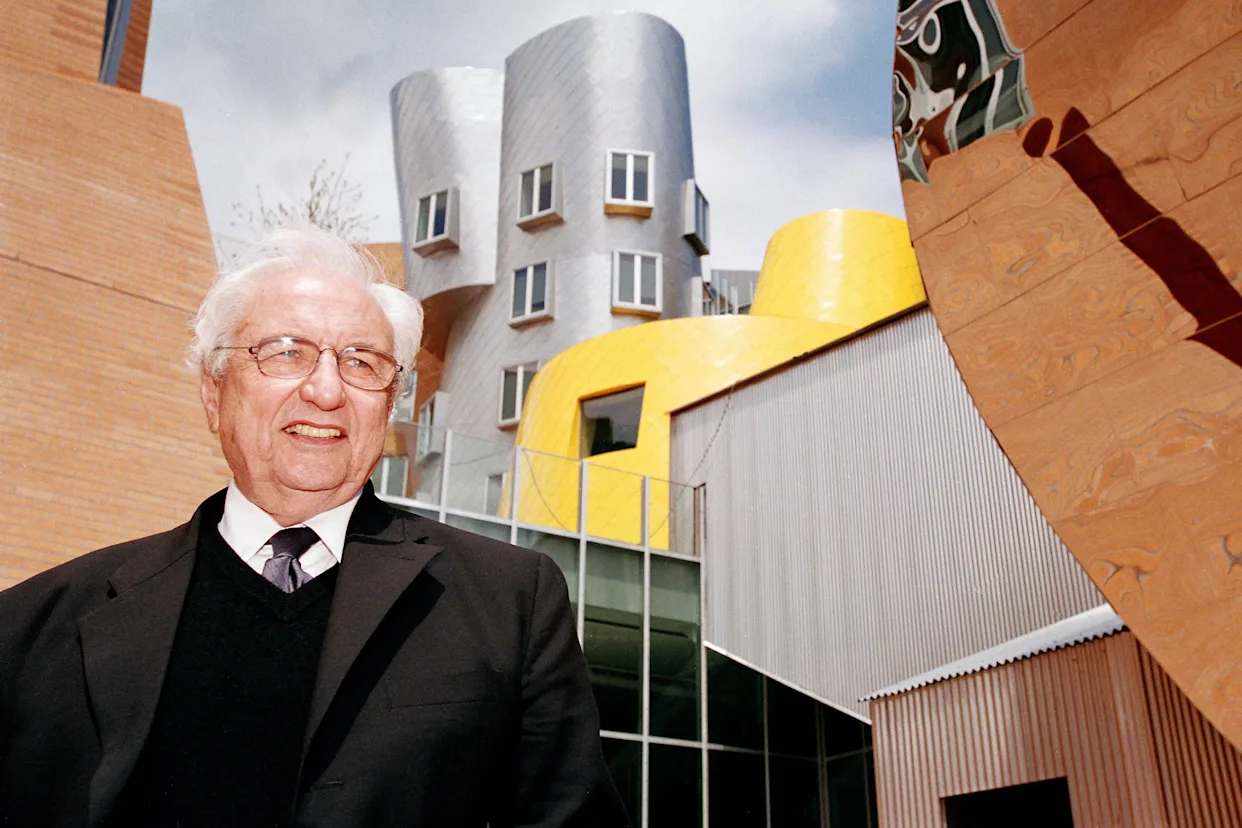

Architect Frank Gehry died on Friday at his home in Santa Monica, Calif., after a brief respiratory illness, the New York Times reports. He was 96.
Born in Canada and later based in the United States, Gehry was celebrated for bold, often gravity-defying designs that turned buildings into sculptural landmarks. In 2010, Vanity Fair hailed him as “the most important architect of our age.” His breakthrough came in 1978, when he radically reimagined his own Santa Monica residence using industrial materials like chain-link fencing and corrugated metal. From there, Gehry went on to design striking structures around the world that draw visitors as much for the architecture as for what’s inside.
Here are some of his most renowned works.

Gehry House (1978) – Santa Monica, California
Gehry’s personal home began as a modest Dutch colonial built in the 1920s. Rather than tear it down, he wrapped and expanded it with corrugated metal, chain link, glass and sharp, unconventional angles. The bold redesign upset some neighbors but soon attracted international attention, transforming the house into an architectural pilgrimage site. Gehry lived there for roughly four decades.

Vitra Design Museum (1989) – Weil am Rhein, Germany
The Vitra Design Museum, dedicated to modern and contemporary design, was Gehry’s first completed building in Europe. Constructed with white plaster and a titanium-zinc alloy, the museum’s interlocking geometric forms and sweeping curves are considered a landmark example of postmodern deconstructivist architecture.

Dancing House (1996) – Prague, Czech Republic
Designed in collaboration with architect Vlado Milunić, the Dancing House is a dynamic building on the banks of the Vltava River that houses a restaurant and gallery. Its curving, paired volumes are often interpreted as a dancing couple, a tribute to classic film partners Fred Astaire and Ginger Rogers.

Guggenheim Bilbao (1997) – Bilbao, Spain
One of Gehry’s most celebrated works, the Guggenheim Museum Bilbao helped transform the industrial city into a global cultural destination. Due to the building’s complex, flowing forms, advanced software was used to realize its design. The exterior combines thin, textured titanium panels with limestone and glass, creating a shimmering, ship-like structure that changes character with the light.

Peter B. Lewis Building (2002) – Cleveland, Ohio
Located at Case Western Reserve University, the Peter B. Lewis Building is home to the Weatherhead School of Management. Its sweeping stainless-steel forms and irregular volumes give the business school a futuristic, sculptural presence while enclosing classrooms, offices and collaborative spaces.

Walt Disney Concert Hall (2003) – Los Angeles, California
Funded in part by a $50 million gift from Lillian Disney in memory of Walt Disney, this downtown Los Angeles concert hall became one of the city’s most recognizable buildings. Gehry’s design uses billowing curves of stainless steel that resemble wind-filled sails or folded ribbons of metal. Inside, the hall is acclaimed for its warm acoustics and intimate seating layout.

IAC Building (2007) – New York City, New York
The IAC Building in Manhattan’s Chelsea neighborhood was Gehry’s first office building in New York City. Rising 10 stories, it features a glass facade composed of subtly twisting and stacked volumes, giving the impression of sails or blocks of ice. The structure serves as the headquarters for IAC (formerly InterActiveCorp).

Lou Ruvo Center for Brain Health (2010) – Las Vegas, Nevada
The Cleveland Clinic Lou Ruvo Center for Brain Health was created as a hub for the treatment and research of neurological diseases. Although Gehry had previously declined projects in Las Vegas, he agreed to this one after entrepreneur Larry Ruvo emphasized that the campus would support Huntington’s disease research, a cause important to Gehry. The building’s undulating stainless-steel exterior casts constantly shifting reflections as the light changes throughout the day.

Fondation Louis Vuitton (2014) – Paris, France
The Fondation Louis Vuitton, a contemporary art museum and cultural center in Paris, was designed to evoke the image of a glass “iceberg” wrapped in billowing sails. Its complex geometry required custom software developed by Gehry Technologies to model and construct the curved glass and supporting structures. Today it stands as one of Paris’s most distinctive modern landmarks.
Through these and many other works, Frank Gehry reshaped skylines and challenged conventional ideas of what buildings can be, leaving behind a legacy that will continue to influence architecture for generations.