For Operation Midnight Hammer, B-2 was airborne for 37 hours, but flying for long durations without a stopover may seem like a challenge, but the stealth bomber is like a flying hotel armed with bombs.
The United States once again demonstrated its air superiority with the deployment of the B-2 Spirit stealth bomber in a high-stakes mission targeting Iranian nuclear facilities. The operation, named “Midnight Hammer,” marked the largest B-2 strike in history and the second-longest mission ever flown by the aircraft since 2001.
Taking off from Whiteman Air Force Base in Missouri, the B-2s flew non-stop for 37 hours, refueling multiple times mid-air. Thanks to its stealth capabilities, the fleet penetrated Iranian airspace undetected and successfully hit key nuclear targets.
Operation Midnight Hammer: A Mission Like No Other
Seven B-2 Spirit bombers, each operated by two crew members, formed the main strike package. The aircraft flew east in radio silence, linking up with mid-air refueling tankers like the KC-135 and KC-46 across several checkpoints during the 18-hour inbound leg of the journey.
As they approached Iranian airspace, the bombers were joined by a support package coordinated through U.S. Central Command (CENTCOM). The operation relied on precise timing and minimal communication to maintain secrecy and coordination.
Just before the bombers entered Iranian airspace, a U.S. submarine launched over two dozen Tomahawk cruise missiles, targeting key surface infrastructure to disable Iran’s early warning and defense systems.
To further mask the bomber fleet, the U.S. Air Force deployed multiple deception tactics, including decoys and both fourth- and fifth-generation aircraft. These jets flew ahead of the bombers, clearing the way by engaging potential enemy aircraft and neutralizing surface-to-air missile threats.
The Strike: First Combat Use of the GBU-57 Bunker Buster
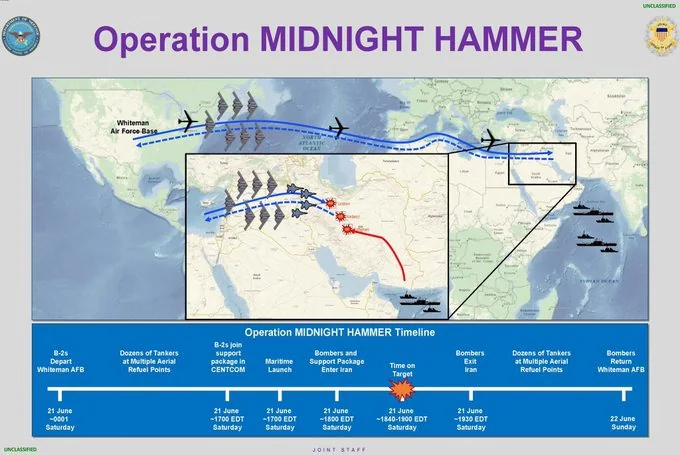
At 6:40 p.m. EST (2:10 a.m. Iran time), the lead B-2 dropped two GBU-57 Massive Ordnance Penetrator (MOP) bombs on the Fordow nuclear site—marking the first combat use of this advanced bunker-busting weapon. Over the next 25 minutes, a total of 14 MOPs were released across three Iranian nuclear targets, successfully striking critical infrastructure between 6:40 and 7:05 p.m. EST.
Inside the B-2: A Flying Fortress
Designed for long-range strategic missions, the B-2 Spirit offers more than just stealth. It’s built for endurance, equipped with bunks, microwave ovens, toilets, and a stash of snacks like sandwiches, candy bars, cereal, and milk to sustain the crew on missions that can stretch well beyond a full day.
Each B-2 typically carries two pilots, though long missions like Operation Midnight Hammer sometimes include a third crew member to rotate responsibilities and allow pilots to rest.
Legacy and Future of the Stealth Bomber
The B-2 first took flight in 1989 and entered active service in 1999 during the Kosovo War. Unlike earlier bombers like the B-1 Lancer or the B-52 Stratofortress, the B-2 revolutionized strategic bombing with radar-evading stealth and precision targeting.
Its most famous mission prior to this was in 2001, following the 9/11 attacks, when a B-2 flew a record 44-hour mission to strike targets in Afghanistan.
The B-2 is set to be succeeded by the B-21 Raider, developed by Northrop Grumman, and hailed as the world’s first true sixth-generation aircraft.