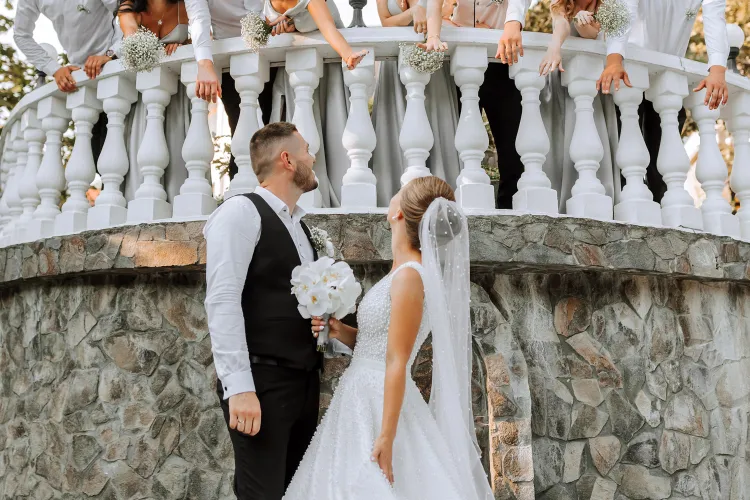

A bride-to-be says wedding planning has been smooth—until she and her fiancé hit a wall over the wedding party.
In a letter to Slate’s “Dear Prudence,” she explains that the couple had agreed on nearly every detail of their upcoming ceremony, but clashed when it came time to choose bridesmaids and groomsmen. The problem, she says, is that they share a tight-knit friend group that’s mostly men—and her fiancé wants all of those friends on his side as groomsmen.
She doesn’t mind having mostly male friends, she wrote, but she does mind being left with no one to stand with her. Unlike her fiancé, she says she doesn’t have a separate group of close girlfriends she can easily ask to be bridesmaids. When she pushed back, he suggested she reach out to old high school or university friends instead. But she says she hasn’t spoken to her high school friends in years, and most of her university friends are men she isn’t as close with.
What upset her most wasn’t just the logistics—it was his attitude. She describes him as usually thoughtful and considerate, so she felt surprised and hurt by what she experienced as a lack of empathy. Since then, she admits she’s avoided bringing it up again.
:max_bytes(150000):strip_icc():focal(728x413:730x415):format(webp)/wedding-party-friends-121925-02-ea899b6ecae74743b9d730216c63c04f.jpg)
Complicating things further, the person she hoped to ask as her “man of honor” is already slated to be one of her fiancé’s groomsmen, and her fiancé has a separate best man picked out.
Her proposed solutions are straightforward: either they share the friend group for the wedding party, or they skip having a wedding party entirely. But she worries about how a non-traditional approach will play with judgmental family members at an otherwise traditional wedding.
The advice columnist pointed out that wedding planning often reveals how couples handle conflict, compromise, and shared decision-making—skills that matter far beyond the ceremony. And while the fight may seem small on paper, the columnist suggested it’s not a great sign if both partners are focused on “winning” instead of supporting each other.
:max_bytes(150000):strip_icc():focal(703x284:705x286):format(webp)/wedding-party-friends-121925-03-b0cb8bab48a84d488a0eb2020f1ffb54.jpg)
The simplest fix, the columnist said, is to have a mixed-gender wedding party that stands up in support of both of them, rather than dividing friends into “his” and “hers.” As a practical guideline, the columnist also suggested a “first dibs” approach—whoever knew a friend first gets priority—but emphasized that the bigger issue is how the couple treats each other once the wedding is over.