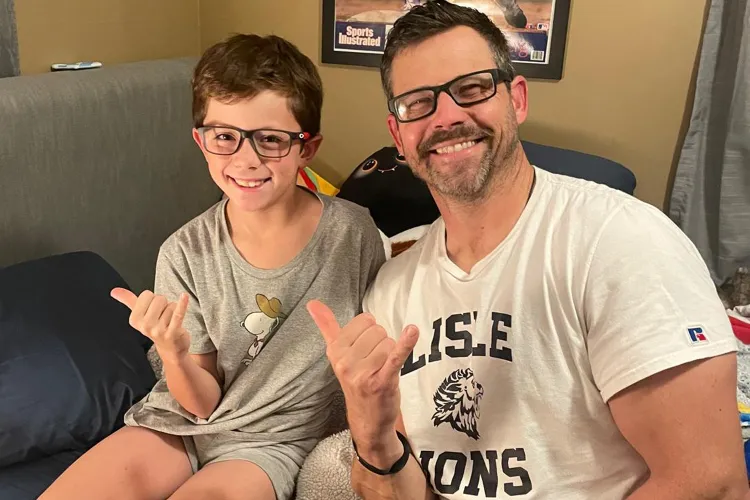

Dr. Nick Mondek credits his 9-year-old son with giving him a second chance at life this Christmas, after a fierce battle with deadly cancer.
In July, Stephen Mondek became the youngest-known stem cell donor at a Los Angeles children’s hospital, hoping his donation could save his father from fatal blood cancer. Nick had previously received a stem cell transplant from his older brother, but after two and a half years of remission, the acute myeloid leukemia returned.
“It’s just amazing,” Nick, a 48-year-old anesthesiologist from Los Angeles, tells PEOPLE about his son’s selfless act. “I got a second chance at a second chance just to still be here. Without the transplant, things would not be good right now.”
Nick, a father of two, began feeling “crummy” in the spring of 2022 before receiving the life-altering cancer diagnosis, which affects the blood-forming cells in the bone marrow. The news was devastating, he says, for him, wife Danielle Boyer, and their sons Stephen, now 10, and John, 6.
:max_bytes(150000):strip_icc():focal(999x0:1001x2):format(webp)/nick-stephen-mondek2-92225-39cf5db9c3894acb86be360d84f2b34b.jpg)
Nick’s brother Dave’s earlier donation had helped him recover, forming a kind of “army” inside his body to keep the cancer at bay. Yet, he remained anxious.
“I had a feeling it would come back. I just didn’t know when,” Nick recalls. “It’s a very aggressive disease, and I had a few mutations that make it even harder to treat and more prone to relapse.”
In 2025, after more than two years, the leukemia returned aggressively.
“We followed every clinical protocol, but the disease still managed to come back, so we had a new problem on our hands,” said Ronald Paquette, MD, clinical director of the Stem Cell and Bone Marrow Transplant Program at Cedars-Sinai Cancer. “How could we treat his cancer a second time and have a better chance that it doesn’t return?”
Nick’s team struggled to find another donor match. Stem cells from his two older brothers were no longer viable, and the National Bone Marrow Registry and other family members could not help.
The anesthesiologist vividly recalls the moment the severity of his situation sank in while waiting for a doctor. “I’m not ready to leave them yet,” he thought about his children.
Inspired by a friend whose 18-year-old son donated stem cells for lymphoma treatment, Nick asked his doctor whether a child could donate. When he learned Stephen could be a potential match, he discussed it carefully with his family.
:max_bytes(150000):strip_icc():focal(599x0:601x2):format(webp)/nick-stephen-mondek4-92225-4c9165c071fd4932b66b197693c3550a.jpg)
“I didn’t want him to feel obligated or pressured,” Nick says. “I didn’t even tell him he was basically our last option. I just said, ‘We’re wondering if you would like to be tested to see if you want to be a potential donor.’”
Stephen didn’t hesitate. “Yeah, let’s do it,” he said.
After confirming the 9-year-old was a match, Cedars-Sinai Guerin Children’s Pediatrics ensured Stephen fully understood the process. He underwent several weeks of “pre-donation prep.”
For the donation, Stephen was placed under general anesthesia while doctors inserted a catheter into a vein in his neck. His blood circulated through a centrifuge to extract the stem cells, and he was in the Intensive Care Unit for six hours.
“That hour while he was asleep was probably one of the toughest periods of my life,” Nick says. “You just start to question everything. Am I doing the right thing?”
Fortunately, Stephen’s procedure went smoothly, and he returned home the same night. Nick then spent six days undergoing chemotherapy to prepare for the transplant, followed by receiving his son’s stem cells.
:max_bytes(150000):strip_icc():focal(999x0:1001x2):format(webp)/nick-stephen-mondek5-92225-68d2623e8a0b4c3f9d8fad0ed199565d.jpg)
“Transplant day is always dramatic,” Paquette explains. “The patient knows they cannot survive without the stem cells, and the delivery of the stem cells into their body is like a rebirth. We call that day their stem cell birthday.”
Nick stayed in the hospital for two weeks as his immune system recovered. By Aug. 16, he was discharged and attended Stephen’s Little League game, filled with awe for his son’s courage.
“I just hope he knows what his actions can do in life, just helping another person,” he says. “It’s an amazing feeling.”
Stephen felt proud too. “I felt good helping my dad,” he said. “It felt good to have him home.”
According to Paquette, it may take over a year to see if Nick’s new immune system can fend off the leukemia. Still, the Mondeks are optimistic.
“I’m just glad that I still get to be around and watch them grow up,” Nick says. He looks forward to simple joys like watching the Cubs play at Chicago’s Wrigley Field with his sons.
“I’m a simple guy. I don’t need to climb [Mount] Kilimanjaro or swim the English Channel to celebrate,” he says. “I just want to be with my family and enjoy whatever time I have.”