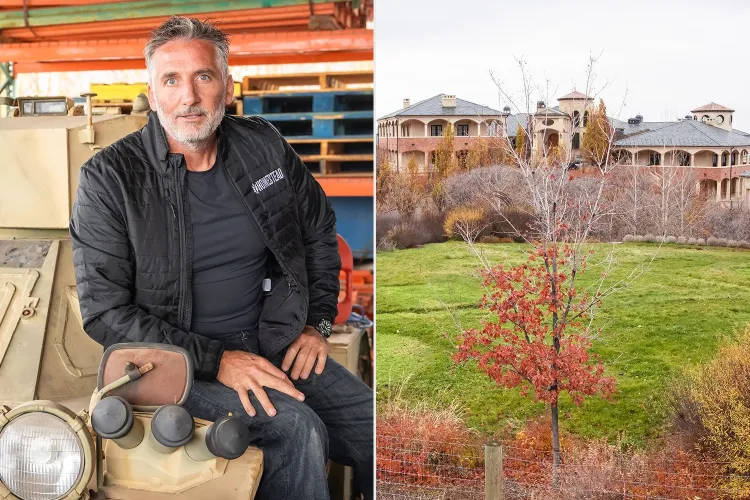

On a recent rainy afternoon in the hills above Bountiful, Utah, multimillionaire Jayson Orvis trudged through the mud on his sprawling 300-acre refuge — a self-sustaining compound he’s built as a sanctuary for himself, his family and roughly 200 close friends in case modern civilization ever collapses.
For the first time, Orvis invited a small group of journalists to tour the property, which doubles as a filming location for Homestead: The Series, a show he created that streams through the Angel app.
The estate, where Orvis lives with his wife and three of their seven children, is outfitted for long-term survival. There’s an armory stocked with enough high-powered firearms to outfit a small private force, a machine shop, greenhouses, a butchery and a vast storeroom packed with everything from medical reference books and portable radios to leather-working tools.
After stopping at each of these outposts, the 56-year-old led visitors into what he calls his “food forest,” a pesticide-free, fertilizer-free landscape that produces a huge variety of fruits and vegetables.
“We have more asparagus and raspberries than we can pick,” Orvis said as he handed one guest a few tart chokecherries he’d just plucked near his lumber mill. “We don’t have cattle, but we have wild deer, turkey, elk, goats, rabbits and chickens — natural meat that lives a full life and then we harvest it.”
:max_bytes(150000):strip_icc():focal(749x0:751x2):format(webp)/doomsday-compound-utah-2-112525-5a963130e85646759791563db25815e7.jpg)
An entrepreneur who built his fortune when his credit repair company was acquired by a private equity fund about 15 years ago, Orvis has nearly everything a prepper might dream of — with one notable exception. He doesn’t have the massive blast-proof underground bunker that some billionaires, including Mark Zuckerberg, are said to be building as elite interest in doomsday planning becomes more mainstream.
Orvis is deeply invested in the idea of surviving catastrophe, but he wants to push back against the stereotype of survivalism as grim and antisocial. That’s part of why he opened his gates for this rare visit: to explain how he envisions preparedness as something more hopeful and community-driven.
He co-wrote the post-apocalyptic Black Autumn book series, which inspired the feature film Homestead and now the television series of the same name. But for Orvis, the traditional image of a buried bunker misses the point.
:max_bytes(150000):strip_icc():focal(749x0:751x2):format(webp)/doomsday-compound-utah-4-112525-509f3832af5b41e5a243e1d29b66f189.jpg)
“It’s like a weird prepper idea from the Cold War,” he said. “If you’re going to be right at ground zero [it might make sense] — but up here, you don’t need to bury yourself in the ground. And even if you did, what are you gonna have once you emerge from the ground?”
For him, the answer is straightforward.
If society disintegrates, Orvis plans for his community — family, friends, medical professionals, master gardeners, beekeepers, Navy SEALs and even several Afghan refugee commandos — to retreat behind the security of the compound. There they’d lean on a stockpile that includes 110,000 pounds of grain, a freshwater well and an extensive solar power system while they continue to produce food from the land.
“We’ll be super well defended and we’ll also do the best we can to share and to help our neighbors along,” he said, estimating that the group could live “indefinitely” on their supplies combined with what they raise and grow.
Beyond stockpiling, Orvis has made it a mission to “redefine what preparedness means.”
That theme runs through the stories he writes with co-author Jeff Kirkham, a former Green Beret who served multiple tours in Afghanistan and Iraq. (Orvis publishes under the pen name Jason Ross.)
“One would think that it’s every man for themselves, kill or be killed [when society collapses],” Orvis said. “Jeff told me that after having seen what happened in places like Haiti, Iraq and Afghanistan, it isn’t the people with the belt-fed machine guns who survive. It’s the people who bind together and form powerful, strong communities.”
In the world of Homestead and Black Autumn, survivors band together in a fortified mountain refuge after a nuclear strike destroys Los Angeles.
In real life, Orvis spends four to five hours each morning writing before turning his attention to the property, where he works alongside his younger brother, Bob. His fixation on preparedness goes back decades, to his childhood in Anaheim, California.
:max_bytes(150000):strip_icc():focal(749x0:751x2):format(webp)/doomsday-compound-utah-7-112525-3c79048cad2c4c09934639fc2fa356ee.jpg)
“My dad was a firefighter turned metal fabricator and a prepper,” he said, noting that he published his first article in a prepper journal at age 15.
“I grew up with chickens, bees, rabbits and gardens in the backyard, so preparedness has always been kind of a hobby,” he added.
After selling his business in 2010, Orvis shifted his focus to philanthropic projects and soon felt “called to help” former special forces soldiers. Using his expertise in social marketing, he helped them launch ventures like Black Rifle Coffee and the self-reliance retail site Readyman.
That work led him to Kirkham, and the two began developing their faith-based post-apocalyptic series. The project has grown into nine books, which Orvis says let them tell stories of “high peril and high hope.”
By that time, Orvis had already begun turning his vast property into what he calls a “paradise for the point of no return.”
“We had a garden and food storage, but we didn’t have goats, rabbits, chickens and all this,” recalled his wife, Pamela, 56. “So Jayson started digging into it. Before long, everything just snowballed and we took it to the next level.”
Their oldest daughter, Alex, isn’t surprised by how far things have gone. The estate now includes multiple food storage buildings, vineyards and a trout pond — and she’s watched it all grow over the years.
“He makes everything seem like a good idea,” the 31-year-old said. “It’s also pretty standard in our family for things to get carried away and become big things.”
So what happens if the apocalypse never comes and civilization keeps chugging along for centuries more?
As it turns out, Orvis isn’t actually convinced the end is imminent.
“I’m pretty damn sure the world isn’t going to collapse,” he said. “It is possible, but I think the odds are probably sub-2 or 1% in my lifetime.”
He paused, taking in the sweeping view of his meticulously built safe haven, before finishing the thought.
“But learning how to ranch and grow things, doing all this together with our kids, it’s been fantastic,” he said. “I don’t regret any of this in the slightest.”