
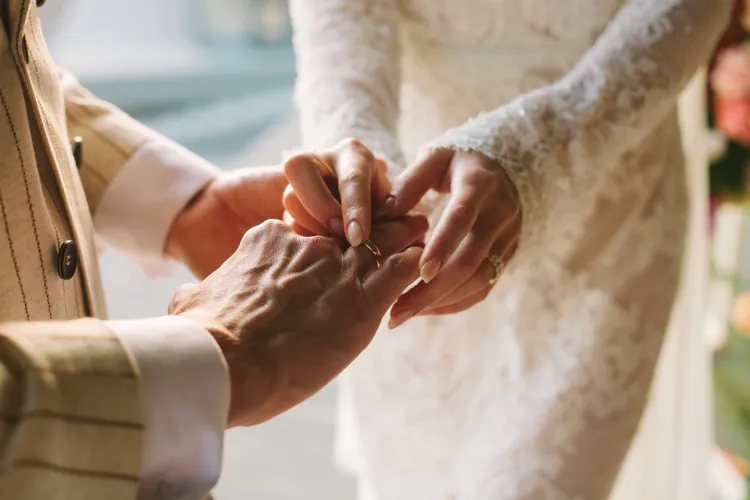

A Toronto couple reimagined the traditional wedding format by centering their celebration around the sensory world they live in every day as deaf people.
Amanda Watson, 35, an elementary school teacher, met Bradley Whitmore, 38, when he arrived as a substitute at her school for Deaf and hard-of-hearing students. Both deaf, they connected quickly, dated for several months, and became engaged in late 2023, per Toronto Life.
Watson said a big part of their early relationship was shaped by conversations about how they moved through environments not designed with them in mind. “…There was something easy about being with someone who understood the rhythms of Deaf life without explanation,” she told the outlet.
From the start, the couple knew they didn’t want a ceremony that asked them to “translate” their experience into a hearing-first template. So for their June 2025 wedding, they chose a silent ceremony—one built around light, movement, vibration, and touch instead of microphones, DJs, or speeches.
“For both of us, silence isn’t unusual. It’s our everyday — but Deaf silence is not quite the way hearing people imagine,” Watson said. “It’s full of movement, vibration and expression. When we started talking about our wedding, we realized we didn’t want to translate ourselves for a hearing format — no microphones, no DJs, no speeches.”
:max_bytes(150000):strip_icc():focal(999x0:1001x2):format(webp)/married-couple-012326-2-db7b22b5d17a40b4a4bf654698b4be4f.jpg)
They held the wedding at the Warehouse Event Venue in Toronto, transforming the space into an immersive, tactile experience that replaced music with carefully designed sensory cues.
“Everything fell into place when we found the Warehouse Event Venue. The space was great—concrete floor, high ceilings, lots of blank walls, perfect for vibration and light,” Whitmore told Toronto Life. “We mapped the room like a classroom layout: welcome area, ceremony circle, tactile reception zone. Everything was intentional.”
Watson leaned on her teaching background to help design elements that guests could physically experience. “I stole a few tricks from my own classroom,” she said, describing gloves that lit up when clapped, centerpieces that pulsed with LED “breath” patterns, and soft projection panels used during their vows.
During the ceremony, the couple used light sensors on the floor along with low vibration patterns beneath their feet as they signed their vows. Later, on the dance floor, they stood on vibration plates to create a shared rhythm—and they built what they called a “listening wall” of vibrating sculptures for guests to explore, per Toronto Life.
One of Whitmore’s favorite moments came during the toast, which replaced the usual glass-clinking with something more playful and sensory.
“My favourite moment was the toast,” he said. “Instead of clinking glasses, we handed out cups filled with sparkling water and tiny edible bubbles that popped lightly on the tongue, like a playful sensory version of champagne. When everyone raised them, the rims lit up with micro-LEDs.”
By the end of the night, the couple felt they had achieved what they set out to do: create a celebration that didn’t just accommodate their world—but expressed it fully.
“We always said we wanted a wedding you could feel. We didn’t realize how deeply it would resonate with everyone else. Deaf or hearing, people walked away understanding us better. That’s the gift we didn’t expect,” Whitmore added.


