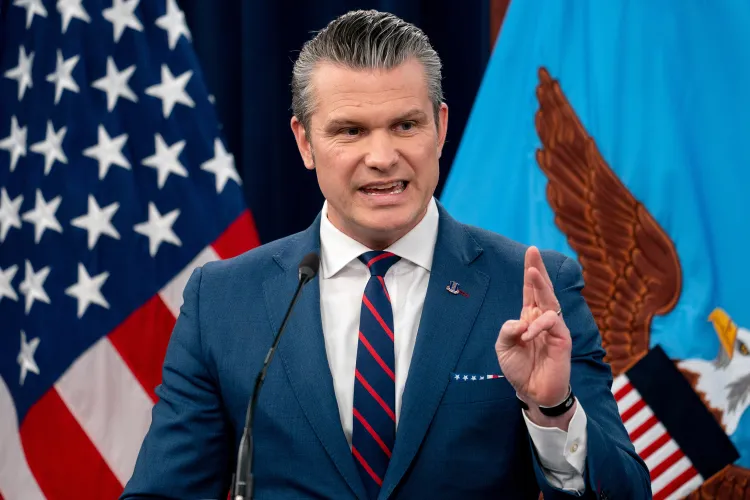

Defense Secretary Pete Hegseth is aggressively integrating conservative evangelicalism into the Department of Defense, sparking intense debate over the secular mission of the U.S. military as the nation navigates a high-stakes war with Iran.
Since taking office, Hegseth has shifted the Pentagon’s cultural landscape, hosting monthly worship services and incorporating Bible verses into official promotional materials. However, his rhetoric has gained new urgency following the outbreak of hostilities between the U.S., Israel, and Iran’s Islamic theocracy.
Critics point to Hegseth’s history of “crusader” imagery as a potential flashpoint. The Defense Secretary sports tattoos of the Jerusalem Cross and the phrase “Deus Vult” (God wills it)—a historical rallying cry for medieval Christian knights.
During a recent briefing on Iran, Hegseth referred to Iranian leaders as “mullahs” and recited Psalm 144, which describes God training “my hands for war.”
“The U.S. voluntarily going to war against a Muslim country under Pete Hegseth is exactly the scenario we warned about,” said Matthew D. Taylor, a scholar at Georgetown University. Taylor argues such rhetoric reinforces the Iranian regime’s narrative of a “holy war,” potentially escalating regional animosity.
Beyond rhetoric, Hegseth is leveraging his office to enact sweeping policy changes aligned with his worldview:
- Personnel Shifts: Banning transgender service members and reviewing the roles of women in combat.
- DEI Rolling Back: Curtailing diversity and inclusion initiatives.
- Chaplaincy Reform: Scrapping the 2025 Army Spiritual Fitness Guide to prioritize religious focus over “secular humanism.”
Hegseth’s ties to the Communion of Reformed Evangelical Churches (CREC) have also drawn scrutiny. The denomination’s co-founder, Doug Wilson—an avowed Christian nationalist—recently preached at the Pentagon at Hegseth’s invitation. Both men have publicly questioned Muslim immigration, with Hegseth citing “growing Muslim birth rates” as a concern for Western civilization.
The intersection of faith and fire has fueled viral, albeit unverified, claims. Mikey Weinstein of the Military Religious Freedom Foundation alleged that commanders are telling troops the Iran conflict fulfills biblical prophecies of Armageddon.
While 30 Democratic members of Congress requested an Inspector General investigation into these claims, major watchdog groups, including the Anti-Defamation League, report they have received no such complaints. The Pentagon has declined to comment on the allegations.
For many within the ranks, the shift is unsettling. “The U.S. military reflects the full diversity of this country,” said retired Rabbi Laurence Bazer, a former Army chaplain. “When leadership draws exclusively from one faith, it risks making service members feel like outsiders.”
Hegseth remains firm, recently telling CBS that while the U.S. fights “religious fanatics” in Iran, he will continue to encourage American troops to “rely on God.”