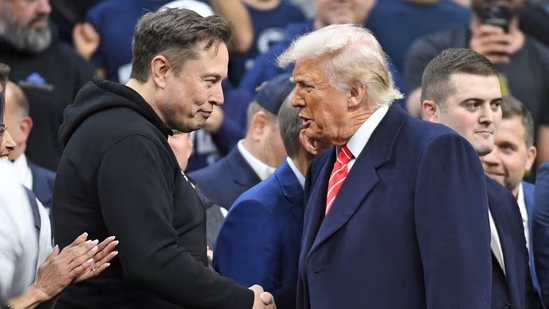

Once allies, Donald Trump and Elon Musk are now trading jabs as their political paths sharply diverge. Musk’s announcement that he’s launching his own “America Party” — and withdrawing support from the GOP — signals more than just a billionaire’s whim. It’s also an early warning that Trump’s once-solid coalition may be starting to fracture.
With his immense wealth and unmatched media reach, Musk has the power to shake up the political landscape. But can a top-down movement led by one of the world’s most erratic billionaires make a real dent in American politics? To find out, CNN spoke with John Kenneth White, professor emeritus of politics at Catholic University and an expert on American political parties.
Musk’s Money Makes Him a Threat
White says Musk’s move highlights a growing trend in U.S. politics: the influence of wealthy individuals who can create their own political machines. “Musk is no longer just withholding donations from Republicans — he’s trying to punish the party by creating an alternative,” White explained. “At a minimum, he could impact elections by tipping close races.”
This approach echoes the legacy of Ross Perot, the billionaire businessman who ran for president in the 1990s and drew widespread support by slamming both parties, particularly over government spending. “Like Perot, Musk is capitalizing on widespread dissatisfaction with both parties — a feeling that’s only intensified since the Tea Party era,” said White.
But Musk faces major hurdles. Unlike successful third-party efforts that began as grassroots movements, Musk’s is purely top-down. That’s a tough sell in a system designed to reinforce the two-party structure.
Trump’s Grip Is Strong — But Not Unbreakable
Donald Trump still dominates the Republican Party with an iron grip. He’s purged dissenters and marginalized moderates, creating a political culture where few in the GOP dare to oppose him. But cracks are starting to show.
“Musk is trying to siphon off part of Trump’s coalition, especially business-minded conservatives who oppose tariffs and hardline immigration policies,” White noted. “Some of Trump’s recent moves — like mass deportations without due process — are creating unease among Latino voters and business leaders alike.”
Historical parallels abound. White compares Trump to Grover Cleveland, whose fractured coalition ultimately weakened his presidency. Cleveland’s unpopular economic policies split his base, much like Trump’s agenda may now be alienating parts of his own.
The Danger of Musk: Not Victory, But Disruption
Despite the headlines, White says Musk is unlikely to build a viable third party in the traditional sense. “He’s not going to win elections,” White said. “But he doesn’t have to. He just needs to play spoiler in a few key races — Senate contests in battleground states, for example — to shift the balance of power.”
With razor-thin margins in both chambers of Congress, even a handful of races flooded with Musk money could tip control away from Republicans.
This strategy resembles what fringe candidates and parties have done in the past: act as “disruptors,” not winners. White notes that over time, the major parties often co-opt ideas from these upstarts — think Bernie Sanders’ progressive policies shaping the Democrats or Ron Paul’s libertarianism influencing the GOP. The difference is that Musk isn’t bringing a clear ideology. He’s extracting influence, not injecting vision.
Musk’s Message: Mixed and Muddled
Musk’s political identity is hard to pin down. He supports climate action but backed Trump, an anti-regulation president. He’s an immigrant himself but has aligned with anti-immigration rhetoric. He rails against government debt but built Tesla with public subsidies.
“He’s erratic, both in policy and personality,” White said. “This could all collapse tomorrow. Or he could double down. That volatility is part of the problem.”
Even Musk’s chosen focus — the national debt — lacks the political urgency he may think it has. “Americans say they care about the debt, but they love the programs that drive it,” White explained. “They don’t want cuts to Social Security, Medicare, or disaster relief. Musk may be ahead of the curve rhetorically, but the public isn’t ready to back him on substance.”
Could the ‘America Party’ Stick?
Historically, third parties that catch on either evolve into major parties (like the Republicans in the 19th century) or flame out quickly (like the Reform Party in the 1990s). Even successful insurgencies, like Theodore Roosevelt’s Bull Moose campaign, were short-lived.
Musk’s effort feels more like a Roman candle: bright for a moment, then gone. “Third parties fade because the big two absorb their energy,” White said. “If Musk has one or two strong ideas — and if those resonate — they’ll likely be co-opted by Republicans or Democrats, rendering his party obsolete.”
Unless, that is, Musk can build a true grassroots movement — something that, so far, he hasn’t shown interest in doing.
Bottom Line: A Warning Shot for Trump
Musk’s “America Party” may not survive, but it doesn’t have to. The bigger story is that parts of Trump’s coalition are showing signs of fatigue — and Musk, with his billions and a media megaphone, is poised to exploit those fissures.
“He’s not a movement. He’s a vacuum,” White said. “And he’s trying to pull energy away from a political machine that, for now, still belongs to Trump.”
In a political environment where the smallest shift can determine control of Congress, that might be all it takes.