
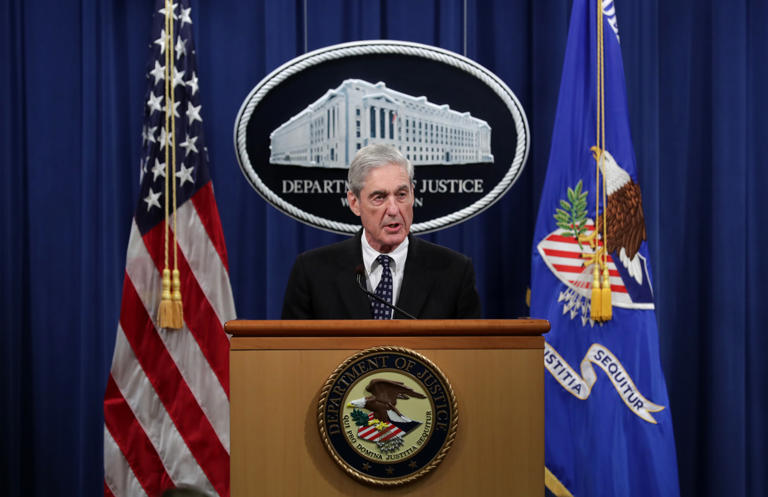

Former FBI Director Robert Mueller, who led the Russia investigation into President Donald Trump’s 2016 campaign, has been diagnosed with Parkinson’s disease, his family told The New York Times.
The diagnosis means Mueller, 81, will not comply with a congressional subpoena about the Jeffrey Epstein investigation.
Why It Matters
Epstein, a convicted sex offender and wealthy financier, died by suicide in a New York jail in 2019 while awaiting trial on sex trafficking charges.
Representative James Comer of Kentucky, the Republican chair of the House Oversight and Government Reform Committee, is leading a congressional review of how the government handled Epstein’s case.
As part of that effort, Comer planned to question politicians and former Justice Department and FBI officials.
What To Know
Mueller’s family told The New York Times that he was diagnosed with Parkinson’s in the summer of 2021.
“He retired from practicing law at the end of that year. He taught at his law school alma mater during the fall of both 2021 and 2022, and he retired at the end of 2022. His family asks that his privacy be respected,” the statement said.
Because of the diagnosis, the congressional committee withdrew its request for Mueller to testify this week, according to the Times.
Mueller was one of 10 high-profile former officials subpoenaed as part of the inquiry into the Epstein case, which has drawn new attention over how the Justice Department handled related files.
The committee wanted to question Mueller, who led the FBI from 2001 to 2013, about the agency’s role in the Epstein investigation.
Others subpoenaed include former President Bill Clinton, former Secretary of State Hillary Clinton, former Attorney General Merrick Garland, and former FBI Director James Comey.
Mueller was appointed in May 2017 as special counsel to investigate Russia’s alleged interference in the 2016 election. His team produced a 448-page report that examined Russian activity and possible connections to the Trump campaign.
The report found no conspiracy between Trump’s campaign and a foreign power but described tensions within the White House and concerns about the president’s behavior during the probe.
What People Are Saying
President Donald Trump said in July, when asked about the Epstein case: “Don’t forget, we went through years of the Mueller witch hunt and all of the different things. … All that information was fake.”
In 2019, when Mueller completed his report, he wrote: “While this report does not conclude that the President committed a crime, it also does not exonerate him.”
What Happens Next
The bipartisan House investigation into Epstein is expected to continue, with more witnesses likely to be called.


