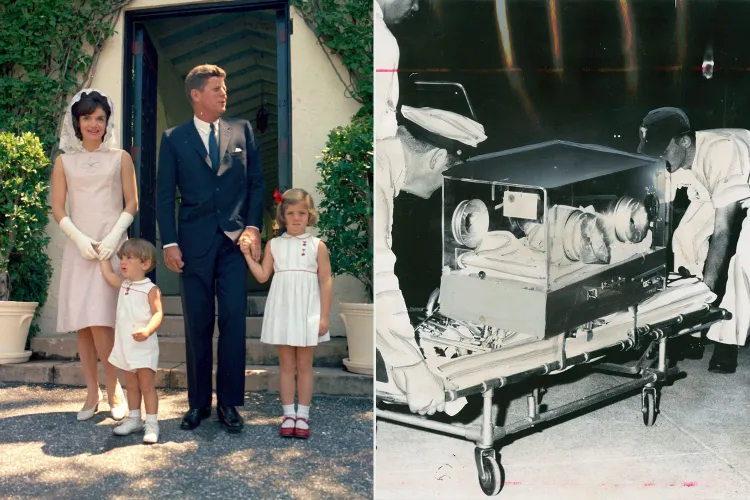

First lady Jacqueline Kennedy was in the backseat of a Ford sedan on her way to the hospital, in the early stages of premature labor, when she let slip a sign of concern for the baby boy she was about to deliver.
“Mr. Landis, can we please hurry?” she asked one of her Secret Service agents, who was driving.
Her voice was hushed and whispery despite an otherwise cool affect behind her trademark sunglasses.
“Can we go a little faster?” she continued.
The moment appears in Twilight of Camelot by Steven Levingston, a new biography that spotlights a lesser-known but influential chapter in the Kennedy family story. The book, set for release on Tuesday, Feb. 24, traces the short life and long legacy of Patrick Bouvier Kennedy, Jacqueline Kennedy’s fourth child with President John F. Kennedy.
Over less than two days, from Aug. 7 to Aug. 9, 1963, Patrick was born, fought for life and died amid intense public attention.
Though just 17 inches long and weighing 4 lbs. and 10.5 ozs., Patrick was described as well formed, with light brown hair, Levingston writes.
:max_bytes(150000):strip_icc():focal(999x0:1001x2):format(webp)/Kennedy-family-baby-death-021926-2-17118c63fa4f477ca20495c452270404.jpg)
“He was beautiful,” Secret Service agent Clint Hill told Levingston. “But he was clearly fighting for each breath, as his poor little chest struggled to get the oxygen he needed to survive.”
Today, doctors would recognize that Patrick’s lungs likely had not developed enough surfactant to help him absorb oxygen. But at the time, medical teams were racing against the clock with limited options.
Patrick lived for 39 hours and 12 minutes. His father was with him at the end, watching through a porthole as Patrick’s body failed inside a hyperbaric oxygen chamber in the basement of Boston’s Children’s Hospital. Patrick had been transported there for cutting-edge, even experimental treatment after being delivered by cesarean section at Otis Air Force Base in Massachusetts.
White House press secretary Pierre Salinger later described the president retreating to a hospital boiler room after Patrick’s death and weeping for 10 minutes.
“He put up quite a fight,” the president said—words that gained added poignancy when he died less than four months later.
The assassination in November 1963 largely overshadowed Patrick’s place in history. But Levingston argues that Patrick’s life and death became turning points, affecting both his parents’ marriage and the course of neonatal care in America.
Drawing on new interviews—including members of the medical team who treated Jacqueline Kennedy—as well as extensive research, Levingston reconstructs the race to save Patrick, often down to the minute, and explores how the ordeal reshaped the family.
Levingston suggests that, in the wake of the loss, the president and first lady began to grow closer again, bound by shared sorrow.
:max_bytes(150000):strip_icc():focal(999x0:1001x2):format(webp)/Kennedy-family-baby-death-021926-4-2285d3d73e2a4fb594af8434f54c0ae3.jpg)
“So much of his life is a mystery,” he says, “but there were signs that they definitely were wrapping themselves around each other.”
Their marriage was never a perfect union, and the book notes longstanding strains and controversies that surrounded it. Still, Levingston portrays fatherhood as transformative for the president—through both joy and grief. Jacqueline Kennedy had four children: a daughter, Arabella, who was stillborn; daughter Caroline; son John Jr.; and then Patrick.
“He really doted on Caroline and John Jr. and he evolved through their tutelage,” Levingston says. “They taught him how to be an emotional man, a caring man.”
“Patrick brought that to the zenith,” he adds.
While Jacqueline Kennedy recovered from her C-section in Massachusetts, it was often her husband who stayed close to Patrick during the next two days.
“He took charge with what was going on with Patrick in his health and grew very quickly,” Levingston says.
After Patrick’s death, the president pressed for major advances in premature care through increased medical funding, Levingston writes.
:max_bytes(150000):strip_icc():focal(999x0:1001x2):format(webp)/Kennedy-family-baby-death-021926-5-5d27032725f94a2790b2ca2cb879e4c0.jpg)
The book also revisits how the nation celebrated Patrick’s imminent arrival and then mourned him—an outpouring of emotion that took place only months before the country would grieve again.
“The nation was totally involved in his life from the moment of pregnancy,” Levingston says. “There was all this adulation and celebration over another Kennedy baby.”
“Nobody ever saw him,” he adds, “but they fell in love with him.”
More broadly, Levingston says he wanted to explore the tangle of pain and perseverance that defined Patrick’s brief place in the Kennedy story—two days of life that carried a larger meaning than any headline could capture.
:max_bytes(150000):strip_icc():focal(999x0:1001x2):format(webp)/Kennedy-family-baby-death-021926-3-38d0725e376d4057b8f9a3ebd18e567e.jpg)
“Their lives reflect a larger human story: that people suffer, people face tragedy,” he says. “But at the same time, there are pockets of hope that exist in those tragedies and you have to go and seek those out and find them.”
Twilight of Camelot will be released on Tuesday, Feb. 24, wherever books are sold.