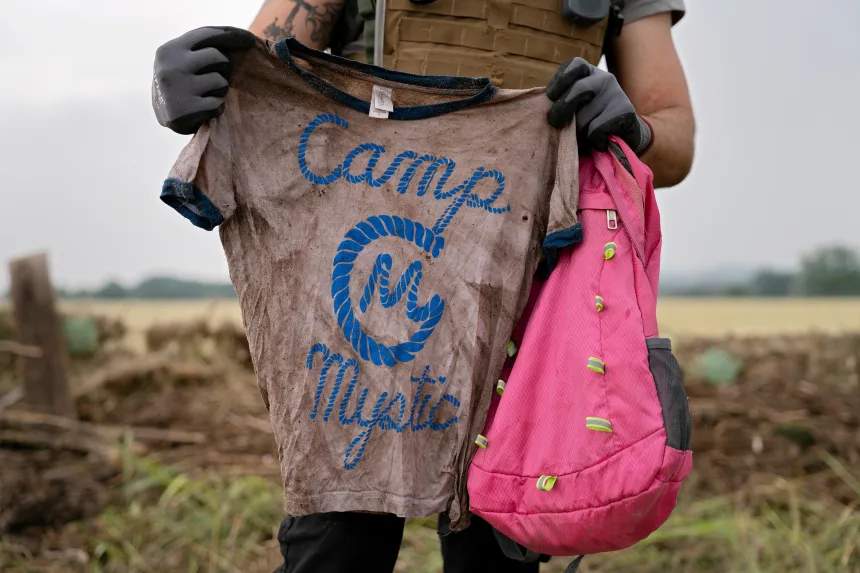

In the early morning hours of July 4, a dire weather alert warned of flash flooding across Kerr County, Texas. At Camp Mystic, an all-girls Christian camp nestled along the banks of the Guadalupe River, 750 campers were fast asleep—unaware that their summer sanctuary was about to become the scene of a devastating tragedy.
Children as young as 7 had only just settled into their cabins, their parents having dropped them off days earlier for the second session of the season. The camp promised a summer of fun and friendship, filled with archery, yoga, and starry-night stories. But by dawn, the serenity had turned to chaos.
Ten-year-old Lucy Kennedy awoke to a crash of thunder and an uneasy feeling she couldn’t shake. Counselors urged the girls to go back to sleep, but Lucy’s instincts told her something was wrong. At the Cozy cabin, camp photographer Nancy Clement noticed water creeping up the porch. And in Bug House cabin, counselor Laney Owens woke to find water pooling on the floor. She rushed to the camp office—this was no ordinary storm.
Camp owner Dick Eastland and his son Edward, a camp director, quickly mobilized. At Bug House, girls were told to grab their pillows and blankets. They were being evacuated to the recreation hall. In another cabin, 19-year-old counselors Silvana Garza Valdez and María Paula Zárate packed up their campers and moved them to higher ground. Then, in a haunting gesture, they wrote the girls’ names on their arms—just in case.
Emergency alerts intensified. But some counselors, like Caroline Cutrona, hadn’t received them—they’d been required to turn in their phones at the start of the session. Cutrona was still trying to keep her campers calm, even as the night grew darker and more ominous.
To avoid panic, another counselor arrived and framed the evacuation as a game: the girls were told to quickly hand over one pair of shorts, a top, and underwear. The reality was far more dire. Counselors soon found themselves leading children through chest-deep water, navigating fallen branches, floating furniture, and unrelenting current—all in near-total darkness.
At Wiggle Inn, a cabin for younger girls, security guard Glenn Juenke placed campers onto mattresses to keep them above the rising water. In Chatterbox cabin, 9-year-old twins told their bunkmates to stash their stuffed animals on the top bunk for safety. But fear was growing, especially as they watched a vehicle they thought would rescue them float away.
At Bubble Inn, the youngest girls—nicknamed the camp’s “littlest souls”—were tucked into their bunks. None of them, nor their two counselors, survived.
Elsewhere, Clement and other staffers stacked their belongings on beds, hoping they’d float if water entered the cabin. But when the door snapped in two and floodwater rushed inside, that hope vanished. The staff pried open another door, holding onto porch columns to stay upright as the water reached their shoulders. They scrambled to higher ground.
Meanwhile, dozens of campers reached the recreation hall by 3 a.m. Owens described the next several hours as “a blur of prayer, singing, and confusion.” Hundreds of girls, soaked and terrified, gathered upstairs with only flashlights. Their cheer mats floated in the rising water.
“Everyone was scared,” said a 12-year-old camper. “The water came in so fast.”
Elsewhere, campers climbed out of windows, counselors scoured hills for missing girls, and Clement climbed onto the roof of her cabin—clutching her wallet, phone, and a soaked stuffed animal from her childhood. She helped pull others up, even tying together shirts to rescue a counselor who had been swept away and briefly caught in a volleyball net.
As morning broke, the floodwaters slowly began to recede. On a hill, the Chatterbox twins huddled together, freezing and afraid. Counselors brought them water and hugs.
“They comforted us whenever we cried,” one of the twins recalled.
At last, a rainbow appeared. The girls took it as a sign from God.
By 6 a.m., rain had stopped. Campers sang worship songs to pass the time, their voices reaching the ears of staffers still stranded on rooftops. That sound—fragile yet resilient—offered a moment of hope.
But the full toll was still unknown. At the recreation hall, roll call began. When names went unanswered, the mood shifted.
“You think maybe they’re with another group,” the 12-year-old camper said. “But then you realize… they’re gone.”
From there, the girls were moved to the dining hall. Counselors handed out pizza while campers tried to nap on tables or busy themselves with crafts. But fear lingered. Some girls sobbed at the thought of leaving camp without seeing their parents. Others were silent, in shock.
Finally, helicopters arrived. Campers, many barefoot and bruised from the rapids, were loaded onto buses. Lucy gave her Crocs to another girl who had lost her shoes. On one bus, the girls sang the hymn “Pass It On.” Then, silence fell as they saw the destruction: cabins torn open, cars piled atop one another, debris where their summer home once stood.
“I kept thinking—this isn’t real,” said Cutrona. “I’m in a dream.”
Search teams worked through the day. Crews in boats and helicopters pulled survivors from trees. The lucky ones arrived at Ingram Elementary, where tearful reunions unfolded. Exhausted, shivering, and overwhelmed, the campers were finally safe.
But as the waters receded, the reality set in: at least 27 campers and counselors were gone.
Camp Mystic—an institution nearly 100 years old, beloved across generations—had suffered unimaginable loss. At a vigil, Stacey Merchant shared that she’d just received the first letter from her 12-year-old daughter, who had been rescued.
“And today,” Owens added, choking back tears, “some parents will be getting that first letter too—from daughters who never made it home. That’s heartbreaking to even imagine.”
Mourners gathered and joined hands. Together, they sang:
“From the lake, from the hills, from the sky;
All is well, safely rest, God is nigh.
Goodnight, Camp Mystic. We love you.”