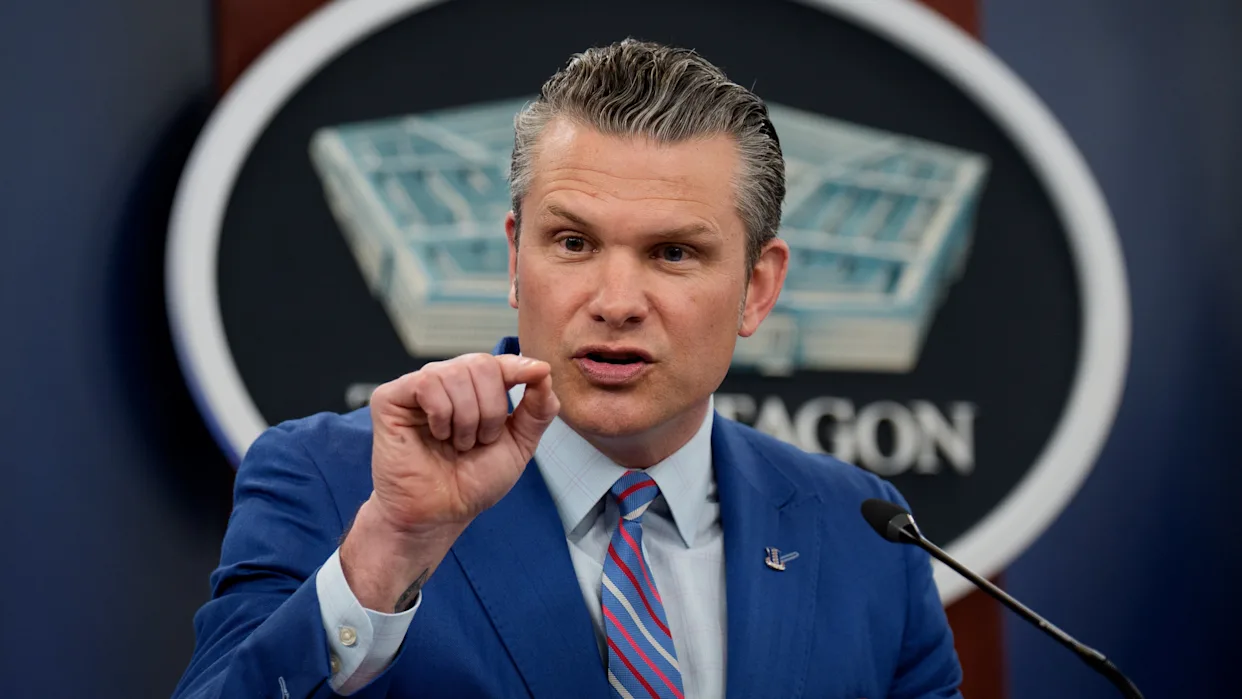

Defense Secretary Pete Hegseth is returning to West Point Military Academy a massive painting of Confederate Gen. Robert E. Lee. The portrait shows Lee in his gray Confederate uniform, with a slave leading his horse.
The painting was first placed in the academy’s library in 1952, during a time of racial segregation and Jim Crow laws in the South. Its display was part of an effort to rebuild Lee’s reputation, The New York Times reported.
This move is part of a wider effort by President Donald Trump’s administration to bring back Confederate symbols, restore monuments that critics say hide the realities of slavery, and remove references to slavery from museums and parks.

Lee had close ties to West Point. He attended the academy from 1825 to 1829, graduating at the top of his class, and later returned as superintendent from 1852 to 1855. His family was stunned when, after more than 30 years of service in the U.S. Army, he resigned in 1861 to fight for the Confederacy.
When Congress passed a law in 2020 to remove Confederate names and symbols from military sites, Lee’s image and name were everywhere at West Point. At least five roads and buildings bore his name. The commission created by the law decided that portraits of Lee in his Union Army uniform could remain, but ordered the removal of the Confederate portrait with the slave. The panel also recommended renaming buildings and roads honoring him.
It’s unclear how Hegseth was able to bring the painting out of storage without violating the law, the Times reported.
“At West Point, the United States Military Academy is prepared to restore historical names, artifacts, and assets to their original form and place,” Army communications director Rebecca Hodson told the paper. “Under this administration, we honor our history and learn from it — we don’t erase it.”

Even before its removal in 2022, many cadets and alumni had criticized Lee’s glorified image. West Point’s Modern War Institute explained in 2020 that this image was created through “Reconciliation,” a process that downplayed treason, ignored slavery, and erased the role of Black soldiers in the Union Army.
After the Confederacy surrendered in 1865, the federal government launched Reconstruction to reunite the nation and create a fairer society in the South. But Reconstruction ended in 1877, replaced by “Reconciliation.” Federal troops withdrew, allowing Southern states to enforce segregation, block Black citizens from voting, and terrorize communities.
The Confederate portrait had been donated to West Point’s library in 1952 to mark the 100th anniversary of Lee becoming superintendent. At its unveiling, Gen. Maxwell Taylor claimed that the issues dividing North and South “no longer had real meaning” — even though the Army had only just committed to full desegregation. Major civil rights milestones, like Rosa Parks’ arrest and Martin Luther King Jr.’s leadership, were still years away.
Lee personally owned enslaved people and managed hundreds more belonging to his wife’s family. Records from the National Park Service say he sometimes ordered their whippings. Though he called slavery a “moral and political evil,” he wrote that it was a greater burden on white people than on Black people, because they had to enforce “discipline” on slaves.
When Virginia seceded, Lee resigned from the U.S. Army and joined the Confederacy, even though he had been asked to lead Union forces. The NPS says he agonized over the choice but claimed his duty was to fight for his state. His Virginia estate was seized during the war and became Arlington National Cemetery for fallen Union soldiers.
Now, his portrait’s return comes as the Trump administration restores Confederate base names, statues, and monuments, including those promoting the idea that the Civil War was a noble “lost cause” supported by enslaved people.