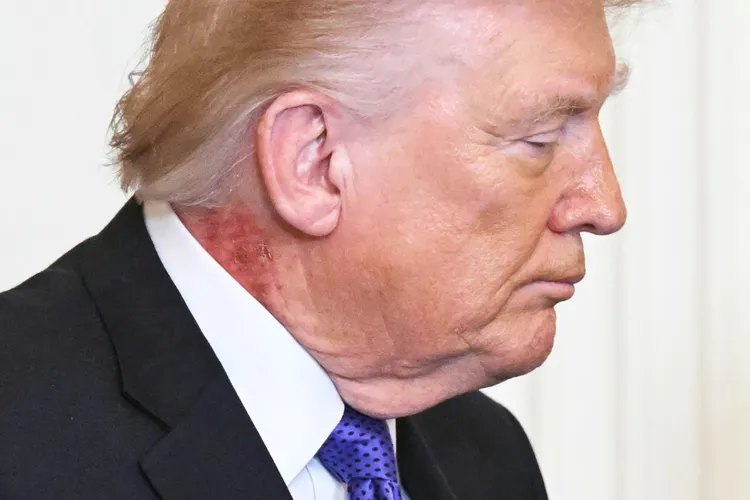

WASHINGTON — President Donald Trump appeared at a White House Medal of Freedom ceremony on Monday with a prominent, bright red rash and visible scabbing on the right side of his neck, reigniting public debate over the 79-year-old commander-in-chief’s medical fitness. The irritation, which extended from below the ear to the hairline, was accompanied by visible bruising on the President’s hand, typically obscured by cosmetic coverage.
White House physician Dr. Sean Barbabella addressed the concerns in a brief statement, characterizing the skin irritation as a side effect of a “very common” prescribed preventative skin treatment.
“President Trump is using a very common cream on the right side of his neck… prescribed by the White House Doctor,” Barbabella stated. While he noted the treatment would last one week and the redness several more, the physician did not specify the underlying condition being treated or the name of the medication.
Patterns of Physical Ailments
The appearance of the rash is the latest in a series of physical markers that have drawn the attention of medical observers and political rivals alike. During Monday’s event, reporters noted a bruise on the President’s right hand—an issue Trump has previously addressed with surprising candor.
In a January interview with The Wall Street Journal, the President admitted to taking 325 milligrams of aspirin daily for “cardiac prevention,” a dosage significantly higher than the standard 81mg “baby aspirin” typically recommended for such purposes.
“I don’t want thick blood pouring through my heart,” Trump told the Journal, citing a “superstitious” adherence to the regimen.
Medical experts note that high-dose aspirin therapy can lead to easy bruising and thinning of the skin, potentially explaining the frequent marks on the President’s hands and his reported use of specialized makeup to conceal them.
Cumulative Health Concerns in the Second Term
Since becoming the oldest person sworn into the presidency, Trump’s health has remained a focal point of his second term. Beyond dermatological issues, the administration has navigated several medical disclosures:
- Chronic Venous Insufficiency: In July 2025, the White House confirmed this diagnosis to explain the President’s swollen ankles. The condition, while common and rarely life-threatening, affects blood flow from the limbs back to the heart.
- Cognitive and Vitality Questions: Instances of the President appearing to close his eyes during Cabinet meetings have prompted questions regarding his stamina. The President has dismissed these reports, attributing them to brief moments of relaxation or ill-timed photography.
The Transparency Gap
While Dr. Barbabella’s statement sought to downplay the severity of the neck rash, the lack of a specific diagnosis has left a vacuum for speculation. In a high-stakes political environment, the health of the Executive is often viewed through the lens of national security and stability.
As the President continues his rigorous schedule of public appearances, the White House medical team remains under pressure to provide more comprehensive updates to satisfy both the public interest and the transparency standards expected of the Office of the President.