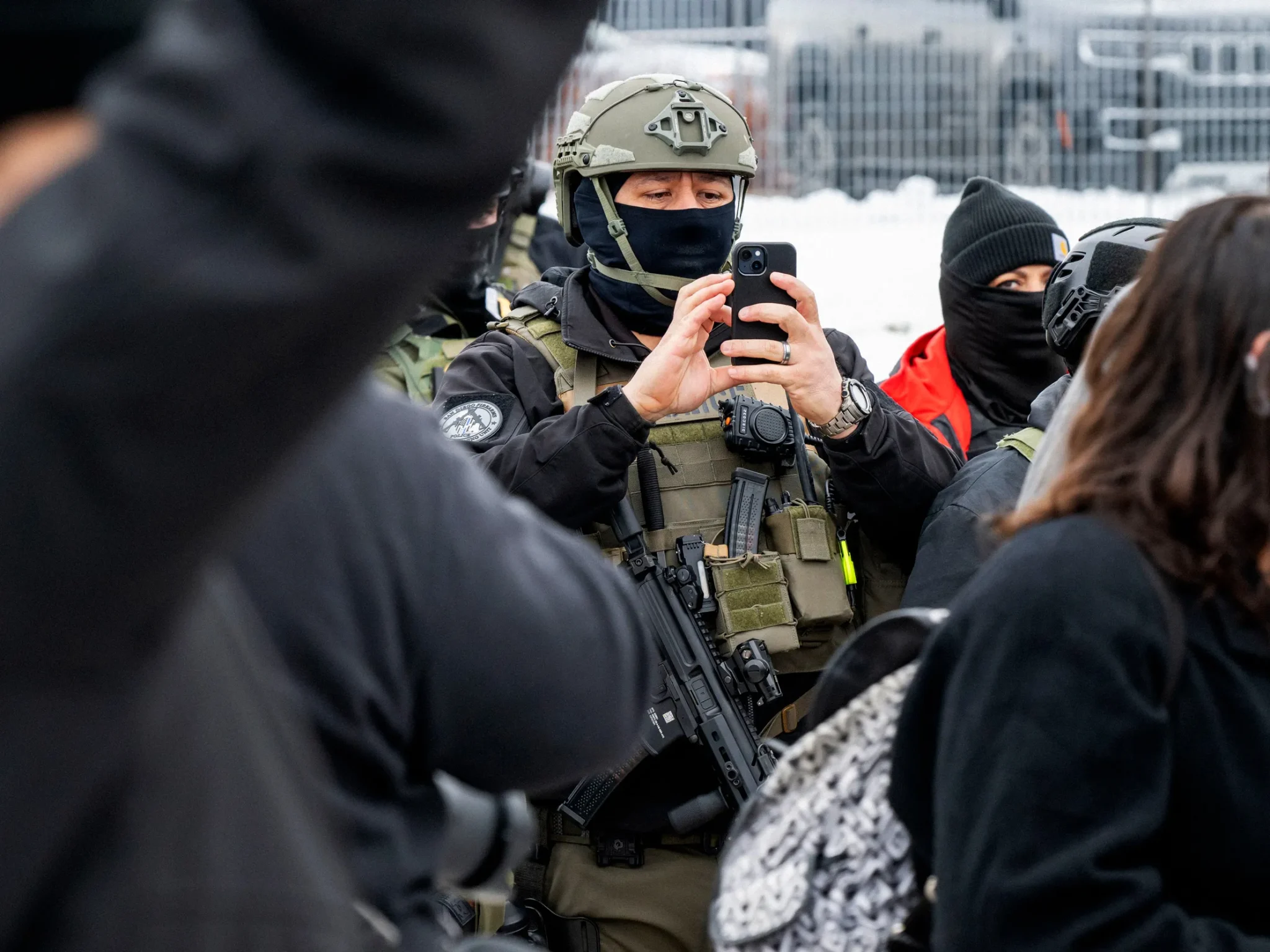

A new generation of mobile biometric tools is pushing facial recognition out of airports and into everyday public spaces—where the line between immigration enforcement and broad domestic surveillance can get blurry fast.
From the border to the sidewalk
For years, federal facial recognition was most visible at ports of entry: airport gates, passport control, and other border-adjacent checkpoints. What’s changing now is where the scans happen. Reporting and advocacy groups say DHS components, including ICE and CBP, have deployed a smartphone-based tool—often referenced as Mobile Fortify—that lets agents capture a person’s face (and in some cases other biometrics) during field encounters and query government biometric systems for potential matches. (WIRED)
That shift matters: when identity checks move into routine street stops, the practical result can look less like “immigration processing” and more like on-the-spot biometric policing.
How “Mobile Fortify” works (and what it can’t do)
According to reporting, the app can capture facial images and “contactless” fingerprints and send them to CBP-managed biometric matching systems, which then return possible matches along with biographic information. (WIRED)
But a key point is what “match” means in real-world conditions. One investigation found that the app does not actually verify identity with certainty; it produces candidate results that can be treated as a lead—yet, in practice, officers may act like it’s confirmation. (WIRED)
In uncontrolled environments—poor lighting, motion blur, odd angles—false matches are not theoretical. They’re a known risk in facial recognition generally, and critics argue street use multiplies the danger. (WIRED)
Used at scale—with limited public visibility
A major concern is scope. Recent reporting and legal filings cited by journalists suggest Mobile Fortify has been used over 100,000 times in the field, indicating this is not a pilot program but an operational tool. (WIRED)
Civil liberties groups argue the public is learning about these deployments after the fact—via lawsuits, leaked records, and investigative reporting—rather than through transparent rulemaking or robust oversight.
When citizens get swept in
While DHS frames many biometric tools as immigration-focused, real encounters can involve U.S. citizens as well. The Associated Press reported on a U.S. citizen in Minnesota who said he was subjected to biometric facial scanning without consent during a stop, underscoring how easily a “targeted” tool can spill into broader public life. (AP News)
That spillover has a chilling effect: if people believe attending a protest, walking to work, or driving through the wrong neighborhood could trigger biometric screening, they may avoid lawful activity altogether.
Oversight gaps and “mission creep”
The hardest question is not whether ICE can use the technology, but whether it should—and under what constraints.
Federal watchdogs and policy researchers have repeatedly flagged risks around facial recognition: inconsistent policies, uneven training, and weak guardrails for civil rights and civil liberties. (U.S. Government Accountability Office)
Critics describe the current trajectory as “mission creep”: tools introduced for narrow use cases become normal infrastructure, and then expand—quietly—into new contexts like protest monitoring or generalized street encounters. (The Washington Post)
The private-sector pipeline: Clearview and beyond
ICE has also pursued facial recognition capabilities through vendors. In 2025, reporting and government spending records tracked a multimillion-dollar ICE contract with Clearview AI, a company known for building a large face database from images scraped from the public web and social platforms. (Forbes)
Even when agencies claim limited use (for specific investigations), the procurement pipeline raises a broader concern: once a tool exists inside an agency, the incentives often push toward wider deployment.
What comes next
If street-level facial recognition continues to expand, the biggest flashpoints will likely be:
- Consent and due process: whether people can refuse, and what happens if they do.
- Accuracy and accountability: what audits exist for false matches, and what remedies exist for wrongful detention.
- Data retention: how long biometric data and encounter records are stored, and who can access them.
- Legal standards: whether courts or Congress will impose tighter constraints on when and how DHS can use facial recognition in public. (U.S. Commission on Civil Rights)
What’s clear is that the “street surveillance” era isn’t hypothetical anymore. The tooling is here—and the policy debate is struggling to keep up.