
Ilia Malinin’s bid for Olympic gold unraveled in dramatic fashion during the men’s figure skating final at the 2026 Winter Olympics, where he fell twice and missed several key elements.
The 21-year-old finished eighth on Friday, Feb. 13, at the Milano Ice Skating Arena after a difficult free skate that left him visibly emotional as he stepped off the ice.
“I blew it,” Malinin said in an interview with NBC after his score was announced. He earned 156.33 in the free skate and 264.49 overall. “Honestly, that was the first thing that came to my mind. I have no words, honestly.”
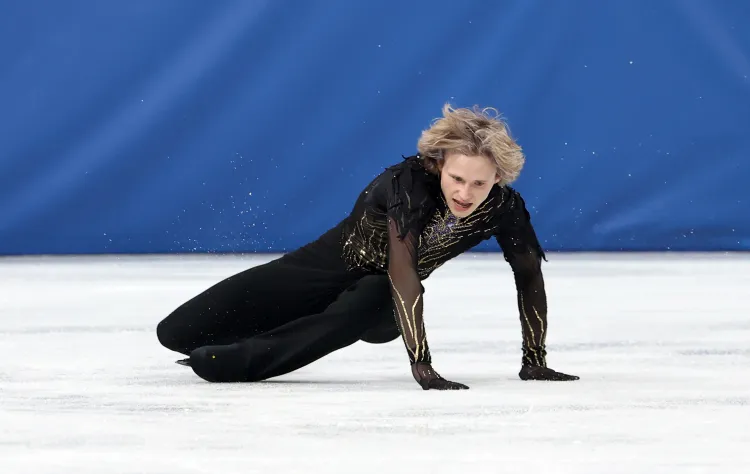
Malinin opened with a quadruple flip, which he landed, but he did not complete his signature quadruple axel—opting for a single axel instead. He followed with a clean quadruple lutz, then attempted a quadruple loop that became a double. From there, he fell twice, fighting to finish the four-minute program and adding a backflip at the end.
:max_bytes(150000):strip_icc():focal(2258x0:2260x2):format(webp)/GettyImages-2261005040-89174cbe2eb44807860578b92d854275.jpg)
Malinin, who calls himself the “Quad God,” is the only skater to have landed a quadruple axel in competition. He first completed it cleanly at the U.S. International Figure Skating Classic in September 2022 and has done it multiple times since. He was widely expected to attempt the move again in the Olympic final, but he said the moment overwhelmed him.
“I think it was definitely mental,” he told NBC afterward. Asked whether the Olympic stage played a role, he agreed: “It’s not like any other competition.”
Malinin had already earned Olympic gold earlier in the Games as part of Team USA’s victory in the team event. He entered the final in first place after scoring 108.16 in the short program on Tuesday, and he appeared well-positioned heading into the free skate—especially after two of his biggest rivals fell during their performances.
But Malinin’s mistakes opened the door for Kazakhstan’s Mikhail Shaidorov, who surged to win gold, delivering his country’s first-ever Olympic figure skating title.
:max_bytes(150000):strip_icc():focal(3538x1712:3540x1714):format(webp)/GettyImages-2260994808-9a0ebdd16cd14e8a88cb05382caba249.jpg)
About 30 minutes after the event, Malinin told reporters he was still trying to understand what went wrong.
“Honestly, I still haven’t been able to process what just happened, it’s a lot of mixed emotions,” he said. “Going into this competition I felt really good, this whole day I felt very solid, and I just thought that all I needed to do is go out there and trust the process that I’ve always been doing with every competition. But of course, it’s not like any other competition. It’s the Olympics, and I think people only realize the pressure in the nerves that actually happen from the inside, so it was really just something that overwhelmed me and I just felt like I had no control.”
When asked whether the ice conditions may have contributed to the falls seen from multiple skaters, Malinin said it might not have been ideal, but he didn’t want to use it as an excuse.
“The ice was maybe not the best condition,” he said, adding that it was “something I cannot complain about because we’re all put in that situation.”
Ultimately, Malinin pointed to nerves as the biggest factor.
“Going into that starting post I just felt like, you know, all the just dramatic moments of my life really just started flooding my head, and there’s just like so many negative thoughts that just flooded into there and I just did not handle it,” he said.
Being the gold medal favorite, he added, “is really just a lot to deal with, especially for my age.”