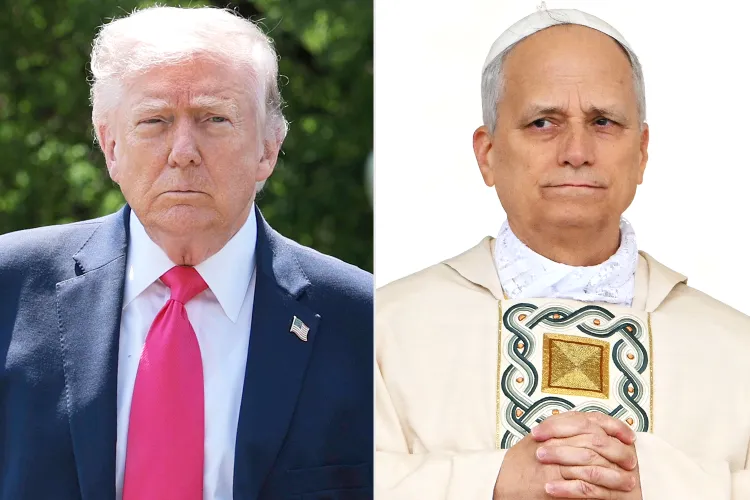

A growing public dispute between U.S. President Donald Trump and Pope Leo XIV has escalated into a broader geopolitical and धार्मिक confrontation, as both figures invoke Christian doctrine to justify opposing positions on the ongoing Iran war.
Speaking outside the White House on April 16, Trump rejected criticism from the Vatican and U.S. Catholic leaders, declaring, “I’m all about the Gospel… as much as anybody can be,” while reiterating his administration’s stance that Iran must not acquire nuclear weapons. The president framed his position as both a national security imperative and a moral one.
The remarks follow weeks of sharp exchanges. Trump previously labeled the Chicago-born pontiff “weak on crime” and accused him of enabling Iran’s government after the pope called for an end to the conflict launched by the U.S. and Israel earlier this year. The war has reportedly resulted in thousands of deaths across the Middle East.
Pope Leo XIV, born Robert Francis Prevost, has taken a starkly different tone. Without directly addressing Iran’s nuclear ambitions, he has repeatedly called for global nuclear disarmament and condemned the war in moral terms. “God does not bless any conflict,” he said during a recent trip, adding that followers of Christ “are never on the side of those who… drop bombs.”
:max_bytes(150000):strip_icc():focal(749x0:751x2):format(webp)/Donald-2Trump-talks-to-press-White-House-041726-31a9ce7c976a4c4e94477f0c95e2d086.jpg)
The Vatican’s position has been reinforced by the United States Conference of Catholic Bishops, which rejected the Trump administration’s interpretation of the Church’s “just war theory.” Bishops emphasized that the pope’s statements are not political opinions but expressions of Gospel teaching.
Tensions have spilled beyond theology into political and cultural arenas. Vice President JD Vance, a Catholic convert, publicly rebuked the pope, urging caution in theological commentary. Defense Secretary Pete Hegseth has also invoked religious rhetoric while overseeing military operations tied to the conflict.
The dispute has drawn international attention. Iranian President Masoud Pezeshkian and Italian Prime Minister Giorgia Meloni have both criticized Trump’s rhetoric, particularly after the president shared AI-generated images depicting himself in messianic imagery—posts that sparked backlash even among conservative allies.
:max_bytes(150000):strip_icc():focal(749x0:751x2):format(webp)/Donald-Trump-talks-to-press-White-House-041726-c5bbf83868a34362a3f9daa901933bb6.jpg)
Trump, for his part, insists he harbors no personal animosity toward the pope. “I’m not fighting with him,” he said. “The pope made a statement… I say Iran cannot have a nuclear weapon.”
However, factual discrepancies remain. Trump claimed Iranian negotiators signaled willingness to transfer enriched uranium—dubbed “nuclear dust”—to the U.S., though Iranian officials have not confirmed any such proposal publicly.
:max_bytes(150000):strip_icc():focal(749x0:751x2):format(webp)/Donald-Trump-holds-Bible-washington-dc-041726-6f7b5aa1f71440deb79a2b3a16f38ec1.jpg)
For Pope Leo XIV, the dispute appears less about policy and more about principle. “I don’t think that the message of the Gospel is meant to be abused,” he said, underscoring a widening divide between religious authority and political power at a moment of escalating global conflict.
As the war continues, the clash highlights a rare and consequential rift—one where theology, diplomacy, and military strategy are colliding on the world stage.