
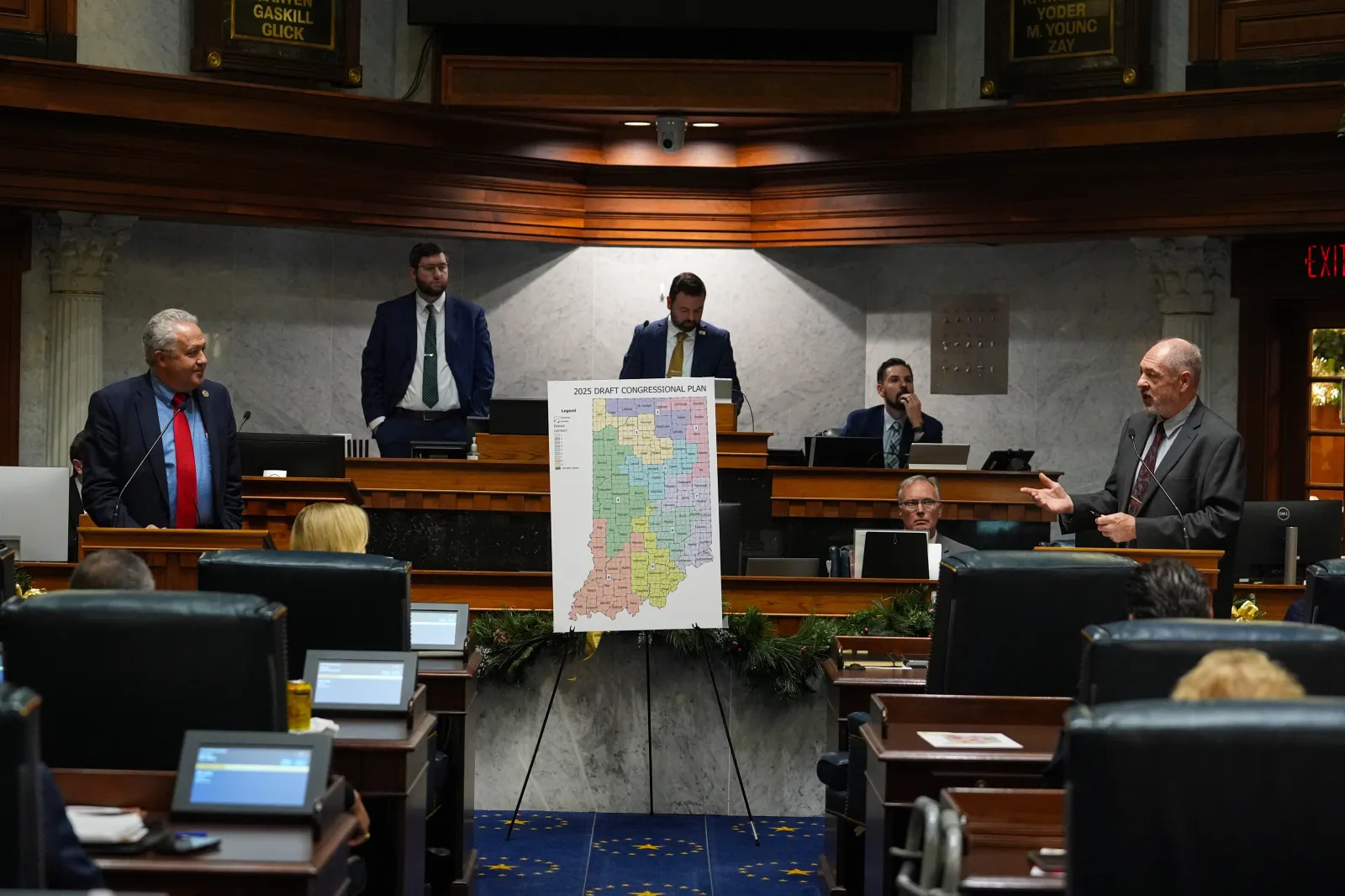

Indiana’s Senate has voted down a redistricting proposal that President Donald Trump publicly pushed—an unusually direct rebuke from a chamber dominated by Republicans.
In a decisive outcome, 21 members of the Republican supermajority joined all 10 Democrats to reject the measure. The plan was widely viewed as a way for the GOP to strengthen its position by gaining two additional congressional seats.
After the vote on Thursday, Trump said it “would have been nice” for the Indiana Senate to advance the map but insisted he “wasn’t working on it very hard” once lawmakers signaled they wouldn’t move forward. Those comments followed his very visible effort to pressure lawmakers: he lobbied senators personally, urged support on social media, and warned he could endorse primary challengers against Republicans who resisted the proposal.
Speaking in the Oval Office, Trump went further—saying he would support any candidate who runs against state Senate president Rodric Bray in next year’s election.
Why It Matters
Indiana’s decision lands in the middle of a broader national fight over redistricting, where both parties are attempting to redraw maps to shape future election outcomes.
The stakes extend beyond state politics. Redistricting could affect the November 2026 midterms and potentially the balance of power in Congress—especially in the U.S. House, where Republicans currently hold a narrow 219–214 majority. That margin is expected to shrink further when Georgia Representative Marjorie Taylor Greene resigns in January, adding pressure to hold every possible seat.
At the same time, the Indiana vote illustrates that Trump’s influence—while significant—does have limits when local lawmakers decide the political cost is too high.
What To Know
Trump had urged Indiana Republicans to support redistricting and criticized Bray for being reluctant to pass the plan.
The map had momentum earlier in the process. It cleared the Indiana House earlier this month by a 57–41 vote and proposed splitting Indianapolis into four districts, a change designed to make additional seats more competitive for Republicans. In a Senate committee on Monday, it advanced 6–3, with only one Republican opposing it.
But when it reached the full Senate on Thursday, the coalition against it held—and the proposal failed.
One key sign of shifting momentum came from Republican Sen. Greg Goode, who moved from undecided to opposed. On the Senate floor, he said constituents objected to having their county split or tied to Indianapolis. While he emphasized his “love” for Donald Trump, he criticized what he called “over-the-top pressure” coming from inside and outside Indiana.
Not all Republicans agreed. Sen. Michael Young argued the national stakes required a tougher approach, warning that Democrats were only a few seats away from retaking control of the U.S. House in 2026. “I know this election is going to be very close,” he said.
The bill’s sponsor, Republican Sen. Mike Gaskill, tried to frame the issue as political realism. He displayed congressional maps from other states—pointing to Democratic-held seats in places like New England and Illinois—to argue that map-drawing is already aggressive elsewhere, and Indiana Republicans should not act as if the state exists outside that reality.
The debate also played out against a tense backdrop. Earlier this month, Indiana State Sen. Mike Bohacek said his family “received threats of a bomb placed at our home” after he broke with Trump on the redistricting issue, calling the intimidation “illegal” and expressing hope that those responsible would face justice.
National Context
Redistricting isn’t only a Republican strategy, and the article notes Democratic efforts as well. On November 4, California voters approved Proposition 50, an amendment backed by Democratic Governor Gavin Newsom in response to Texas’s redistricting moves. The measure would temporarily revise California’s congressional map and is expected to strengthen Democrats’ future prospects.
Meanwhile, Republicans have had success in Texas: the U.S. Supreme Court this week allowed Texas to proceed with its new congressional map after declining to keep in place a lower court’s freeze.
What People Are Saying
Trump wrote Wednesday on Truth Social: “If Republicans will not do what is necessary to save our Country, they will eventually lose everything to the Democrats.”
He also argued that “Every other State has done Redistricting,” claiming Indiana was the lone exception because Bray “enjoys being the only person… who is against Republicans picking up extra seats.”
Democratic state Sen. Fady Qaddoura said Thursday: “Competition is healthy my friends. Any political party on earth that cannot run and win based on the merits of its ideas is unworthy of governing.”
Gaskill, urging support for the proposal, declared that a “second civil war has already started” in the United States, arguing that political conflict is being carried out through “surrogates,” and adding, “I submit to you that that’s accurate.”
Indiana Republican Spencer Deery said, “The federal government should not dictate by threat or other means what should happen in our states.”
What Happens Next
Redistricting is off the table in Indiana for now, but the national battle continues. The article points to ongoing efforts in states like Virginia and Maryland—moves that could still reshape the political map ahead of the November 2026 midterms.


