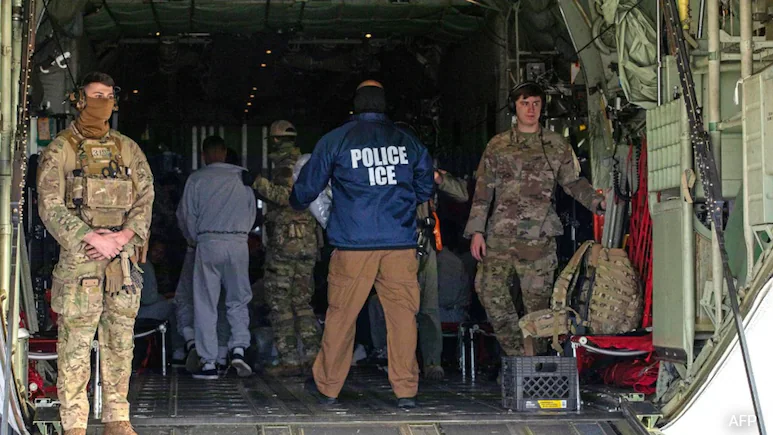

At an obstacle course in Georgia’s humid heat, an instructor demonstrates how to pull a wounded partner to safety. In a classroom lined with thick legal books on immigration law, recruits dive into lessons on how the Fourth Amendment shapes their work. And at a firing range scattered with shell casings, new Immigration and Customs Enforcement recruits practice handling their handguns.
“Instructors, give me a thumbs up when students are ready to go,” a voice crackled over the loudspeaker as roughly 20 recruits practiced drawing and firing their weapons.
The Federal Law Enforcement Training Center in Brunswick, Georgia, serves as the central hub for training nearly all federal law enforcement officers, including the Immigration and Customs Enforcement officers spearheading President Donald Trump’s mass deportation initiatives.
With Congress approving substantial new funding this summer, ICE is amid a major hiring push, aiming to place thousands of new deportation officers into the field in the coming months.
On Thursday, The Associated Press and other news outlets were given a rare glimpse into the Basic Immigration Law Enforcement Training Program, which prepares new ICE recruits—especially those in the Enforcement and Removal Operations unit responsible for locating, arresting, and deporting individuals.
ICE is receiving $76.5 billion in new funding from Congress to advance Trump’s deportation goals, nearly ten times its current annual budget. About $30 billion of that funding is earmarked for hiring new staff.
While the agency is recruiting across multiple roles, including investigators and lawyers, the largest growth is in deportation officers. Todd Lyons, ICE’s acting director, attended Thursday’s training demonstration. He noted that the agency currently employs around 6,500 deportation officers and plans to hire 10,000 more by year’s end.
The surge in hiring has sparked concerns that vetting and training might be compromised. Similar hiring booms in the early 2000s at the Border Patrol, when standards were relaxed, led to a rise in misconduct arrests.
Lyons dismissed worries about shortchanging training, while acknowledging that some streamlining has occurred.
“I wasn’t going to water down training,” he said.
Caleb Vitello, ICE’s assistant director overseeing training, explained that recruits undergo approximately eight weeks of intensive instruction at the Georgia facility, supplemented by pre- and post-training sessions elsewhere.
One notable change, Vitello said, is the elimination of five weeks of Spanish-language training. He explained that recruits were only reaching “moderate” proficiency in the language, and technology for translation can help bridge gaps in the field.
During the six-day-a-week program, recruits live on the sprawling, pine-covered campus near the Atlantic Ocean, just under an hour north of the Florida state line. Hundreds have completed the training in recent months.
The curriculum includes extensive firearms instruction at a vast indoor shooting range. On Thursday, spent shell casings covered the floor as about 20 recruits, dressed in blue shirts and pants, practiced bent-elbow and transitional shooting techniques under the supervision of instructors in red shirts. Eye protection and noise-reducing earmuffs with earplugs were standard.
Dean Wilson, who oversees firearms training, likened ICE operations to a haunted house, where agents never know what challenges may appear.
“We do our very best to make sure that even though they’re in that environment, that they have the wherewithal to make the proper decision,” Wilson said. “Nobody wants to be the one to make a bad shot, and nobody wants to be the one that doesn’t make it home.”
Recruits also practice advanced driving techniques on courses that simulate wet pavements and urban streets with blind corners. The training emphasizes de-escalation to prevent the use of force whenever possible.
“In any type of law enforcement situation,” Lyons said, “you’d rather de-escalate with words before you have to use any use of force.”
Not all instruction takes place outdoors. Immigration law is complex—second only to the tax code, ICE instructors often say. Recruits spend around 12 hours in classrooms studying the Fourth Amendment, the Immigration and Nationality Act of 1952, and other laws that govern their work.
Training manuals and immigration law handbooks, some two to three inches thick, help recruits learn how to determine if someone is removable, when searches are allowed, and when officers must step back.
ICE officials rejected accusations that the agency indiscriminately pulls people over or sets up random checkpoints. They emphasize that operations require probable cause and are targeted. While ICE does not conduct traffic stops, it works alongside local authorities who do.
“Once local law enforcement makes a stop, and then they contact ICE saying we have somebody that we possibly think might be an alien,” said Greg Hornsby, an associate legal adviser at ICE, “that’s where we step in.”