
The administration has not provided full details on its talks with Intel, or whether similar discussions are happening with other companies.
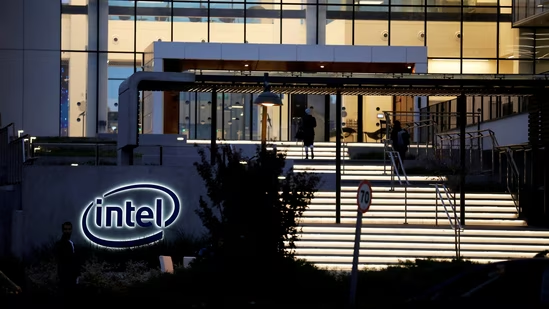
President Donald Trump announced that Intel Corp. had agreed to give the U.S. government a 10% equity stake in the struggling chipmaker, with a formal announcement expected Friday, according to people familiar with the matter.
“They’ve agreed to do it, and I think it’s a great deal for them,” Trump told reporters at the White House.
Trump framed the agreement as a chance to revitalize Intel, saying the company had fallen behind its competitors in chipmaking. He said he first suggested the idea earlier this month during a meeting with Intel Chief Executive Officer Lip-Bu Tan, who is expected to join the White House event finalizing the deal.
“I said, you know what? I think the United States should be given 10% of Intel. And he said, ‘I would consider that.’ And I said, ‘Well, I’d like you to do that,’” Trump recalled.
Talks centered on converting grants under the Chips and Science Act into an equity stake.
Such an arrangement would mark a dramatic level of government intervention in a major U.S. company—something historically reserved for extreme circumstances such as war or systemic financial crises. Intel declined to comment on the timing of the announcement.
Commerce Secretary Howard Lutnick recently said Trump wants taxpayers to see more direct benefits from federal support of key companies. In an interview with CNBC, he explained the goal is to “get a good return for the American taxpayer instead of just giving grants away.”
A U.S. official noted that companies expanding investment in the United States—such as Taiwan Semiconductor Manufacturing Co. and Micron Technology Inc.—will not be required to offer equity in exchange for federal funding.
Though the administration had signaled this move in recent weeks, the Intel deal raises significant risks. Critics warn it could distort markets, disrupt capital flows, and expose taxpayers to steep losses. At the same time, it could deliver a major turnaround for Intel, which has been struggling with fears it is losing its technological edge to competitors.
Trump has increasingly embraced economic statecraft in his second term, aiming to strengthen U.S. manufacturing, rebalance trade relationships, and secure American leadership in critical industries.
Earlier this month, Trump announced that Nvidia Corp. and Advanced Micro Devices Inc. agreed to give the U.S. government 15% of revenue from sales of artificial intelligence chips to China. Earlier this year, he also secured a “Golden Share” from Nippon Steel Corp., which gives him decision-making power over United States Steel Corp..