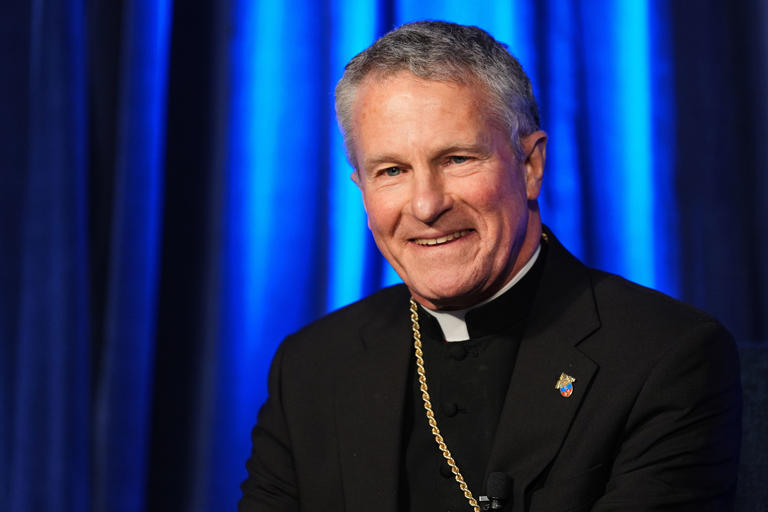

As the Trump administration intervenes in Venezuela, prepares troops for a possible deployment to Minnesota, and threatens to seize Greenland, the Catholic archbishop who serves U.S. military personnel said service members could, in certain circumstances, be morally justified in refusing orders that violate their conscience.
Archbishop Timothy P. Broglio told the BBC on Sunday that a U.S. attack on Greenland would be difficult to justify, noting that the island is part of Denmark.
“Greenland is a territory of Denmark,” Broglio said. “It does not seem really reasonable that the United States would attack and occupy a friendly nation.”
Broglio, who leads the D.C.-based Archdiocese for the Military Services, USA, oversees chaplains who serve Catholics and others at U.S. military bases, Veterans Affairs health care facilities, and diplomatic missions worldwide. Asked whether he was concerned about troops under his pastoral care, he said the risk is that service members could be placed in a position where they are told to carry out actions they believe are morally wrong.
“I am obviously worried because they could be put in a situation where they’re being ordered to do something which is morally questionable,” he said.
He also emphasized the practical danger for individual troops. While refusal might be morally defensible in a narrow sense, he said it can still put a service member in an impossible situation.
“It would be very difficult for a soldier or a Marine or a sailor to by himself disobey an order,” Broglio said. “But strictly speaking, he or she would be, within the realm of their own conscience, it would be morally acceptable to disobey that order, but that’s perhaps putting that individual in an untenable situation — and that’s my concern.”
Broglio is among several Catholic leaders questioning the administration’s use of force. His remarks also highlighted growing unease being voiced by Pope Leo XIV and senior Catholic officials in the United States about the direction of American foreign policy.
Though Broglio is widely seen as a conservative figure in the U.S. church — including for earlier comments opposing the end of “don’t ask, don’t tell” and for criticizing policies allowing transgender people to serve — he has also taken a hard line against the use of lethal force in certain military operations.
He recently criticized military strikes on boats the administration says are smuggling drugs, stressing that moral limits still apply even in the pursuit of a widely supported goal.
“In the fight against drugs, the end never justifies the means,” Broglio said in a statement last month. “No one can ever be ordered to commit an immoral act, and even those suspected of committing a crime are entitled to due process under the law.”
The statement followed a Washington Post report describing an incident in which commanders in the first known boat strike saw survivors and ordered a second barrage to kill them. Broglio did not cite the specific episode, but his language appeared to refer to that scenario.
“As the moral principle forbidding the intentional killing of noncombatants is inviolable,” he said, “it would be an illegal and immoral order to kill deliberately survivors on a vessel who pose no immediate lethal threat to our armed forces.”
Trump is scheduled to arrive Wednesday in Davos, Switzerland, for the World Economic Forum, where European leaders plan to discuss his demand to seize and annex Greenland — a push that has turned the annual gathering of political and financial leaders into a tense diplomatic confrontation.
Military personnel swear an oath to the Constitution, not to an individual leader. Their enlistment oath includes both a pledge to “support and defend the Constitution of the United States against all enemies” and a promise to “obey the orders of the President of the United States and the orders of the officers appointed over me,” consistent with the Uniform Code of Military Justice. Service members are obligated not to comply with “manifestly unlawful orders,” but such cases are rare and carry serious legal risk, and troops can be court-martialed for refusing lawful orders.
The Pentagon in November announced an investigation into Sen. Mark Kelly (D-Arizona), a combat veteran and prominent Trump critic, after he appeared in a video with five other Democrats reminding service members of their duty under military law to disobey illegal orders. Trump criticized the message at the time as “seditious behavior,” and the other lawmakers said this month that they, too, were being investigated over the video.
Kelly has since filed a lawsuit seeking to reverse Defense Secretary Pete Hegseth’s letter of censure and an effort that could lead to his demotion in rank.
Broglio’s warnings aligned with concerns raised in a joint statement Monday by the three highest-ranking U.S. Catholic archbishops, who argued that renewed threats or use of military force — including by the United States in Venezuela and Greenland — were raising fundamental moral questions about America’s role in the world.
“The events in Venezuela, Ukraine and Greenland have raised basic questions about the use of military force and the meaning of peace,” wrote Cardinals Blase Cupich of Chicago, Robert McElroy of D.C. and Joseph Tobin of Newark.
After the U.S. operation in Venezuela to capture Nicolás Maduro and after Trump said he was now “in charge” of the country, the pope urged respect for Venezuela’s sovereignty.
In a Jan. 9 meeting with diplomats in Vatican City, Leo warned of a shifting global climate in which multilateralism is being replaced by “a zeal for war,” and in which “peace is sought through weapons as a condition for asserting one’s own dominion.” He did not mention the United States by name.
In his comments on the boat strikes, Broglio pointed to just-war theory — the Catholic framework that allows for the “defensive use of military force” against an aggressor only as a last resort and only under strict conditions.
The Catechism of the Catholic Church says the harm inflicted by an aggressor must be “lasting, grave and certain”; nonviolent alternatives must be shown to be “impractical or ineffective”; there must be “serious prospects of success”; and any action must avoid causing “evils and disorders graver than the evil to be eliminated.”