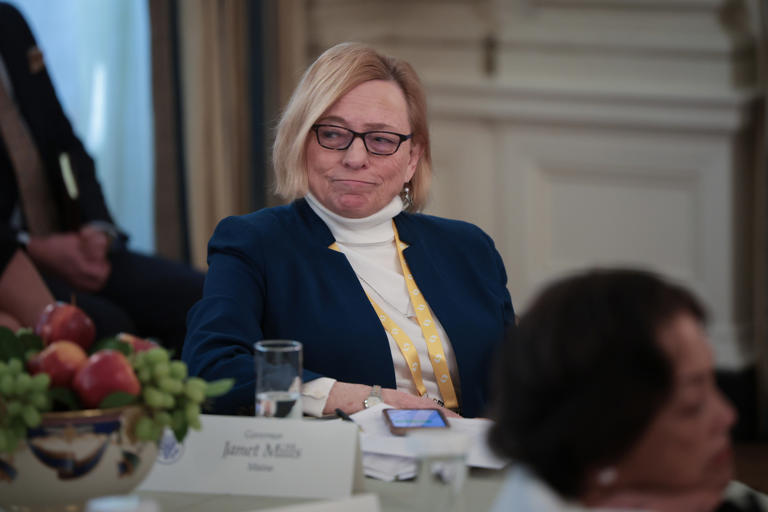

Maine Governor Janet Mills, a Democrat, has shared a new timeline for when she might announce whether she will challenge Republican Senator Susan Collins in the 2026 midterm elections.
Newsweek reached out to both Collins and Mills for comment via email.
Why It Matters
Maine, which voted for former Vice President Kamala Harris by 7 points last November, is seen as one of the Democrats’ best chances to flip a GOP-held seat in the midterms. Winning here could be key for them to gain a majority in the Senate.
Collins, a moderate Republican, has sometimes broken from her party on big votes and has won reelection before, even though Maine often votes Democratic. Mills is seen as a strong challenger because she is well-known and has won statewide elections by comfortable margins.
However, Mills has not confirmed if she will run, leaving the 2026 race uncertain.
What To Know
Mills told reporters she is “seriously considering the run” and could decide by November, according to The Portland Press Herald.
“I’m not in any rush to make a decision. [I have] a lot to do with my present day job, so I’m seriously considering it,” she said.
Polling in Maine is limited, but some recent surveys show how Collins and Mills are viewed by voters.
A University of New Hampshire poll from June found that 14% of Mainers view Collins favorably, while 57% view her unfavorably; 26% were neutral. In comparison, 51% view Mills favorably, 41% unfavorably, and 7% were neutral. This poll surveyed 846 Mainers between June 19–23, with a margin of error of ±3.4%.
A Pan Atlantic Research poll had better results for Collins: 49% of Mainers viewed her favorably, while 45% viewed her unfavorably. Mills had 52% favorable and 44% unfavorable. It surveyed 840 likely voters from May 12–26, with a ±3.5% margin of error.
A recent Morning Consult poll found Collins’ approval rating at a record low of 38%, with 54% disapproving. Mills had a +2 approval rating, making her the least popular Democratic governor in the U.S.
Kalshi betting odds in August showed Democrats with a 51% chance to win the Senate race, while Republicans had 49%.
With Mills undecided, other Democrats, including Graham Platner and Jordan Wood, have joined the race and are visiting towns across Maine to meet voters.
Besides Maine, Democrats see North Carolina as another key pickup opportunity, where former Governor Roy Cooper announced his run for the seat vacated by retiring GOP Senator Thom Tillis. North Carolina voted for Trump by about three points last November.
Democrats also need to defend seats in Michigan and Georgia, which Trump won, and try to flip GOP-held seats in states like Alaska, Iowa, Ohio, and Texas. To take control of the Senate, they would need to defend their seats and win at least two of the states Trump won by double digits. Republicans currently hold a 53–47 majority.
What People Are Saying
Mills told Maine Public Radio in July:
“I mean, look, I wasn’t born with a burning desire to be in Washington, D.C. — any month of the year. And what’s going on there is a bit chaotic. It’s not something anybody would want to jump into and be a part of automatically.”
NRSC spokesperson Nick Puglia said in June:
“No one fights harder for Maine than Senator Susan Collins. Her ability to pass serious legislation that genuinely improves the lives of Mainers is why she is the only choice to keep fighting for them in the U.S. Senate.”
What Happens Next
Collins has not formally announced if she will run, but told CNN in May that she is “preparing to do so” and her “inclination is to run.”
The Cook Political Report labels the race as “Lean Republican,” meaning it is competitive but Collins has an advantage. Sabato’s Crystal Ball also sees the race leaning toward Republicans.