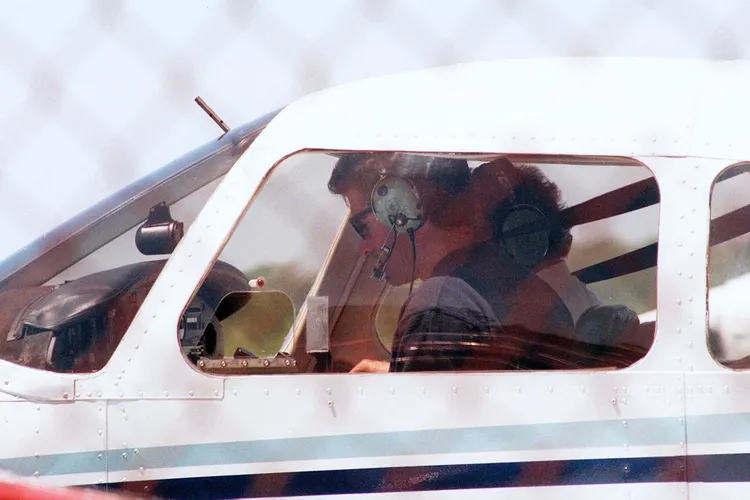

A single decision to fly solo on the evening of July 16, 1999, remains the focal point of the aviation disaster that claimed the lives of John F. Kennedy Jr., his wife Carolyn Bessette, and her sister Lauren Bessette. National Transportation Safety Board (NTSB) records confirm that Kennedy explicitly declined the assistance of his flight instructor, Bob Merena, opting to pilot his Piper Saratoga alone—a choice that preceded the high-speed plunge into the Atlantic Ocean.
The flight, which departed from Essex County Airport in New Jersey at 8:39 p.m., faced deteriorating environmental conditions that challenged Kennedy’s limited experience. Although the weather technically met visual flight rules (VFR), a heavy maritime haze erased the horizon over the open water. Kennedy, who had not yet earned his instrument rating, was forced to rely on his physical senses rather than his cockpit’s technical data.
:max_bytes(150000):strip_icc():focal(999x0:1001x2):format(webp)/carolyn-bessette-airport-7d2a27b2f64947e691bcf63a451766a2.jpg)
“As soon as he turned out to the black ocean… it might as well be instrument flight rules,” explains Jeff Guzzetti, a former NTSB investigator featured in the 2024 biography JFK Jr.: An Intimate Oral Biography.
:max_bytes(150000):strip_icc():focal(999x0:1001x2):format(webp)/JFK_JR_crash-1-a338961176bd441aa9c49693d112e529.jpg)
The “Graveyard Spiral”
Investigators concluded that Kennedy fell victim to spatial disorientation. Without a visible horizon to provide a reference point, the pilot’s inner ear sent conflicting signals to his brain, creating the illusion of level flight while the aircraft was actually banking. This phenomenon often leads to a “graveyard spiral”—a high-speed, nose-down descent where the pilot inadvertently tightens the turn while attempting to climb.
:max_bytes(150000):strip_icc():focal(1180x0:1182x2):format(webp)/PEOPLE_JFK_JR_cover-1-0fb3ed8ac78e4c5e9e9e692c98689fc3.jpg)
The final descent was swift and violent:
- Duration: The aircraft diverted from its path and impacted the water in just 17 seconds.
- Forces: Passengers likely felt an increase in g-force and heard the rush of air accelerate against the fuselage.
- Pilot Status: While passengers may have been unaware of the danger until the final seconds, experts believe Kennedy would have been “confused and frightened” as his instruments contradicted his physical sensations.
Investigative Findings
Because the Piper Saratoga was not equipped with a “black box” cockpit voice recorder, the NTSB reconstructed the tragedy using radar data and wreckage analysis. The impact forces were so severe that the recovery operation—led by the U.S. Navy—was conducted under strict secrecy and 24-hour guard to protect the dignity of the victims.
:max_bytes(150000):strip_icc():focal(999x0:1001x2):format(webp)/JFK_JR_crash-2-ac42b8bd732c4d0fbbcb84a792bcf9c9.jpg)
The NTSB’s final report cited the “pilot’s failure to maintain control of the airplane during a descent over water at night” as the probable cause. Ultimately, the combination of a moonless night, heavy haze, and the pilot’s decision to bypass professional oversight created a scenario that exceeded his technical capabilities.