

Former National Security Adviser John Bolton criticized President Donald Trump’s Ukraine policy on Monday, describing it as inconsistent, impulsive, and driven more by optics than strategy—even as the White House prepares a new military aid package for Kyiv.
Speaking to Newsweek, Bolton said Trump’s foreign policy decisions are guided by personal impulses and self-image rather than long-term planning. “He doesn’t really do policy as most of us understand it,” Bolton said. “It’s all transactional, episodic, ad hoc, and focused on how he’s perceived.”
Trump Threatens Secondary Tariffs Over Ukraine War
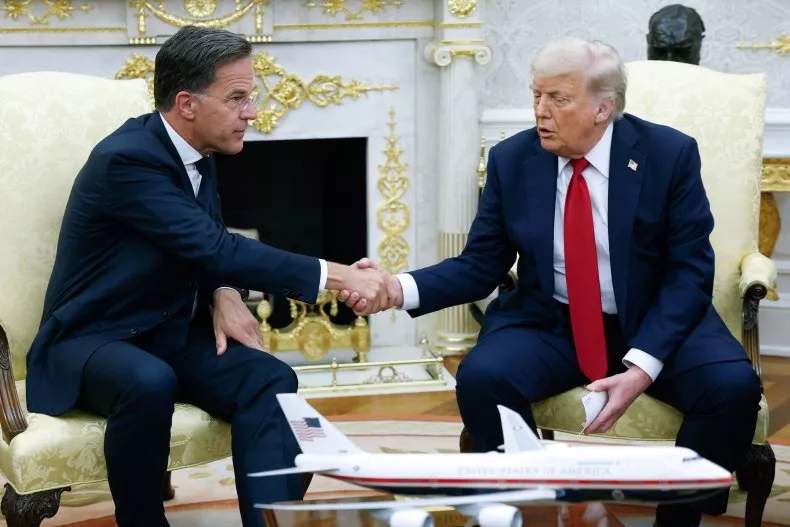
During an Oval Office meeting with NATO Secretary General Mark Rutte, President Trump announced that the U.S. would deliver additional weapons to Ukraine through NATO, with European allies covering the cost. He also issued a blunt ultimatum to Moscow: unless a ceasefire is reached within 50 days, the U.S. would impose steep secondary tariffs on countries continuing to do business with Russia.
“We’re going to be doing secondary tariffs if we don’t have a deal in 50 days,” Trump told reporters. “It’s very simple, and they’ll be at 100 percent.”
A Shift in Tone on Russia
Trump’s recent shift marks a dramatic departure from his earlier reluctance to arm Ukraine with offensive weapons and his repeated claims that Ukrainian President Volodymyr Zelensky bore blame for prolonging the war. The president had long touted his personal rapport with Russian President Vladimir Putin, suggesting he could broker peace quickly.
But recent months have tested that confidence. After a series of phone calls with Putin were followed by fresh missile attacks on Ukraine, Trump reportedly grew frustrated, privately complaining that the Russian leader “talks nice and then bombs everybody in the evening.”
According to Bolton, Trump’s growing irritation with Putin reflects a personal grievance more than a strategic shift. “He seems to think Putin is supposed to play along with his script,” Bolton said. “And when he doesn’t, Trump lashes out.”
Bolton also noted that Trump’s decision to greenlight new U.S. weapons for Ukraine likely reflects a desire to pressure Putin back into negotiations—rather than a firm commitment to Ukraine’s defense.
Iran, Israel, and the Elusive Nobel Prize
Bolton also weighed in on Trump’s record in the Middle East, saying the president’s decision to join Israeli airstrikes on Iranian nuclear facilities earlier this year was “the right move—albeit too late.” But he criticized the ceasefire that followed, calling it “premature” and arguing it left much of Iran’s nuclear program intact.
“Only regime change in Tehran will truly end Iran’s nuclear ambitions,” Bolton said.
He also suggested Trump’s motivations had less to do with strategy and more with personal legacy. “He wanted to share in the credit if the strikes were successful,” Bolton said. “It’s another case of stumbling into the right policy for the wrong reasons.”
Bolton recalled Trump’s long-standing desire to win a Nobel Peace Prize, often referencing former President Barack Obama’s award. That ambition, he said, has colored Trump’s approach to international affairs—but may now be out of reach.
“With the war escalating, and Trump talking about sending offensive weapons that could strike Moscow, it doesn’t look like there’s much chance for a peace deal—let alone a Nobel Prize,” Bolton said.
The Bigger Picture
Despite Trump’s latest pivot toward a more confrontational posture with Moscow and Iran, Bolton remains skeptical that the president has fundamentally changed his worldview.
“He still governs based on impulse,” Bolton said. “Each day is a new day. That’s just how he does things.”


