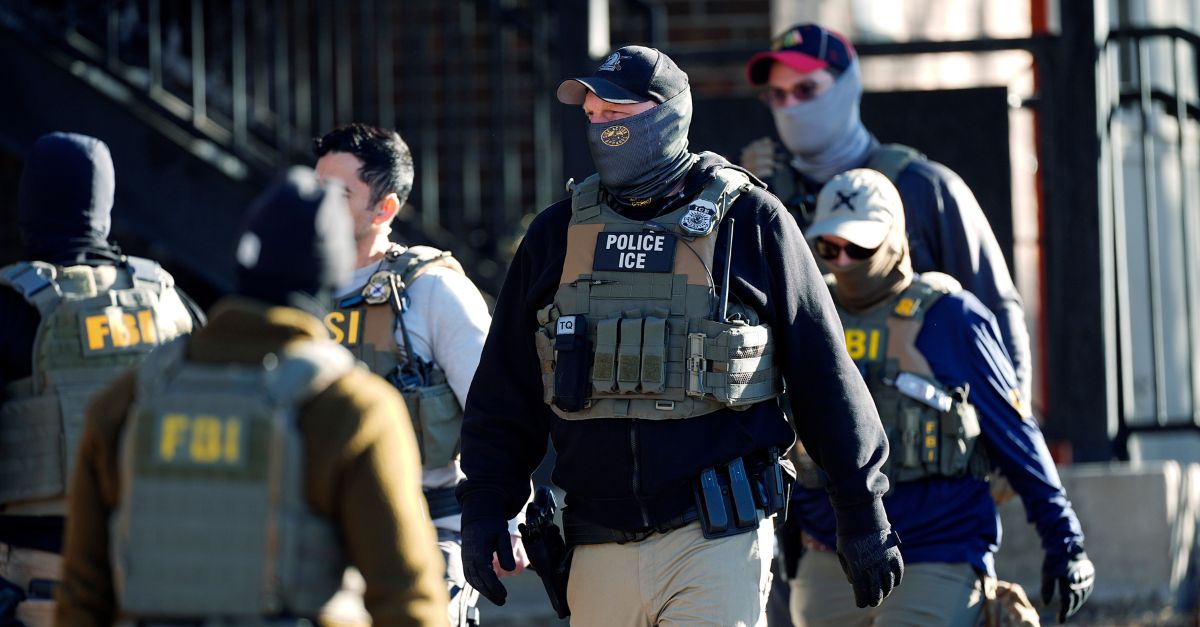

A federal judge has ruled that Immigration and Customs Enforcement (ICE) officers in Colorado have been acting unlawfully in the way they arrest suspected undocumented immigrants.
In a 66-page order issued Tuesday, U.S. District Judge R. Brooke Jackson sharply criticized ICE for carrying out warrantless arrests without first establishing probable cause that the individuals posed a flight risk. He sided with four immigrants — all found to be in the country without legal status but with “deep and longstanding ties to their communities.”
“No reasonable officer could have reasonably concluded that these plaintiffs were likely to flee before a warrant could be obtained,” Jackson wrote. “Yet ICE nonetheless arrested each one immediately and detained them for significant periods, causing severe hardship and loss.”
The judge, who was appointed by Barack Obama, stressed that violating immigration law alone does not justify treating someone as likely to flee. “Mere presence within the United States in violation of United States immigration law is not, by itself, sufficient to conclude that a person is likely to escape before a warrant for arrest can be obtained,” he wrote.
The four immigrants, represented by the American Civil Liberties Union (ACLU), filed suit last month, arguing that ICE agents in Colorado were “indiscriminately stopping and arresting people” based on their skin color in an effort to meet the administration’s escalated enforcement demands. They also argued that the agency cannot arrest people without warrants, then hold them without probable cause and without evidence that they might flee.
The Trump administration countered that agents did obtain warrants — but only after the initial arrests. Jackson rejected that justification.
“Under the defendants’ reasoning, ICE could simply stop any suspected undocumented person, conduct a warrantless arrest with no probable cause of flight risk, and then bring the arrest within the color of law by issuing a warrant at the field office,” he wrote, concluding that such an approach violates the law.
Jackson agreed with the plaintiffs that they had likely suffered harm as a result of ICE’s practices. “Although none of them presented a flight risk by any reasonable measure, they were each arrested and detained without warning, ultimately spending between approximately two weeks and three months in custody,” he said, finding that a preliminary injunction blocking such arrests without probable cause was necessary.
He pointed to broader enforcement trends in Colorado to underscore the stakes of his decision.
“ICE has almost doubled its headcount in Colorado this year alone, is actively recruiting and hiring many more officers, and plans to open three additional detention centers in Colorado, nearly tripling its current capacity,” Jackson wrote. “On this record, plaintiffs have shown that, without the requested injunction, there is likely to be a substantial increase in the number of warrantless arrests made without probable cause of flight risk.”
The judge also ruled that the plaintiffs can represent a broader class of people — anyone who has been arrested since Jan. 20, the day the Trump administration began, or who will be arrested in the District of Colorado by ICE “without a warrant and without a pre-arrest, individualized assessment of probable cause that the person poses a flight risk.”
Jackson further found that the plaintiffs were likely harmed financially, citing the “burdens” created by the arrests and the bonds they were forced to pay. As a result, the administration has been ordered to reimburse them for their bond payments.
Immigrant rights advocates hailed the ruling. The ACLU of Colorado said the court had “confirmed what has been enshrined in federal law for decades: ICE cannot terrify our communities with their haphazard warrantless arrests.”
“A federal court has now declared that ICE must immediately stop these aggressive and unlawful tactics,” added Tim Macdonald, legal director for the ACLU of Colorado.
The Department of Homeland Security (DHS), which oversees ICE, signaled that it would appeal the decision.
“This activist ruling is a brazen effort to hamstring the Trump administration from fulfilling the President’s mandate to deport the worst of the worst criminal illegal aliens,” said a statement attributed to Tricia McLaughlin, DHS assistant secretary for public affairs, according to Colorado Public Radio.