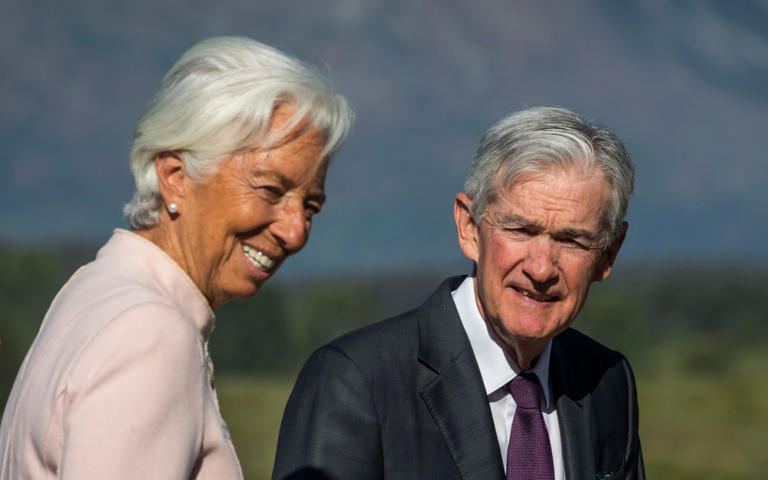

Christine Lagarde has issued a sharp warning to President Donald Trump, cautioning that U.S. economic stability could be at risk if the White House interferes with the Federal Reserve.
Lagarde, president of the European Central Bank, stressed that central banks must remain independent to effectively control inflation and support long-term economic growth.
“If monetary policy independence is undermined, it becomes dysfunctional, it starts doing things that it shouldn’t do,” she told Fox News. “The next step is disruption. It is instability, if not worse. So I think that this should not be debated.”
Though she did not name President Trump directly, her remarks come amid growing tension between the White House and Fed Chairman Jerome Powell.
President Trump appointed Powell during his first term but has since derided him as a “numbskull” and “Mr. Too Late” over his reluctance to cut interest rates more aggressively. He has also criticized the cost of renovation projects at the Fed, raising concerns in financial markets that he might attempt to remove Powell from his post.
While Trump admitted last month that he had considered firing Powell, he described the move as “highly unlikely.” Powell’s current term ends next May.
The Fed’s benchmark interest rate stands at 4.5 percent, though Trump has argued it should be cut to around 1 percent.
Powell and other members of the Federal Open Market Committee are tasked with balancing low inflation and strong employment. Recent meeting minutes reveal concerns that Trump’s tariffs on imports are fueling inflation, even as unemployment remains low. Some policymakers also worry that the labor market could be starting to weaken.
Lagarde made clear that the Fed’s independence should not be compromised.
“The independence of any central bank is critically important,” she said. “We have to be accountable, we have to report back and answer all the questions of either Congress in the U.S. or the European Parliament, for me. But it’s vitally important that a central bank is independent.”
Economists argue that independence helps shield central banks from political pressure, particularly from leaders who might push for rate cuts to boost growth before elections. Such moves often create short-term booms but risk runaway inflation later.
The goal of independence—introduced in the UK with the Monetary Policy Committee in the late 1990s—is to reduce economic volatility and create stronger foundations for long-term stability.