
On Plum Island in Massachusetts, one woman’s beachcombing habit has turned discarded junk into a powerful reminder of how much plastic ends up in our oceans.
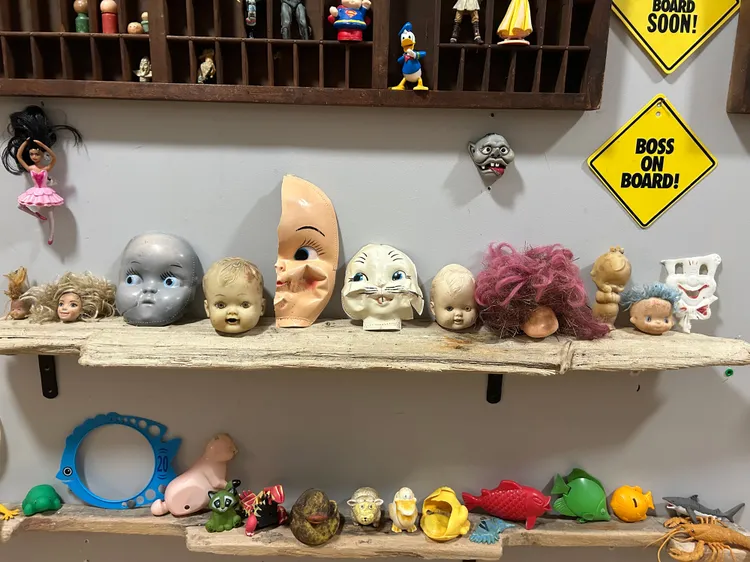
Tucked away in an old carriage factory building in Amesbury, the Museum of Lost Toys & Curiosities is filled with thousands of objects that once floated in on the tide — Monopoly pieces, spoons and forks, toy soldiers, doll parts and countless other odds and ends. By arranging this flotsam on shelves and in cases, founder Corinn Flaherty hopes visitors will feel the impact of marine pollution in a way that statistics alone can’t.
“Nobody wants to be slapped on the hand and be like, ‘Stop buying plastic,’ ” she says. “But I think the visual impact that you feel when you walk into the space stays with you.”
Flaherty, a public library director originally from Long Island, N.Y., moved to Plum Island in 2011 after a decade living in Boston. Each morning she began her day the same way: walking the beach with her dog toward the jetty at the mouth of the Merrimack River.
In 2015, one of those walks changed everything. On a bitterly cold morning, she spotted a lone plastic doll’s head stuck in the sand.
“It was just this one doll head stuck in the sand,” she recalls. “And when I tried to get it off, it was literally frozen in the sand. I took it home just out of curiosity.”
:max_bytes(150000):strip_icc():focal(599x0:601x2):format(webp)/museum-of-plastic-debris8-111125-b34cee4128ab4342b2b64c897f5c01fe.jpg)
That single, eerie find opened her eyes. Soon she was picking up other items too: plastic straws and cutlery, bottle caps, microplastics and more.
“The most common thing I find, oddly enough, are shotgun shells, which usually confuses people,” she says. “But there are people hunting ducks in all of the marshes up and down the river, and all of those spent shells end up floating right down the river and onto our beach.”
Because there was once a thriving shoe industry along the Merrimack Valley in Lawrence and Haverhill, she also frequently comes across shoe heels with their plastic injection molds still attached. Other unexpected discoveries have included a Merrimack College professor’s name badge and a cloth label with a name and number that she later learned belonged to someone with a history of run-ins with the law.
“Most of what I find is plastic trash, and I’d say three quarters of what I pick up goes back into my own garbage or recycling,” she explains. “And then the gems or things that already have a collection end up going into a bucket and getting cleaned because they’re dirty.”
By 2021, the “gems” had grown into a sizable collection. Flaherty rented studio space in a historic Amesbury building that once housed a carriage factory and officially gave the objects a home as the Museum of Lost Toys & Curiosities.
Today, the museum spans three rooms and offers visitors an interactive twist: scavenger hunts.
“There’s four different ones, and you can go through the museum and each scavenger hunt has nine items, and you have to find each little item,” she says. “Anytime people do it, they’re like, ‘Oh my God, I’ve been here before, but I never noticed this.’ It brings people’s attention to things.”
:max_bytes(150000):strip_icc():focal(599x0:601x2):format(webp)/museum-of-plastic-debris4-111125-38a34623a4754bee8ef5d7ff2323bbce.jpg)
The museum — which has been featured on local television station WCVB and in The Boston Globe — is open by appointment only for now. Flaherty hopes that additional funding will eventually allow for regular public hours and school field trips.
What delights her most is the range of people who find their way in. “It attracts other collectors, environmentalists, and those just curious to see this collection of stuff that’s all been culled from one little strip of beach,” she says. “I’ve met really interesting, wonderful people as a result.”
Another highlight is listening to the memories that bubble up when visitors recognize something from their own past — like a small red bird whistle.
“This weekend a man about 70 was visiting and was so excited to tell me he had the same whistle when he was a boy and used to think he could communicate with the birds when he played it,” she says. “He said he hadn’t thought of that memory probably since he was a kid. Everyone who comes through the space inevitably has a reaction like this to something in the collection.”
For Flaherty, the museum lives in a bittersweet space: it is both playful and sobering. The objects are colorful, nostalgic and often charming — but they are also the direct result of a growing pollution problem in the ocean and along the shore.
:max_bytes(150000):strip_icc():focal(599x0:601x2):format(webp)/museum-of-plastic-debris5-111125-60a0236c30034bb4b9d95f9586566d5e.jpg)
Still, she’s already seen how small shifts inspired by the museum can ripple outward. About a year after first visiting, a woman who handled events for her school’s PTA returned to say the exhibits had changed her purchasing habits: she stopped buying plastic cutlery for events.
:max_bytes(150000):strip_icc():focal(999x0:1001x2):format(webp)/museum-of-plastic-debris7-111125-ba091a36259b49f88648dc73f51fbda0.jpg)
“I was like, ‘If I had done one thing in my life, I did that!’ ” Flaherty says.
“That’s my goal,” she adds. “No one can avoid plastic. No one’s perfect. We are part of this giant machine. But you can make little tiny changes in your life and actually have a big impact, which is pretty cool.”